Grinding Brakes on an Audi A1 – What’s Causing the Noise?
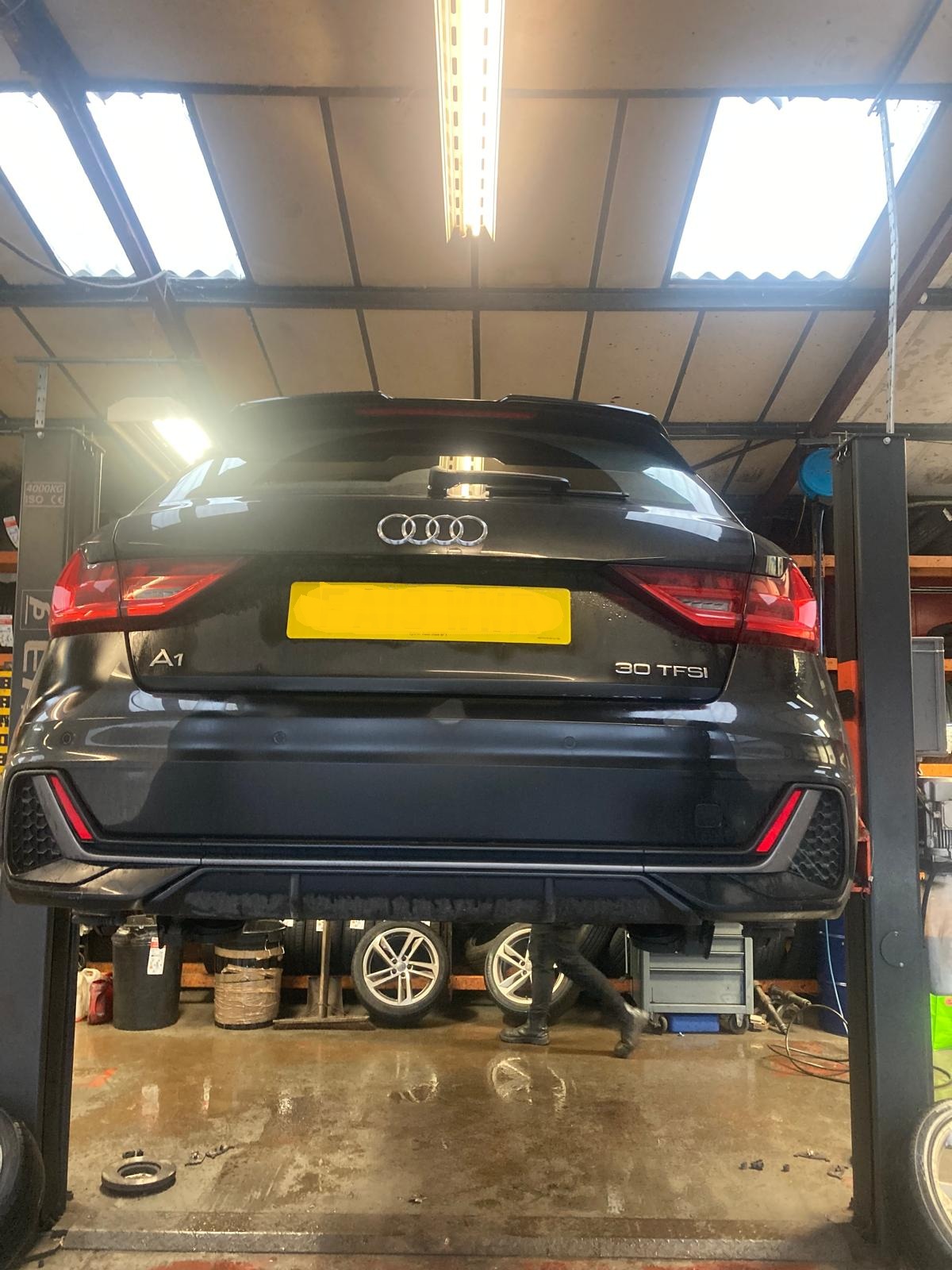
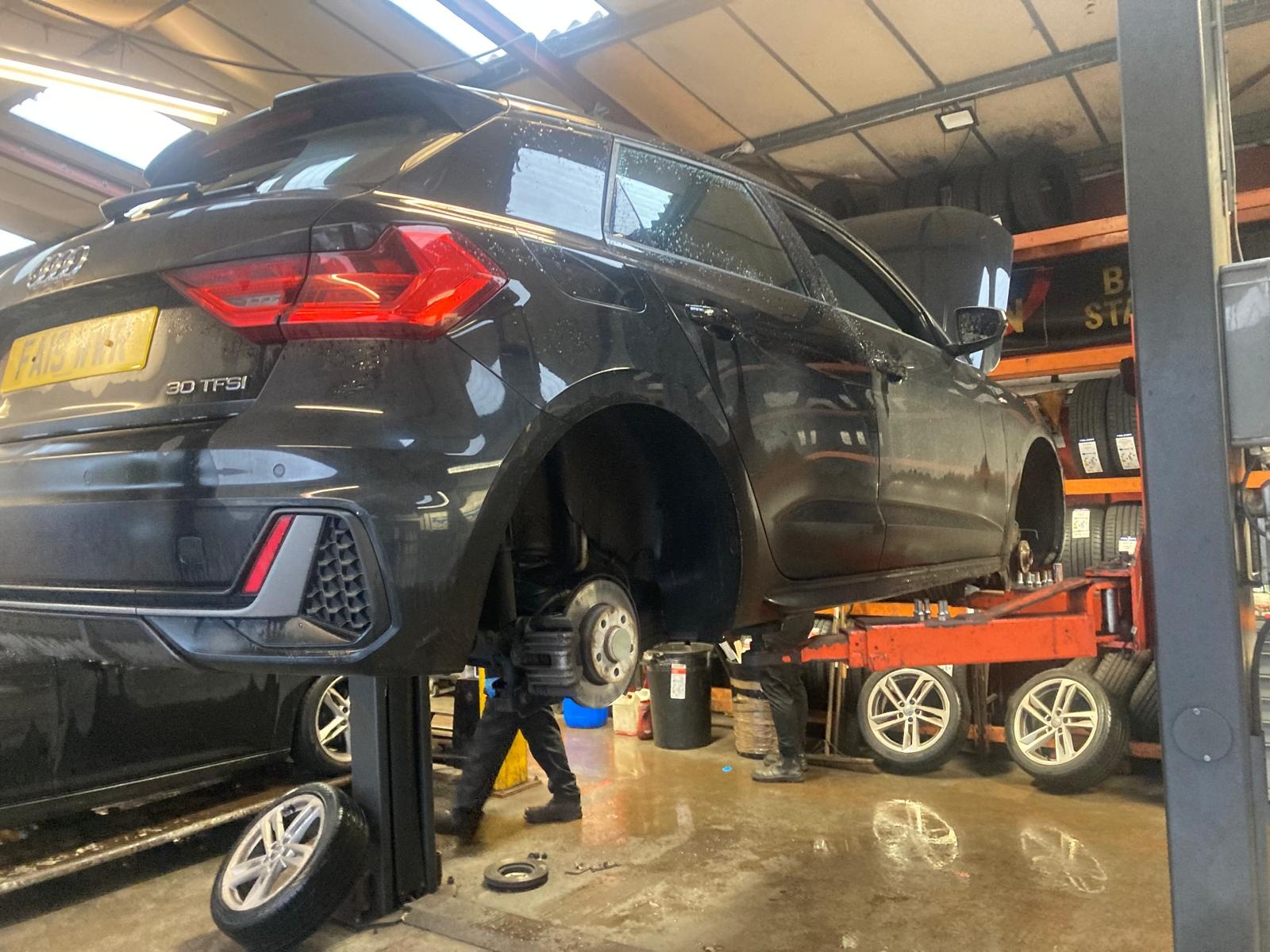
Yesterday at Pellon Tyre & Autocentre in Halifax, we were presented with an Audi A1 whose owner was worried about a nasty grinding noise every time the brakes were applied. It’s a sound that makes most drivers wince, and for good reason.
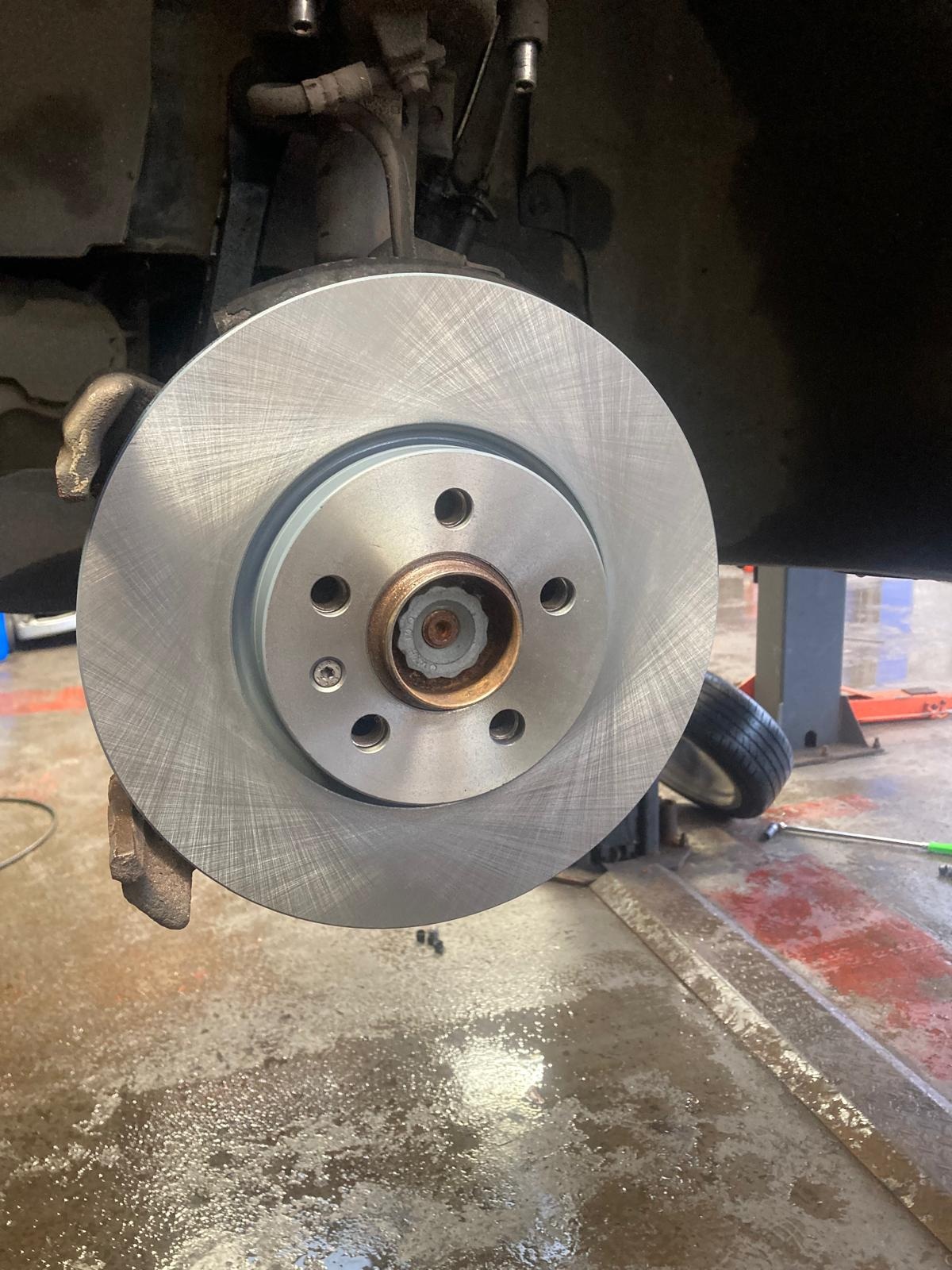
A quick inspection soon showed the cause – the car needed new brake discs all round, along with a full set of brake pads. Sadly, this is something we see quite often, not just on Audi A1s but on many modern cars driven around Calderdale’s hills, traffic lights, and stop-start town driving.
So let’s look at why brakes grind, what it means for your car, and a bit of background on the Audi A1 here in the UK.
Audi A1 for new Brake Discs
Why Do Brakes Make a Grinding Noise?
A grinding noise when braking is never something to ignore. Around Halifax, with steep hills like Pellon Lane, Boothtown Road, and the run down into the town centre, brakes work hard – and problems show themselves quickly.
1. Worn Brake Pads
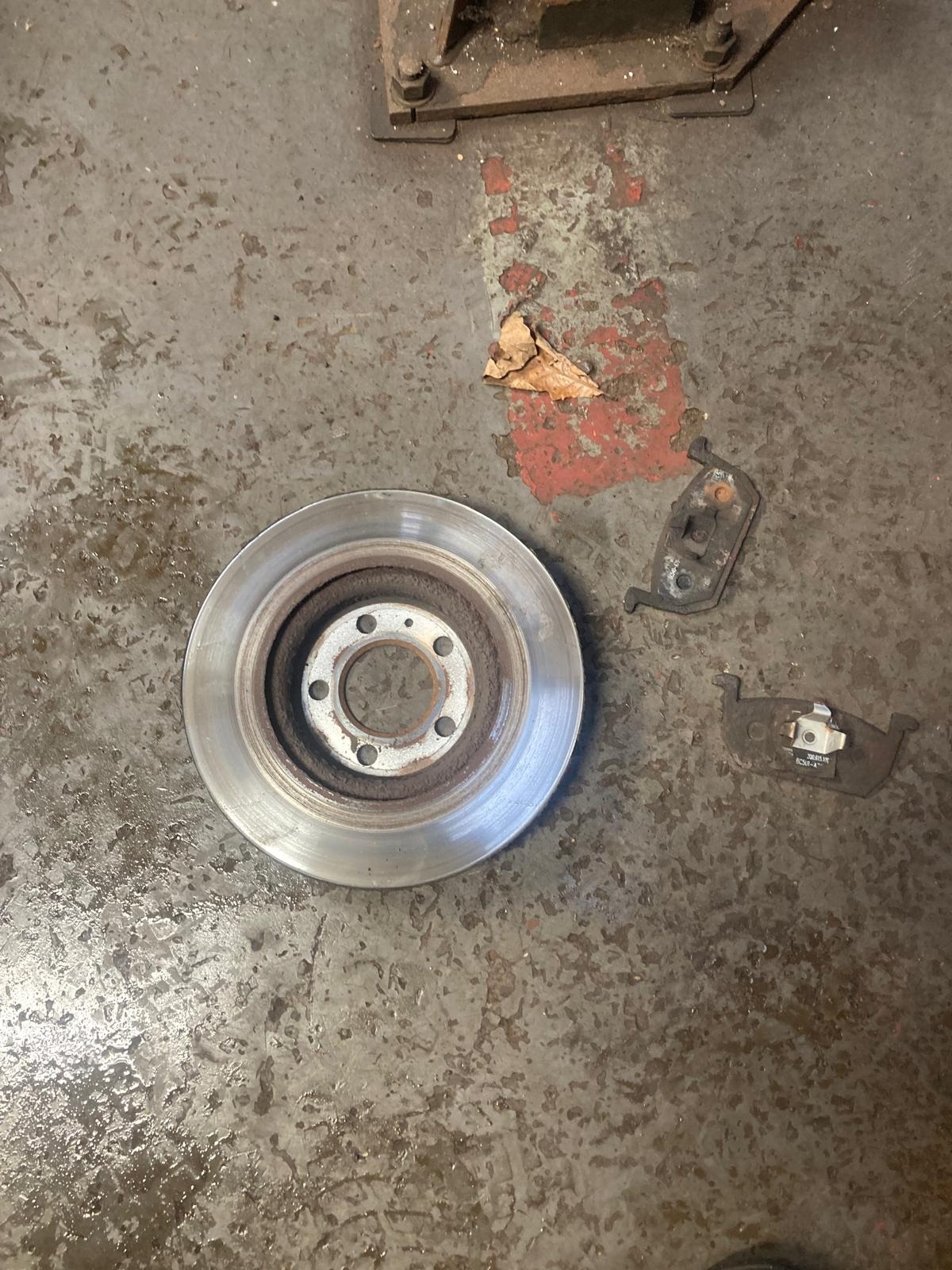
The most common cause is brake pads worn right down. Once the friction material is gone, you’re left with metal scraping on metal. That grinding sound is your brake pad backing plate eating into the disc.
At this stage:
Braking performance is reduced
Discs get damaged very quickly
Repair costs rise sharply
What could have been pads only often turns into pads and discs.
old worn out disc
2. Discs Worn or Corroded
In Calderdale, cars often sit overnight in damp air, especially near the River Calder. This leads to surface rust on brake discs.
Short journeys around Halifax, Sowerby Bridge or Illingworth mean:
Brakes don’t get hot enough to clean themselves
Rust builds up
Discs wear unevenly
Once discs are badly worn or lipped, they’ll grind even with new pads fitted.
Audi A1 for new Brake Discs
3. Cheap or Incorrect Brake Parts
Some budget pads are:
Too hard
Poorly matched to the disc material
This can cause grinding, squealing, or vibration. At Pellon, we always fit quality, correctly specified parts, because cheap brakes are false economy.
new disc fitted
4. Seized Brake Components: Audi A1 for new Brake Discs
Salted winter roads around Halifax don’t help. Brake callipers and sliders can seize, causing:
Pads to stay in contact with the disc
Overheating
Premature wear and grinding noises
Regular brake servicing helps prevent this.
5. Ignoring Early Warning Signs: Audi A1 for new Brake Discs
Most cars give you plenty of notice:
Squealing
Slight vibration
Pulling to one side
Sadly, many drivers wait until the noise becomes a full-on grind – by then, damage is already done.
A Bit of History – The Audi A1 in the UK
The Audi A1 first arrived in the UK around 2010, aimed at drivers wanting Audi quality in a small, stylish package. It was Audi’s answer to cars like the MINI and VW Polo, but with that familiar German premium feel.
Over the years, the A1 has been popular with:
Younger drivers
Town and city commuters
Drivers wanting something compact but well built
Here in Halifax and Calderdale, they’re ideal for:
Narrow streets
Busy town centres
Tight parking spots
But like all modern cars, they rely heavily on well-maintained braking systems, especially with hill starts, traffic queues, and roundabouts being part of daily life around here.
Why Regular Brake Checks Matter in Calderdale: Audi A1 for new Brake Discs
Local driving conditions really do take their toll:
Hills increase brake wear
Short journeys encourage corrosion
Wet weather speeds up rust
We recommend having your brakes checked:
At least once a year
Or whenever you hear a new noise
A quick inspection can save a lot of money – and a lot of worry.
https://www.pellonautocentre.com/wp-content/uploads/2024/07/pellon-tyres-logo-509x321.jpg00Eric Robertshttps://www.pellonautocentre.com/wp-content/uploads/2024/07/pellon-tyres-logo-509x321.jpgEric Roberts2025-12-16 07:52:572025-12-16 07:59:54Audi A1 for new Brake Discs
Bridgestone Tyres Fitted to a VW Tiguan at Pellon Tyres
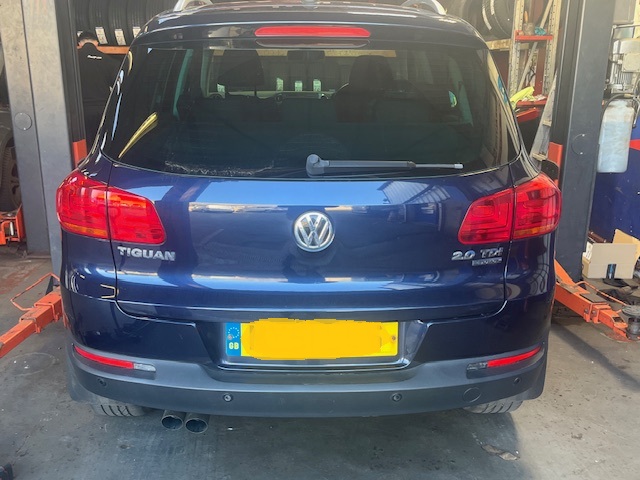
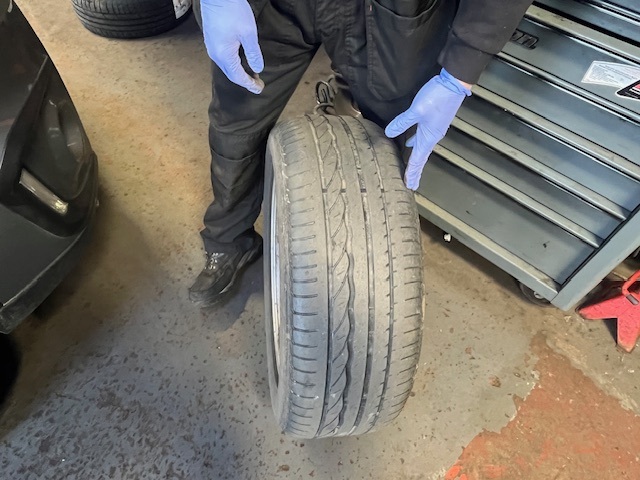
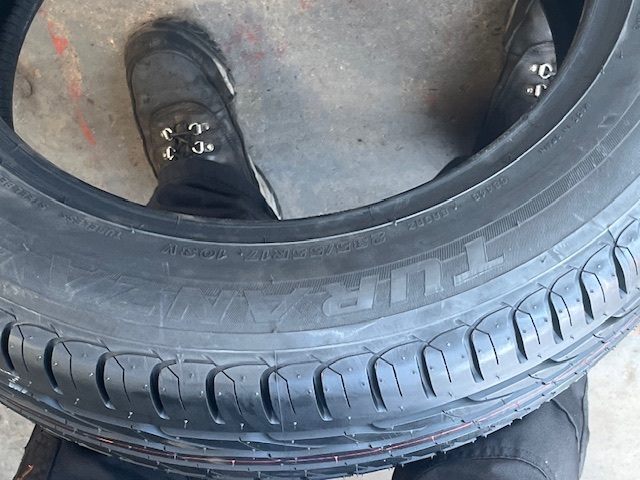
We had a Volkswagen Tiguan in the workshop recently for a pair of new Bridgestone tyres. The customer had spotted their front tyres wearing down and, knowing how changeable the Yorkshire weather can be, wanted something reliable for year-round driving.
Supplying and Fitting the New Tyres
As usual, we got stuck in straight away. The correct Bridgestones were brought out, fitted, and balanced properly on our machines so the Tiguan would run smoothly the moment it left the depot. Quick, tidy, and done the right way.
Why Wheel Alignment Matters
The customer wasn’t daft either — they knew that fitting new tyres is only half the job. Before heading off, they asked for a wheel alignment, which is exactly the right call.
Many drivers overlook how important correct alignment is, especially on heavier SUVs like the Tiguan. Even a small amount of misalignment can lead to:
Uneven tyre wear
Poor fuel economy
Wobbly or vague handling
Not ideal when you’re dealing with the bends and hills around West Yorkshire, that’s for sure.
Back on the Road, Safe and Ready for Anything
Once everything had been checked, adjusted, and tightened up, the customer left happy knowing their Tiguan was set up properly for the coming months. A fresh pair of Bridgestones and a spot-on alignment make a big difference—and they were soon safely back on the road.
VW Tiguan for New Bridgestone Tyres
A Brief Look at the VW Tiguan’s UK Journey
The Volkswagen Tiguan first arrived in the UK back in 2008, and it didn’t take long to make its mark. Built on the popular Golf platform, it was Volkswagen’s answer to the growing demand for compact SUVs — something roomy enough for families but still enjoyable to drive day-to-day.
Early Competition and Rapid Popularity
When it landed, the Tiguan found itself up against strong rivals like the Ford Kuga and Nissan Qashqai, both already well established in the SUV market. But the Tiguan quickly carved out its own corner.
UK drivers praised it for:
solid German build quality
good fuel efficiency
a comfortable ride on long motorway journeys
and steady, predictable handling on our twisty B-roads around Halifax and Calderdale
It soon became a very common sight on our roads.
The 2016 Second-Generation Model
Volkswagen stepped things up again in 2016 with a second-generation Tiguan. This version brought:
sharper, more modern styling
updated technology
more interior space
and improved efficiency
Volkswagen also launched the Tiguan Allspace, a stretched seven-seat model built for bigger families or anyone needing extra room.
A Best-Seller Around the World
By 2020, the Tiguan had become VW’s best-selling vehicle globally, which tells you everything you need to know about how well it fits into modern life.
Whether you choose the everyday versions, the frugal hybrid options, or the sporty R models, the Tiguan continues to be one of the UK’s favourite SUVs — and a regular visitor to our workshop whenever a fresh set of tyres is needed
Bridgestone is one of the most respected names in the premium tyre world. Founded in Japan back in 1931, the brand has built a strong reputation here in the UK tyre market, supplying dependable tyres for just about every type of driver — from high-performance models to eco-friendly designs and all-season options.
Innovation That Suits British Roads: VW Tiguan for New Bridgestone Tyres
One of Bridgestone’s standout developments is the DriveGuard system. This clever technology lets you carry on driving safely even after a puncture, which is ideal for the UK’s never-ending battle with potholes. You can limp home or reach a safe spot for repair without being stranded at the roadside.
Bridgestone also has deep roots in motorsport, including years supplying tyres to Formula 1. That racing heritage plays a big part in pushing their everyday tyre technology forward.
A Great Match for the VW Tiguan: VW Tiguan for New Bridgestone Tyres
For vehicles like the Volkswagen Tiguan, Bridgestone tyres tick all the boxes. They offer:
Excellent grip in wet and dry conditions
Strong durability for both motorway and rural driving
Comfortable handling for UK roads, whether you’re on the M62 or weaving through the Calder Valley
They’re a popular and trusted choice for SUV drivers, and we fit plenty of them here at Pellon Tyres.
Get the Best from Your New Tyres: VW Tiguan for New Bridgestone Tyres
Whichever Bridgestones you go for, it’s important to have them fitted correctly and aligned properly. A good alignment not only protects your tyres but also improves handling and fuel economy — exactly what you want from a quality SUV like the Tiguan.
So, just like our recent customer, if your Tiguan (or any SUV) needs new tyres, you’re welcome to call in and see us at Pellon Tyres, Halifax. We’ll get you sorted quickly and professionally. 🚗🔧
https://www.pellonautocentre.com/wp-content/uploads/2024/07/pellon-tyres-logo-509x321.jpg00Eric Robertshttps://www.pellonautocentre.com/wp-content/uploads/2024/07/pellon-tyres-logo-509x321.jpgEric Roberts2025-12-05 18:39:442025-12-06 09:44:10VW Tiguan for New Bridgestone Tyres
At Pellon Tyres, we specialize in Audi servicing in Halifax, ensuring that your vehicle receives the best care possible.
Audi A6 Full Service in Halifax—Premium Cars Properly Looked After at Pellon Tyres
When it comes to Audi servicing Halifax, we provide a comprehensive check-up to ensure your car is in top condition.
Trust us for your Audi servicing Halifax, as we have the experience and expertise.
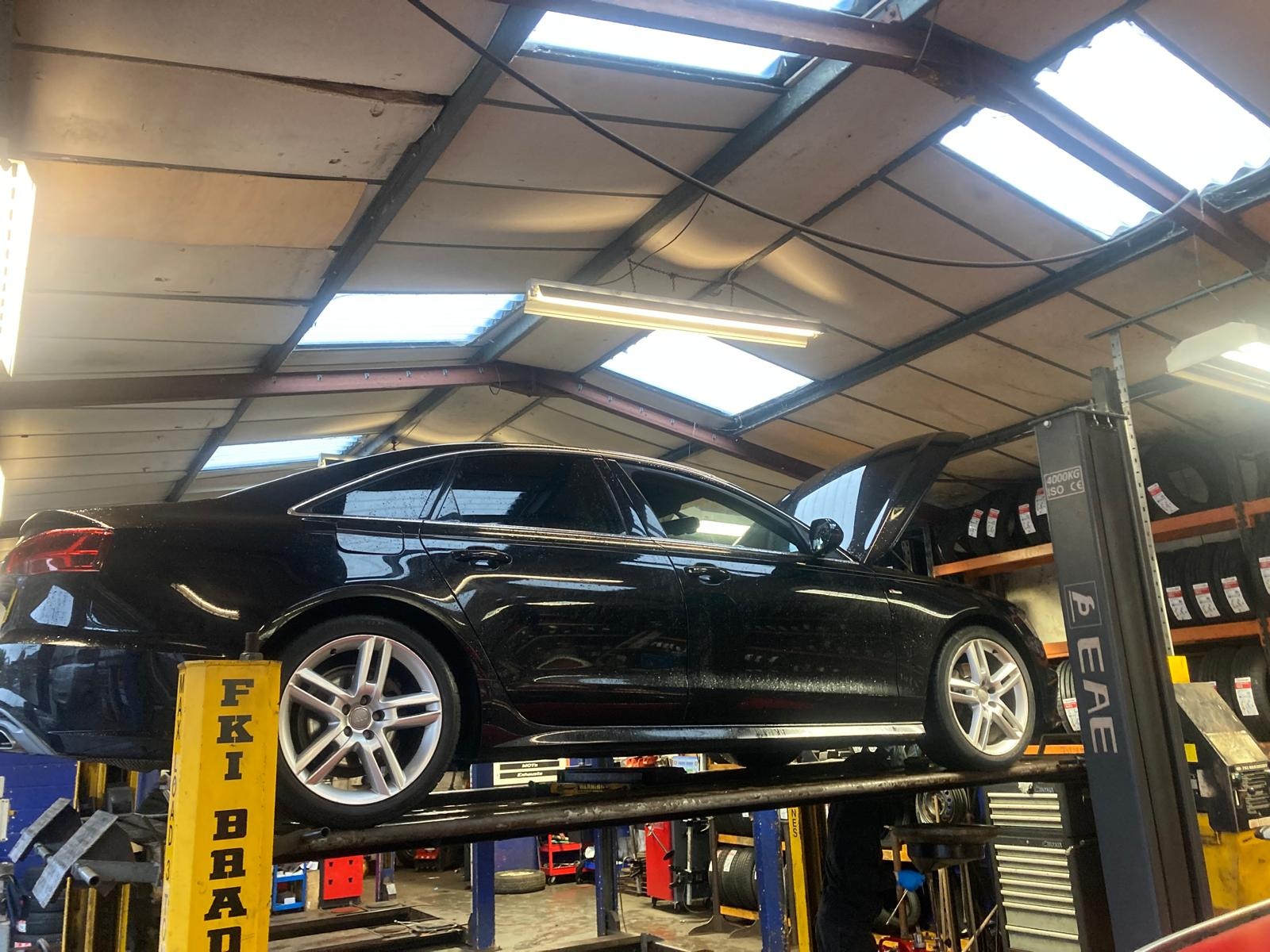
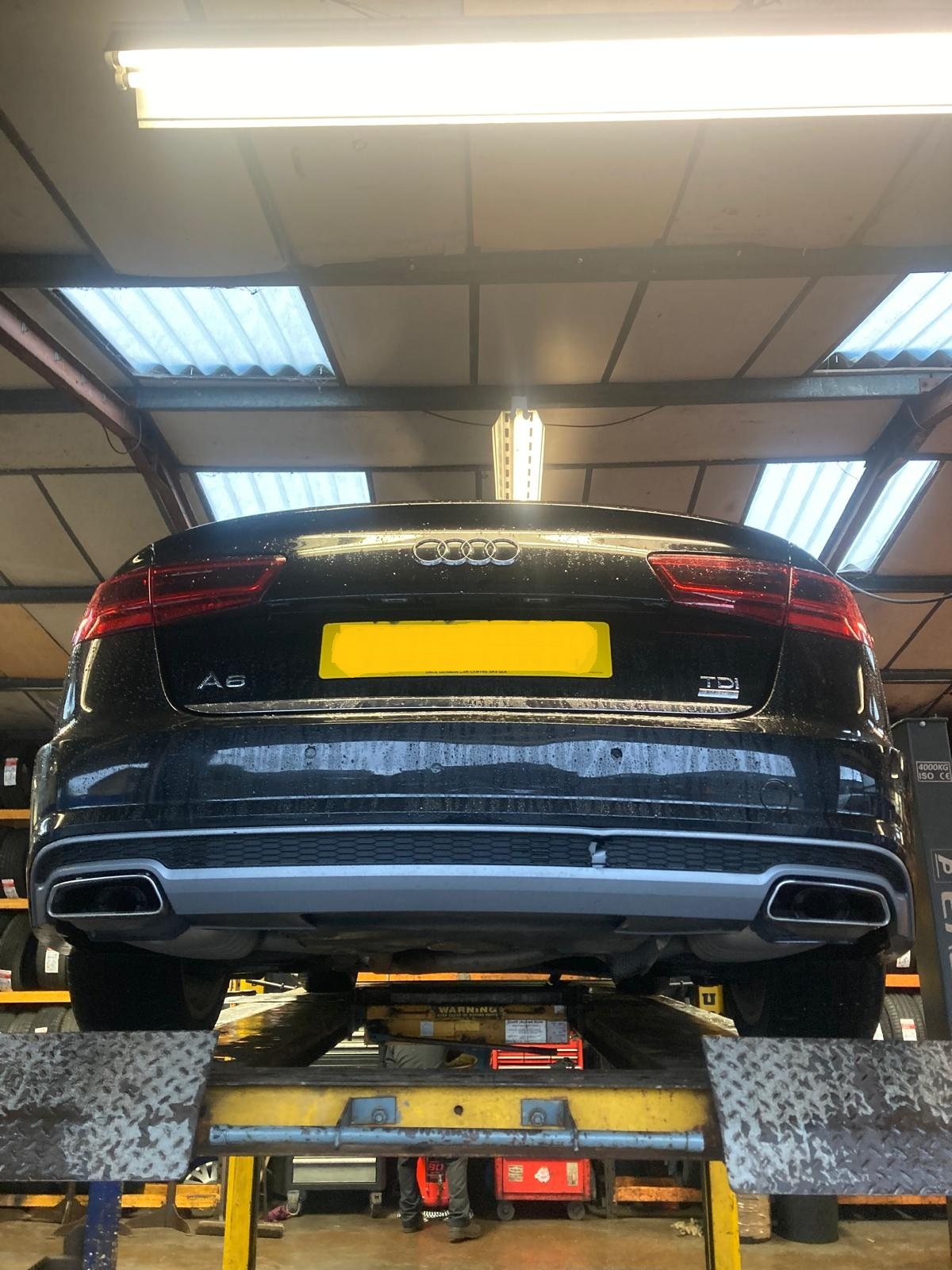
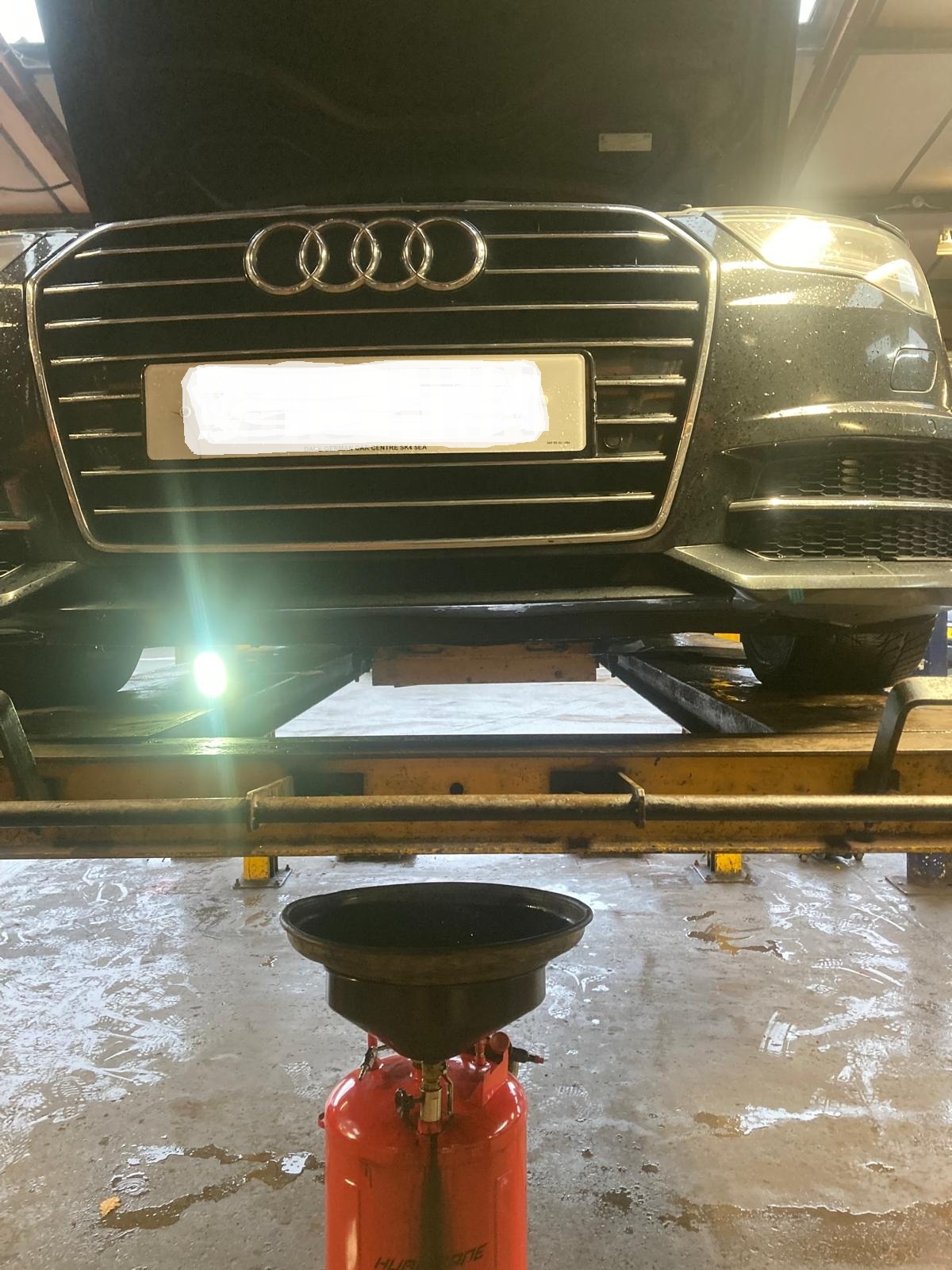
We had a cracking-looking Audi A6 in the workshop yesterday for a full service, and it reminded me how many higher-end motors we’re now seeing around Halifax and the wider Calderdale area. Over the years, there’s been this old-fashioned assumption that small independent garages only work on everyday run-arounds — little Fiestas and Corsas and the like. But that idea couldn’t be further from the truth. These days, our diary is full of everything from family hatchbacks to high-end German saloons, and we deal with them all to the same high standard.
So when this Audi A6 rolled up, gleaming in the winter sunshine, it was a pleasure to give it the sort of proper Yorkshire service we’re known for at Pellon Tyre & Autocentre.
Audi Servicing Halifax
Our team is equipped to handle all aspects of Audi servicing Halifax, giving you peace of mind.
Using Only the Correct Oils and OE-Quality Parts: Audi Servicing Halifax
One thing we never mess about with is quality. When you service a premium car like an Audi, you can’t be guessing or cutting corners, especially with oils. Audi engines — particularly the TDI and TFSI units — are very particular about the oil grade. Use the wrong stuff, and you’re asking for timing chain issues, premature wear, or even turbo trouble. So we always stick rigidly to the manufacturer-approved oil and nothing less.
Everything was done exactly as the manufacturer sets out in their schedule. It’s essentially the same quality of service you’d get at an Audi dealership — only without the main dealer price tag or the fancy showroom overheads. We prefer a warm brew, a chat, and a good bit of graft instead.
Audi-Servicing-Halifax
Why Halifax Drivers Choose Us Over Dealerships: Audi Servicing Halifax
We get customers from all over Calderdale — Halifax, Sowerby Bridge, Illingworth, Elland, Brighouse, even Hebden Bridge — and many of them tell us the same thing:
“I’d rather come to you lads than pay silly money up the hill at the dealership.”
Folk around here aren’t daft. They know value when they see it. With the cost of living climbing higher every month, people want honesty, fairness and proper workmanship. That’s something our little garage has always offered, ever since we first opened our doors in the late ’80s.
We use the same quality parts as the dealers, follow the same service schedules, and carry out the same checks — but without the hefty price attached. And because we’re independent, we’re not tied to upselling unnecessary extras or pushing add-ons customers don’t really need. If it needs doing, we’ll tell you. If it doesn’t, we’ll tell you that too. Simple Yorkshire logic.
Choosing our garage for Audi servicing Halifax means choosing quality and reliability.
We understand the unique requirements of Audi servicing Halifax, ensuring your car gets the best treatment.
More Premium Cars Visiting the Garage: Audi Servicing Halifax
It’s not just Audi owners either. In the last month alone we’ve looked after:
A Mercedes C-Class in for brakes and servicing
A BMW 3 Series needing engine diagnostics
A Volvo XC60 with worn suspension bushes
An Audi Q5 due a major service
A 5 Series BMW needing new run-flat tyres
There’s definitely been an increase in premium and executive cars around Halifax. You see them parked up in town, heading up Pellon Lane, or cruising down towards West Vale. Calderdale has its fair share of motorists who take pride in their cars, and they want somewhere trustworthy to maintain them — not somewhere that treats them like a number on a spreadsheet.
That’s why we’re proud to welcome every sort of vehicle, from a tiny Toyota Aygo to a big executive Audi A6. Everyone gets the same care, the same honest advice and the same friendly Yorkshire service.
We have serviced a variety of vehicles, including Audi, highlighting our proficiency in Audi servicing Halifax.
Saving Customers Money Without Sacrificing Quality
Our competitive pricing structure is one of the biggest reasons customers keep coming back. We know how expensive motoring has become — fuel prices, insurance, repairs, everything seems to be going up. So when people realise they can get dealership-level servicing and OE-quality parts at a fair and sensible price, they don’t hesitate to book in.
There’s also real peace of mind for customers knowing that using us doesn’t affect their warranty. Thanks to modern servicing regulations, as long as we follow the correct schedule and use the right parts and oils (which we always do), your warranty remains intact. So you get proper servicing without the dealership bill.
It’s the sort of down-to-earth, honest motoring support that Halifax garages have been offering for generations.
A Proper Local Garage You Can Trust: Audi Servicing Halifax
What I love most about running a garage here in Halifax is the sense of community. We see the same faces year after year — customers who trust us with their cars, their family vehicles, and now their higher-end motors too. We’ve grown alongside the town, adapting to new technology, investing in diagnostics, and keeping up with the changes in modern motoring.
Whether someone drives in from Siddal, Mixenden, Mount Tabor or right here on Pellon Lane, everyone gets the same warm welcome. Word of mouth has always been our strongest form of advertising, and it’s still true today. When someone tells us:
“My mate said to bring my Audi to you because you look after him right.”
You can’t ask for better than that.
Is Your Audi or Mercedes Due a Service?
If your Audi, Mercedes, BMW or any other premium car is due a service, or you’re simply tired of paying dealership prices, give us a shout. We’re more than happy to look after it and keep it running exactly as it should.
No nonsense. No surprises. Just proper Yorkshire servicing done right.
Ford-KA-Exhaust-Replacement: With a Christmas Deadline – Keeping Halifax Moving at Pellon Tyres
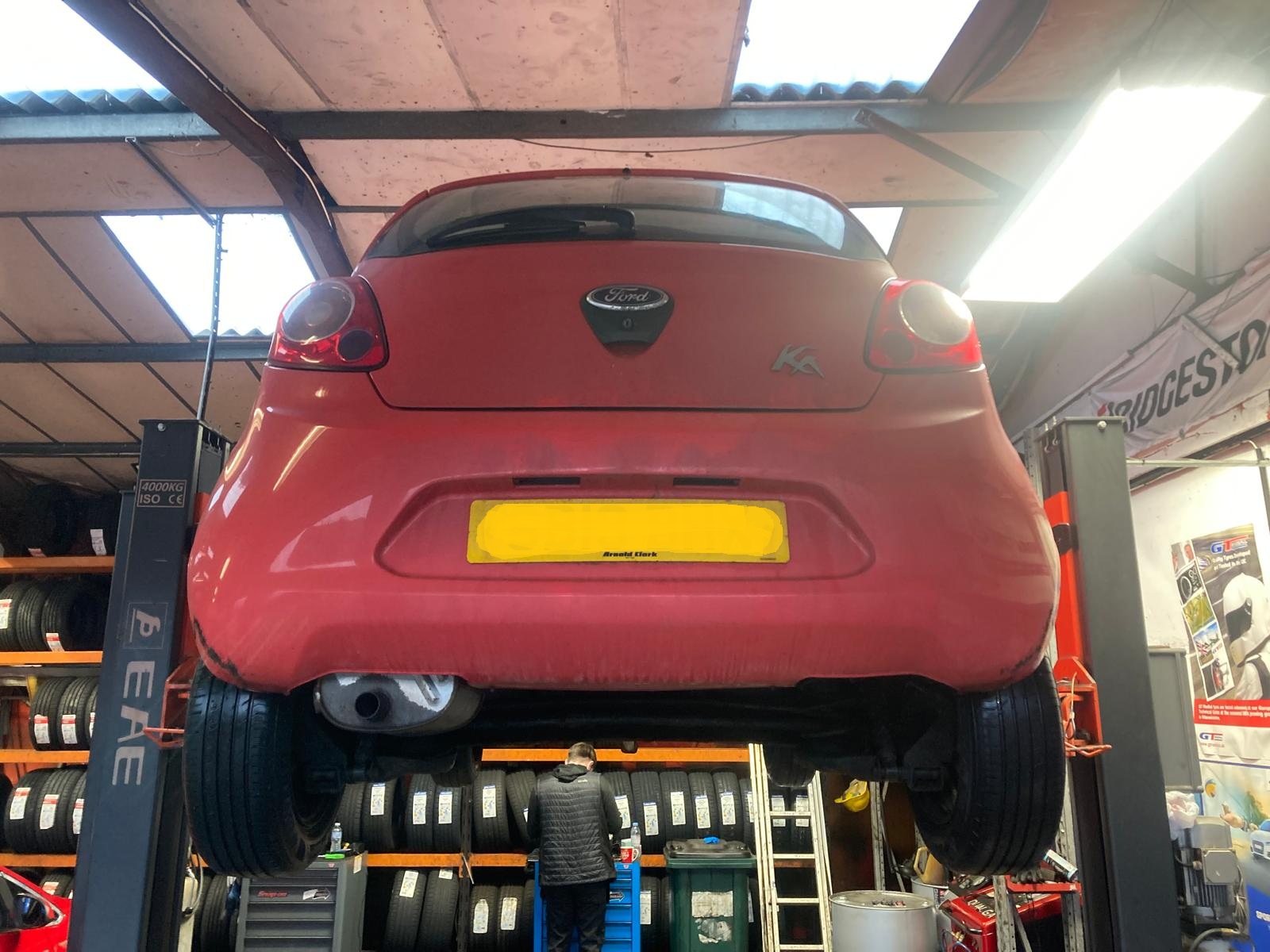
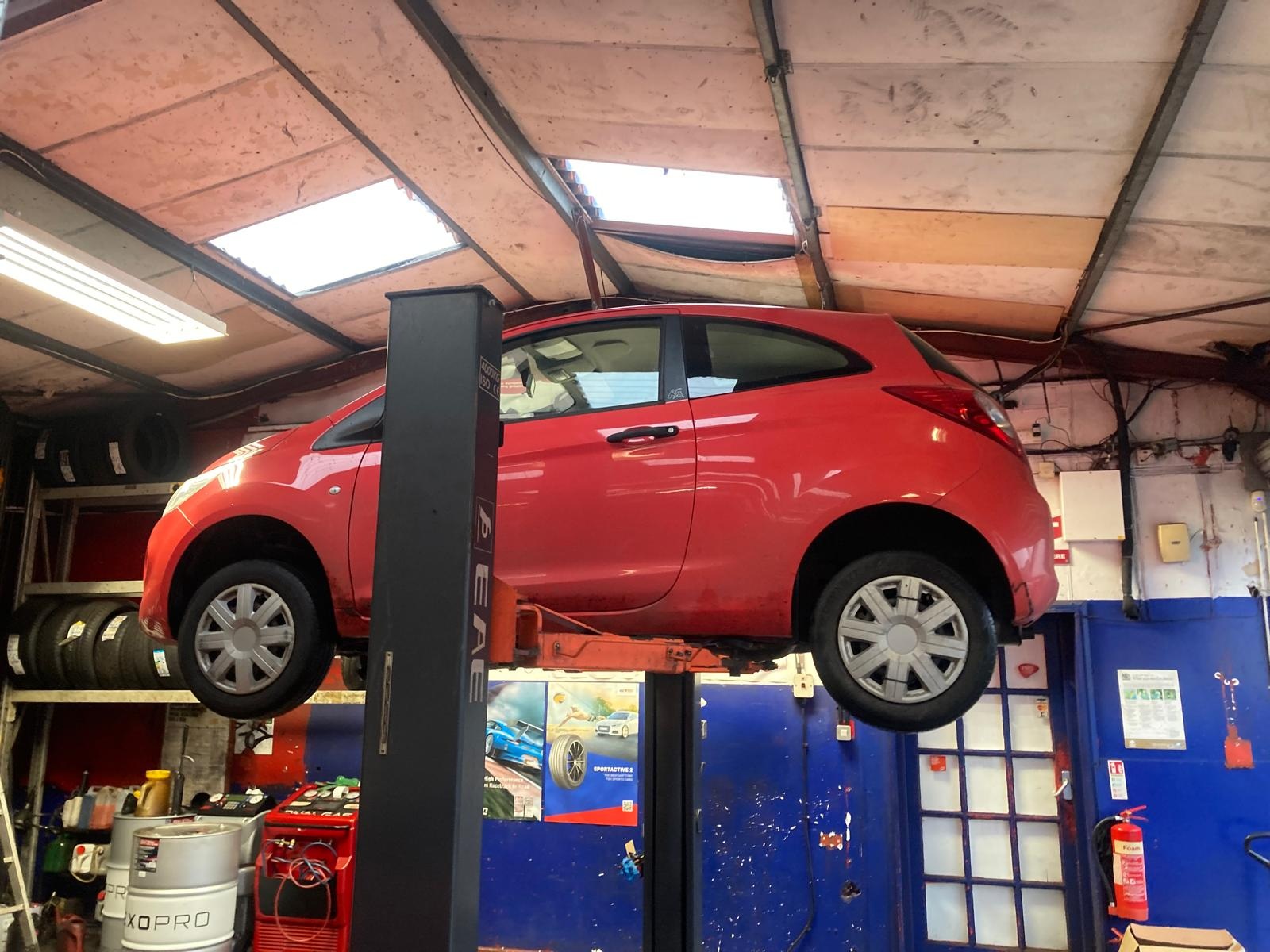
Yesterday brought one of those jobs into the forecourt that reminds you why running a local garage is still such a rewarding way to spend your days. A bright red Ford Ka rolled in, coughing, spluttering, and rattling its way up to the workshop doors. You didn’t need a trained ear to know something underneath was ready to part company with the rest of the car.
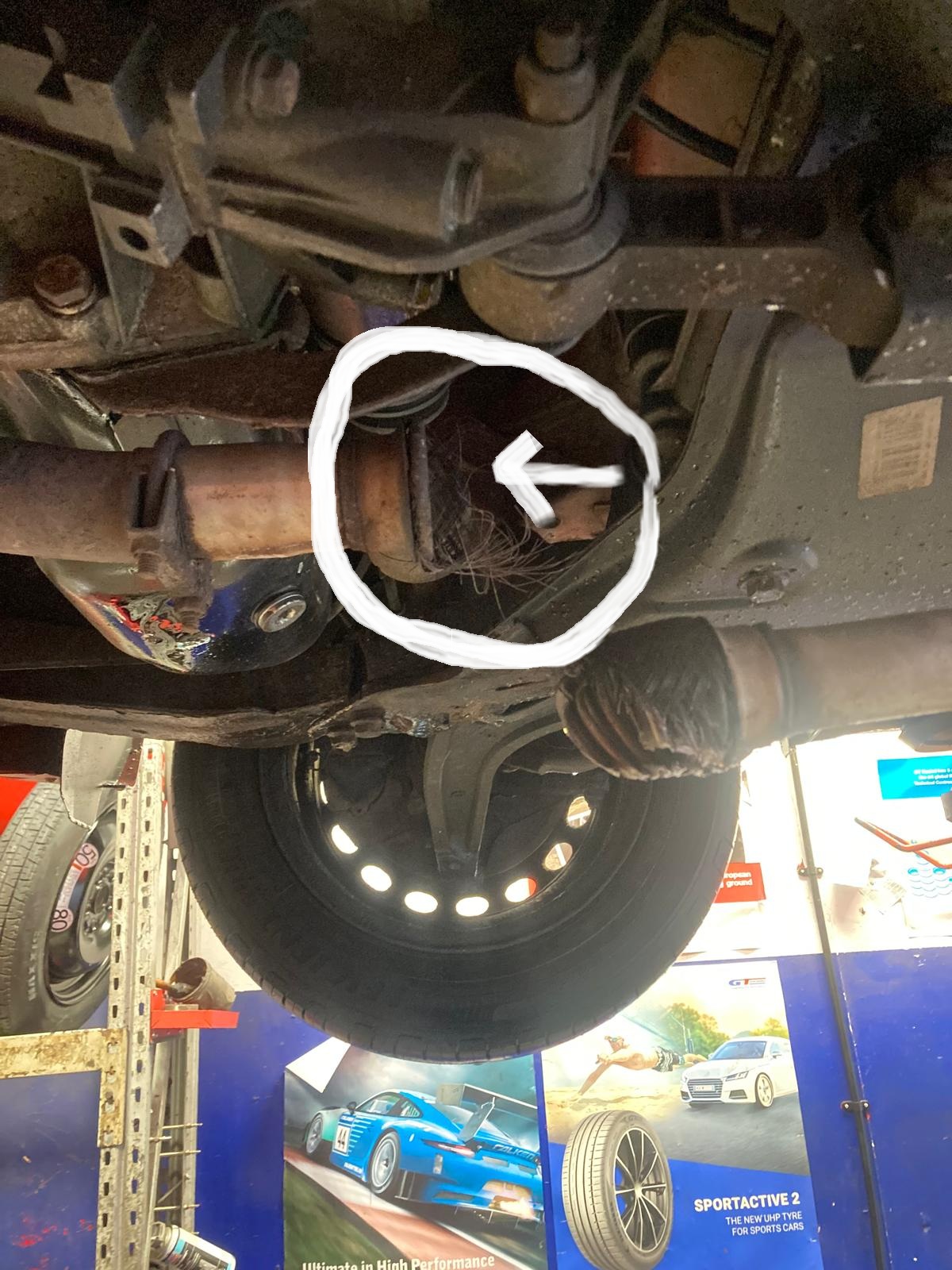
Sure enough, once Dale popped it onto the ramp for a quick look, the exhaust was hanging on by little more than hope and rust flakes. An easy diagnosis for once — the Ka needed a complete new exhaust system, no ifs or buts.
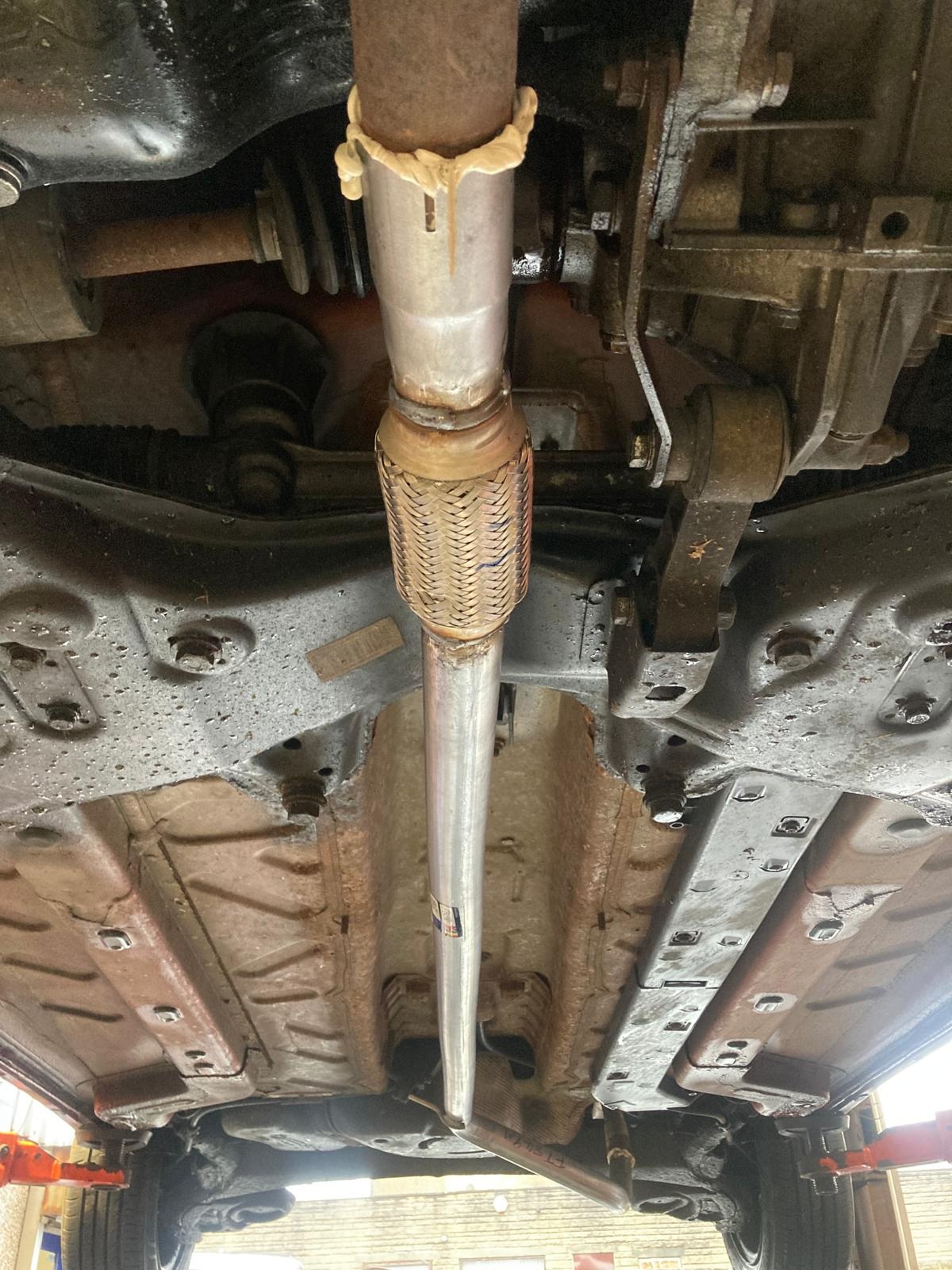
The lady who owned the car was a lovely local customer, the type we’ve had the pleasure of helping for years. She was hoping to nip into Halifax town centre for a bit of Christmas shopping and didn’t fancy driving through the queues on King Cross Road with a car that sounded like an old farm tractor. Luckily for her, we keep good stock levels and could fit the system straightaway. By the time she’d finished browsing the festive stalls in the Piece Hall and Woolshops, her Ka was already back to its cheerful, quiet self.
Happy customer, happy Ka, and a bit more peace on the Halifax roads!
Ford-KA-Exhaust-Replacement
A Little Ford Ka History – A British Favourite With a Yorkshire Following
The Ford Ka, launched back in 1996, has a special place in the hearts of many UK drivers. Whether you loved its quirky styling or weren’t quite sure about it at first, there’s no denying it became a familiar sight on our roads — especially in towns like Halifax, where its tiny turning circle and cheap running costs made it perfect for navigating tight streets and car parks.
A few quick bits of Ka nostalgia:
The first-generation Ka was built in Valencia, Spain, and later in Poland.
It was based on the old Fiesta platform but had its own distinctive rounded shape.
Ford kept the Ka simple — no fancy gadgets, just honest motoring.
It quickly became a favourite for new drivers, city commuters, and anyone wanting a dependable little runaround.
Even now, nearly 30 years later, we still see plenty of them come through our doors at Pellon Tyres. Many belong to long-term owners who swear by them, and with the right maintenance they keep going far longer than you’d expect. The weak points tend to be the usual culprits: exhausts, tyres, and suspension bushes — nothing our lads can’t sort.
Ford-KA-Exhaust-Replacement
Why Exhausts Fail on Older Cars – Especially in Halifax: Ford-KA-Exhaust-Replacement
Halifax isn’t the easiest place on exhaust systems. With our steep hills, damp winters, and all the road salt spread from October onwards, exhausts on older motors take a real hammering.
Common problems we see include:
Rusting from the inside out due to short journeys
Back boxes splitting at the seams
Centre pipes weakening where they curve around the axle
Hangers snapping and leaving the system dangling
Yesterday’s Ka was a perfect example — years of Yorkshire weather, short hops around town, and the usual rust traps had taken their toll.
Once a system gets to that stage, fitting a new one is the safest and most cost-effective option. Patching them up only delays the inevitable (and usually not for long in Halifax weather!).
Ford-KA-Exhaust-Replacement
Exhaust or Tyre Trouble? Just Pull Into Pellon Tyres – No Appointment Needed
One thing that’s never changed since we opened back in 1989 is the way we look after people. If something sounds wrong, feels wrong, or looks like it’s hanging off the bottom of the car, you can simply pull into Pellon Tyres and we’ll take a look as soon as a mechanic is available.
There’s no need to book weeks in advance, no call centres, and no fuss. Just drive up, pop into reception, and we’ll do our best to get you sorted. We deal with:
And because we’re right here in Halifax, you can leave the car with us while you do your shopping, grab a coffee, or catch the bus to town. Many customers take the short walk down towards Pellon Lane and are in the centre in minutes.
We know how important cars are in this area — between the hills, the weather, and the buses that never seem to come when you need them, having your motor off the road is more than an inconvenience. That’s why we try to get everyone back on the road as quickly and safely as possible.
Pellon Tyres – Proud to Be Part of the Local Community: Ford-KA-Exhaust-Replacement
We’ve always said that running a garage in Halifax is more than just fitting tyres and fixing exhausts. It’s about being part of the community — the same people we see in the supermarkets, at the Piece Hall events, walking their dogs around Shibden, or queueing with us at the chippy on a Friday night.
That’s why we’re proud when customers trust us enough to pop in without hesitation. Whether it’s a £25 puncture repair or a full exhaust system, it all matters to someone trying to get to work, pick the kids up, or, like yesterday’s customer, finish their Christmas shopping in peace.
Another job done, another customer sorted, and another Ford Ka given a new lease of life. Just another day at Pellon Tyres — and that’s exactly how we like it.
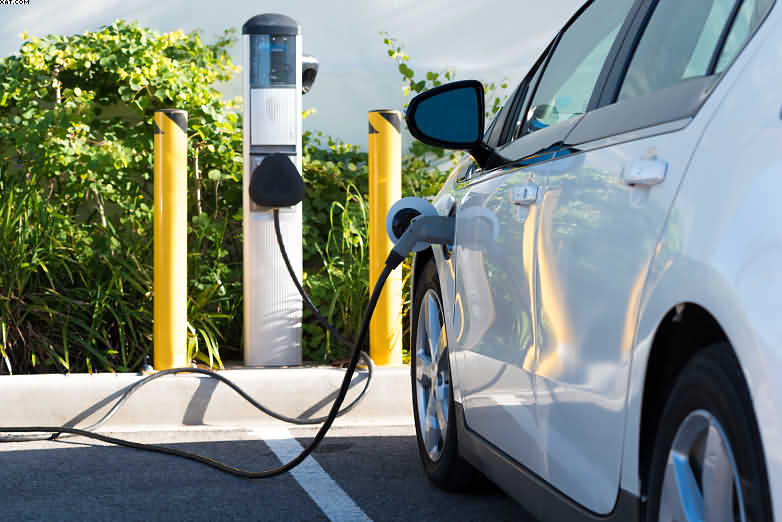
Electric vehicles bring four main challenges when it comes to tyre performance:
1. Extra Weight (20–30% more than a petrol equivalent)
Most of that extra weight comes from the battery pack. A heavier car puts more strain on the tyres, especially during cornering and braking. EV-specific tyres are built with stronger structures to cope with the extra load.
2. Range and Rolling Resistance
Every bit of drag reduces how far you can travel on a charge. EV tyres use advanced compounds and tread patterns to reduce rolling resistance, helping you squeeze every mile out of your battery.
3. Instant Torque = Faster Wear
One thing EV drivers notice straight away is how quick the acceleration is. Great fun—but very tough on tyres. EV-designed rubber uses improved compounds that resist the quick wear you get from that instant torque.
4. Quiet Running
Electric motors are whisper-quiet. That means tyre noise becomes much more noticeable. Many EV tyres include built-in noise-reducing technology to keep the cabin nice and peaceful.
What Exactly Is an EV Tyre? Why-Your-EV-Has-Different-Tyres
An EV tyre is specially engineered to maximize your vehicle’s efficiency. The tread pattern, compounds, and construction are all designed to:
Reduce rolling resistance
Improve grip under heavy loads
Handle the unique wear patterns of electric cars
Keep road noise to a minimum
It’s all about helping the car perform as the manufacturer intended, giving you better range and a smoother, safer drive — especially on the steep climbs and twisty roads around Halifax.
How Are EV Tyres Different from Standard Tyres? Why-Your-EV-Has-Different-Tyres
Standard tyres will fit an electric car — but they’re not designed for the job. Most EVs weigh significantly more than their petrol or diesel equivalents, meaning:
Standard tyres wear out faster
Handling can feel heavier or less predictable
The car may lose more range
The risk of tyre damage or blowouts increases
EV tyres are built to cope with that weight while still remaining efficient. They maintain pressure better under load, which helps the battery work less and keeps you on the road longer.
Can I Just Fit Normal Tyres on My EV? Why-Your-EV-Has-Different-Tyres
Yes, you can. But you probably shouldn’t.
Fitting standard tyres on an EV can reduce your range by up to 20% and may cause irregular wear or overheating on longer journeys. In extreme cases, it can even lead to premature tyre failure.
Considering how heavy EVs are — and how quietly they run—sticking with proper EV-rated tyres is the safest choice.
What Do EV Tyres Cost? Why-Your-EV-Has-Different-Tyres
You might expect EV tyres to cost a fortune, but in reality the prices are similar to any good-quality ICE (petrol/diesel) tyre. You pay more for premium brands with the latest tech, but budget and mid-range options are available too.
Here at Pellon Tyres, we always match the tyre to the car and customer—no upselling, just honest advice for Halifax drivers.
Do EVs Need Winter Tyres?
Winter tyres aren’t compulsory in the UK, but EV drivers can benefit from them more than most.
EV winter tyres:
Grip better in freezing temperatures
Offer shorter stopping distances on wet and icy roads
Keep their flexibility when standard tyres become hard and slippery
For Calderdale’s winters, they’re well worth considering.
Choosing the Right EV Tyre
Before buying any new tyre, always check the markings on your existing tyres. These tell you the exact size, load index, and speed rating your car needs. Getting it wrong can affect:
Range
Ride comfort
Safety
Warranty conditions
If you’re unsure, just give us a call at Pellon Tyre and Autocentre, Halifax, on 01422 362030. We’ll help you choose the right EV tyre for your car — without any fuss or flannel.
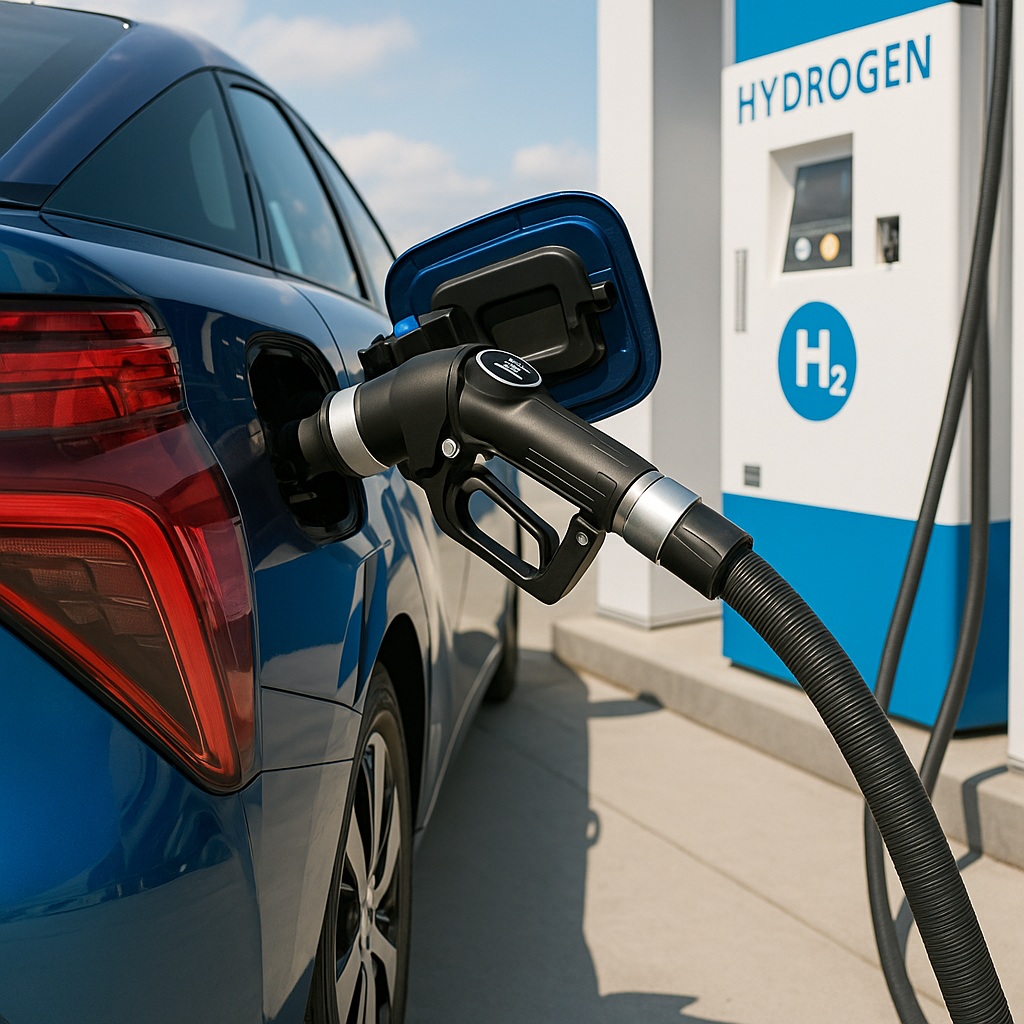
The Toyota Mirai is an electric-drive, mid-size four-door sedan powered by hydrogen, with a range of up to 300 miles and a refuel time of about f…
This is just another part of the big mix of fuels that will power the cars of the near future.
Hydrogen cells are also the favourite of some car manufacturers. Including Toyota now with the Toyota Mirai and BMW. In my opinion, hydrogen will be available at many filling stations in the future.
Toyota Mirai is one of the leaders in hydrogen cell-fuelled cars
It has come to my attention that there are at least three leading car manufacturers that are heading down the hydrogen fuel road with their cars. I am a keen follower of market trends and the direction that the green way forward is heading, and that includes the battle that is rising between EV vehicles, battery Tec technology, the Hydrogen cell technology.
Apart from Toyota with the Toyota Mirai, the other two players are Hyundai and Honda. Other carmakers have also been involved with Hydrogen including the American giant GM. Apparently GM has been running a test fleet of them for a few years now, but it is the Far Eastern country’s carmakers that are ahead of the field.
Toyota Mirai
There are enemies of hydrogen as well as battery-driven cars
But when the largest car company in the world looks interested in something, then it is time to sit up and take note. Toyota is a very experienced and successful manufacturer of cars and has made over 5,600 fuel cell-related patents available. Toyota has started off the motion for hydrogen-powered cars to make it to market at a faster pace.
The inclusion of the auto industry is of particular import to Japan.
Toyota, Honda, and Nissan are key contributors to Japan’s economy, and the industry together accounts for 10% of the national workforce and 20% of exports. To me it is a good thing that Japan is thinking about supporting the home industry, and developing these new products will bring stability to the home workforce.
It does have to make these technologies available to us all eventually to comply with European and American laws, but I think that the Japanese are thinking about this when they free off the patents for the new technology cars.
The scrap between battery power and hydrogen is on.
Both systems have their advantages and disadvantages. So, for instance, electric cars only require plug-in stations. Of course, to be recharged. Significantly, the hydrogen cars will require a network of filling station locations. However, this will mean that they could just be added to the existing gas stations all over the world.
Both cars can claim to have zero emissions.
But the lithium-ion cars are recharged by “dirty” coal-fired power stations. So they are not as green as people think. Especially in countries like China! So, the hydrogen car only emits water, so until the power supplies are greener, the hydrogen car wins there.
At the time of writing this post. Both cars are getting about the same mileage! Subsequently, both types of cars are still very expensive to buy. Hydrogen cars can be refuelled the same as a gas engine. While the battery car has to be charged up over a long period. Although scientists are working on a faster-charged battery all the time,.
Only time will tell which idea brings the most success, but you have to admit that it is interesting times that us auto guys live in.
2025 Update
Hydrogen vs EV – Could Hydrogen Cars Really Work Here in the UK?
Following on from the earlier look at hydrogen-powered cars like the Toyota Mirai, I thought it would be useful to dig a bit deeper into how hydrogen might fit into everyday motoring here in the UK — and more importantly, what it might mean for drivers around towns like Halifax over the next decade.
We all know the government keeps pushing the electric-only route, but the truth is that the future of motoring isn’t settled at all. You’ve got battery EVs racing ahead in sales, yes — but at the same time, hydrogen technology is quietly gaining pace, especially among the big Japanese and Korean brands who tend to think long-term rather than hype-driven.
Why Hydrogen Might Suit British Roads Better Than Many Think
Plenty of drivers are starting to question whether battery-only EVs really suit our infrastructure. Long charging times, queues at chargers, and the simple fact that many people around Halifax live in older terraced properties or flats with no off-street parking make charging a nightmare.
Hydrogen, on the other hand, has big advantages:
Fast refuelling – roughly the same time as filling a petrol tank
Longer range compared to many EVs
Lighter vehicles, because hydrogen fuel cells don’t weigh as much as big lithium batteries
Cleaner power, with only water vapour coming from the exhaust
In many ways, hydrogen fits more closely with how people actually use cars today — quick fill-ups, longer trips, and no waiting around for hours at a charger.
Hyundai, Honda, and Toyota – The Far Eastern Push Forward
As mentioned in your original piece, Toyota isn’t alone. Hyundai and Honda are deep into hydrogen research, and in typical fashion, they’re playing the long game. Toyota Mirai, has already reached its second generation, Hyundai has the Nexo, and Honda has experimented with both the Clarity Fuel Cell and several commercial hydrogen platforms.
These companies aren’t just tinkering — they’re investing billions because they believe batteries alone won’t meet global demand.
Meanwhile, over in the USA, GM is working with hydrogen for military and commercial vehicles. The American market often leads with pickup trucks and heavy-duty vehicles, and hydrogen suits those far better than giant battery packs.
But the real innovation still seems to come from Japan and Korea. They’ve always had a knack for building technology that lasts — look how long Toyota hybrids have been running around Halifax without missing a beat!
Could Hydrogen Work in Towns Like Halifax? Toyota Mirai
Honestly, yes — if the infrastructure arrives.
Hydrogen refuelling is still rare in the UK, but the few stations we do have prove the technology works perfectly well in British weather and terrain. Halifax, being hilly and often cold, is exactly the type of environment where hydrogen has an advantage over heavy battery EVs struggling with winter range.
Imagine being able to pull into a station near the Calder Valley, fill up in five minutes, and head straight off again — no messing, no apps, no cables across the pavement.
It’s very similar to how we treat petrol and diesel cars now, which is probably why many drivers feel more comfortable with the idea.
Why Toyota Keep Betting on Hydrogen: Toyota Mirai
Toyota has always been cautious about fully committing to battery EVs. Instead, they produce:
Petrol cars
Hybrids
Plug-in hybrids
Hydrogen cars
They’re spreading their bets, and hydrogen is a big part of their long-term vision. The Mirai isn’t just a science experiment — it’s a proper production car that already has loyal owners.
Toyota knows something the rest of the world is slowly discovering:
There isn’t going to be one single solution to replace petrol and diesel—we’re going to need a mix.
Hydrogen, hybrids, and improved batteries will all have a part to play.
ABS Braking Systems Today—How Modern Cars Keep You Safe on the Road
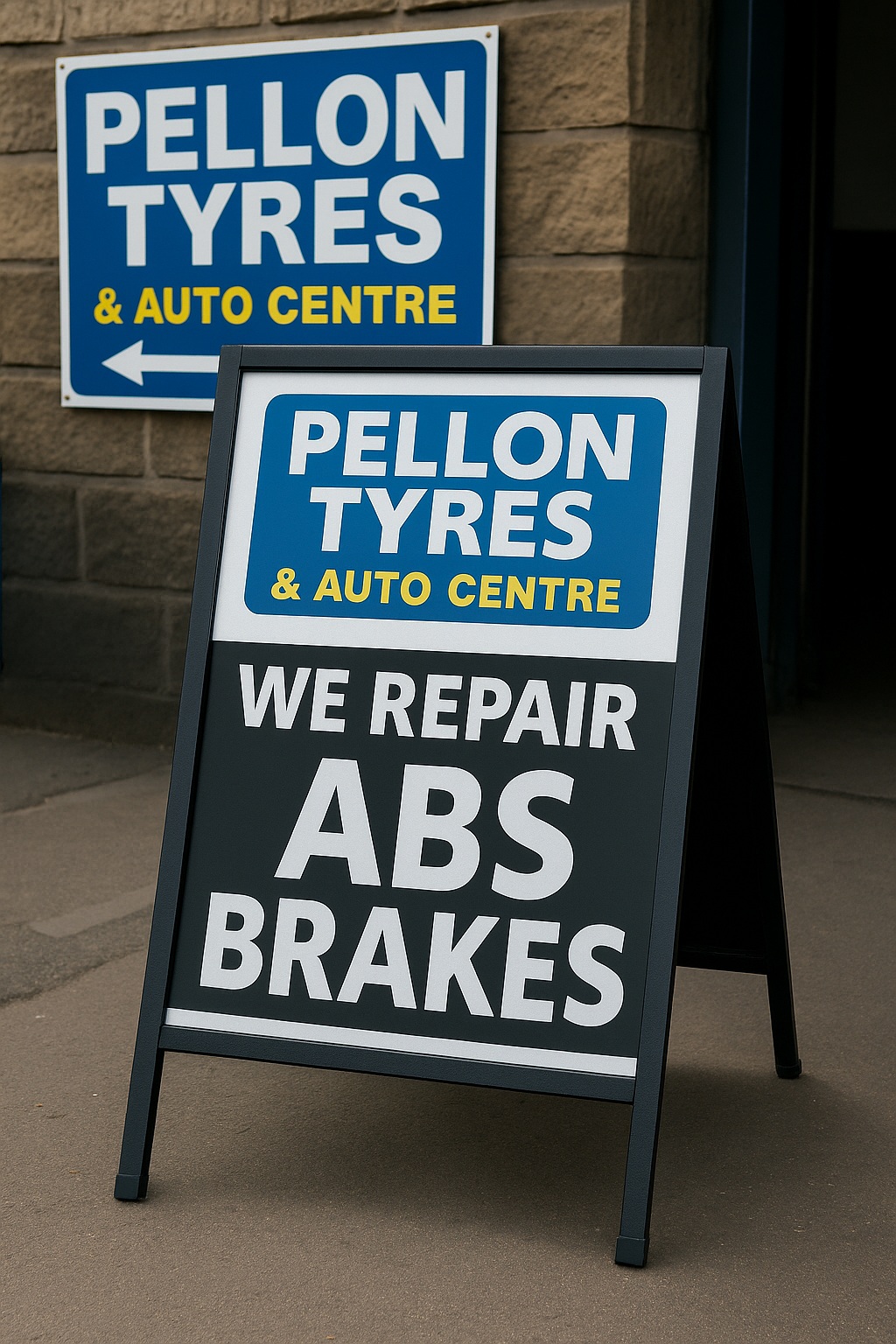
When ABS braking systems first appeared on mainstream cars, most drivers thought they were a bit of a gimmick. These days they’re an essential part of a car’s safety system, working quietly in the background every time you hit the pedal. Yet many drivers still aren’t sure how ABS actually works or what affects its performance. As someone who sees brake issues, tyre wear, and ABS faults every single week at Pellon Tyres in Halifax, I thought it was time to take a closer look.
What ABS Actually Does: ABS Braking Systems Today
ABS (Anti-lock Braking System) is designed to stop your wheels from locking when you brake hard. Locking wheels means skidding, and skidding means zero steering control. ABS steps in by rapidly pulsing the brake pressure on each wheel—far quicker than a human could pump the pedal—so the wheels keep turning just enough to maintain grip.
In real terms this gives you two big advantages:
You can steer while braking, avoiding hazards.
Your car often stops quicker and in a straight line on most road surfaces.
In today’s traffic, that can easily be the difference between a near miss and a major accident.
Modern ABS – Smarter, Faster, and Linked to Other Systems
Today’s ABS isn’t a standalone gadget. It’s linked to a whole host of systems:
Traction control, preventing wheel spin
Electronic Stability Control (ESC), keeping the car stable in a skid
Brake Force Distribution, balancing braking across all wheels
Automatic Emergency Braking on newer cars
The wheel-speed sensors and control units are far more accurate than they used to be, and modern systems can monitor individual wheel grip in milliseconds.
Even electric cars rely heavily on ABS integration to work alongside regenerative braking, so the system has become more important than ever.
When ABS Can Feel Different: ABS Braking Systems Today
Most of the time ABS gives you shorter stopping distances, but there are situations where you’ll feel it working harder:
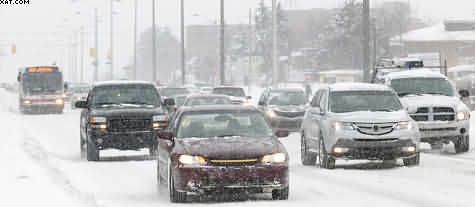
Loose gravel and deep snow—a locked wheel can dig in, so ABS may take slightly longer to stop, but it gives you steering control.
Polished ice—ABS prevents total lock-up, but grip is still almost zero.
Big mismatches in tyres — worn, mixed, or cheap tyres confuse the sensors and reduce efficiency.
That last point is a big one — because your tyres and your ABS are a team, and if the tyres can’t grip, ABS can’t do its job properly.
Tyres and ABS: Why the Right Rubber Matters
ABS relies on the tyres maintaining contact with the road. That means:
Good tread depth
Correct tyre pressures
Correct tyre size (especially on cars with fancy electronics)
Matching tyres on each axle
At Pellon Tyres in Halifax, we regularly see cars where the ABS is fighting a losing battle because the tyres are poor quality or badly worn. Regular checks, wheel alignment, and choosing a proper brand — not the nameless budget stuff — make a huge difference.
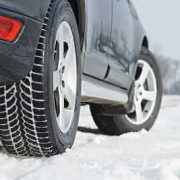
If you drive in winter or spend time on hilly Yorkshire roads, you’ll feel the benefit of fitting a quality all-weather or winter tyre, which gives the ABS system the grip it needs in bad conditions.
Looking After Your ABS System: ABS Braking Systems Today
ABS systems are reliable but not indestructible. Here’s what to keep an eye on:
ABS warning light on your dashboard — don’t ignore it
Corroded or damaged wheel-speed sensors
Broken wiring after pothole impacts Incorrect tyre sizes confusing the readings
Low brake fluid
If your ABS light is on, your car will still brake—but without the safety net. It’s worth popping into Pellon Tyres for a quick check rather than risking an emergency.
ABS Braking FAQ: ABS Braking Systems Today
1. Does my car fail its MOT if the ABS light stays on? Yes. If the ABS warning light is illuminated, the car will fail its MOT because the system is classed as a major safety feature.
2. Is ABS supposed to buzz or vibrate when it activates? Yes. A pulsing feeling through the pedal is normal — it means the ABS is kicking in and preventing wheel lock.
3. Can worn tyres affect how well the ABS works? Absolutely. Low tread, uneven wear, or cheap part-worn tyres can all stop ABS from gripping properly on wet roads.
4. Is it safe to drive with the ABS light on? The car may still brake normally, but the anti-lock function isn’t working. Braking distance increases, especially in wet weather.
ABS Matters More in Halifax Than You Might Think With our steep hills, tight back roads, and long wet spells, ABS plays a huge part in stopping safely. Whether you’re coming down Boothtown Road in the rain or braking on black ice towards Sowerby Bridge, a properly working ABS system can make the difference between a clean stop and a collision.
Wexford to Halifax – Another Customer Travels for Pellon Value
You’d think after all these years in the tyre trade that nothing would surprise me… but no. Every so often, something happens at Pellon Tyres that makes me smile and reminds me why we’ve built such a loyal customer base.
This week we had another long-distance visitor – and this chap came even further than the lad from the Isle of Arran. This one travelled all the way from Wexford in Ireland.
Yes… Ireland!
Wexford to Halifax
A Kia Sportage, a Family Visit, and Halifax Prices That Can’t Be Matched
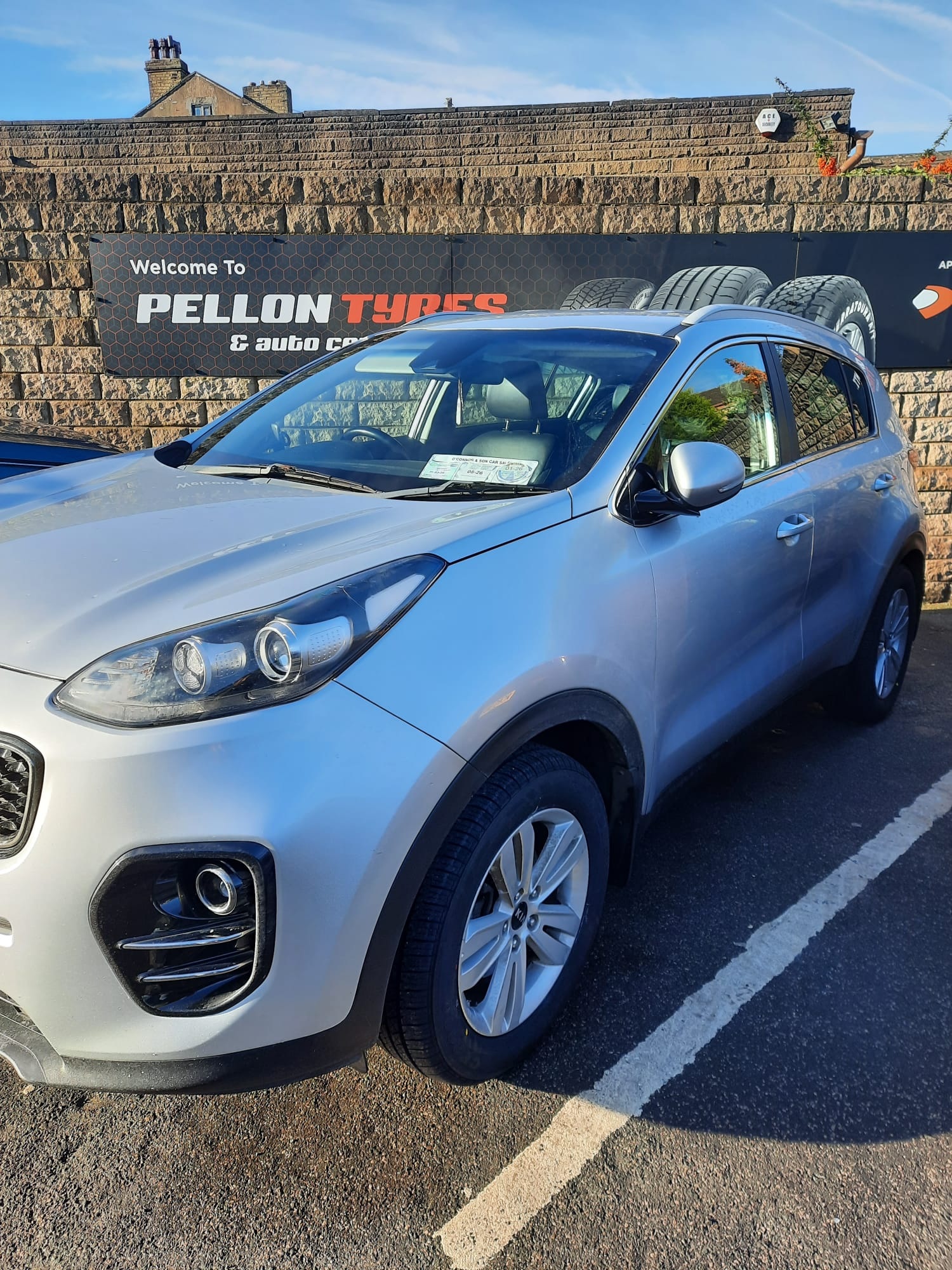
The story began when my manager received a phone call from a friendly Irish fella who was planning to visit family over here. He runs a Kia Sportage, and like a lot of people these days, he’d been shopping around online for the best tyre prices.
It didn’t take him long to realise something:
Our prices in Halifax were cheaper than the ones he was getting in Ireland — even after ferry trips and travel costs.
He’d already heard good things about us from a mate of his who’d lived in West Yorkshire years ago (word gets around!), so he booked in for a full set of tyres:
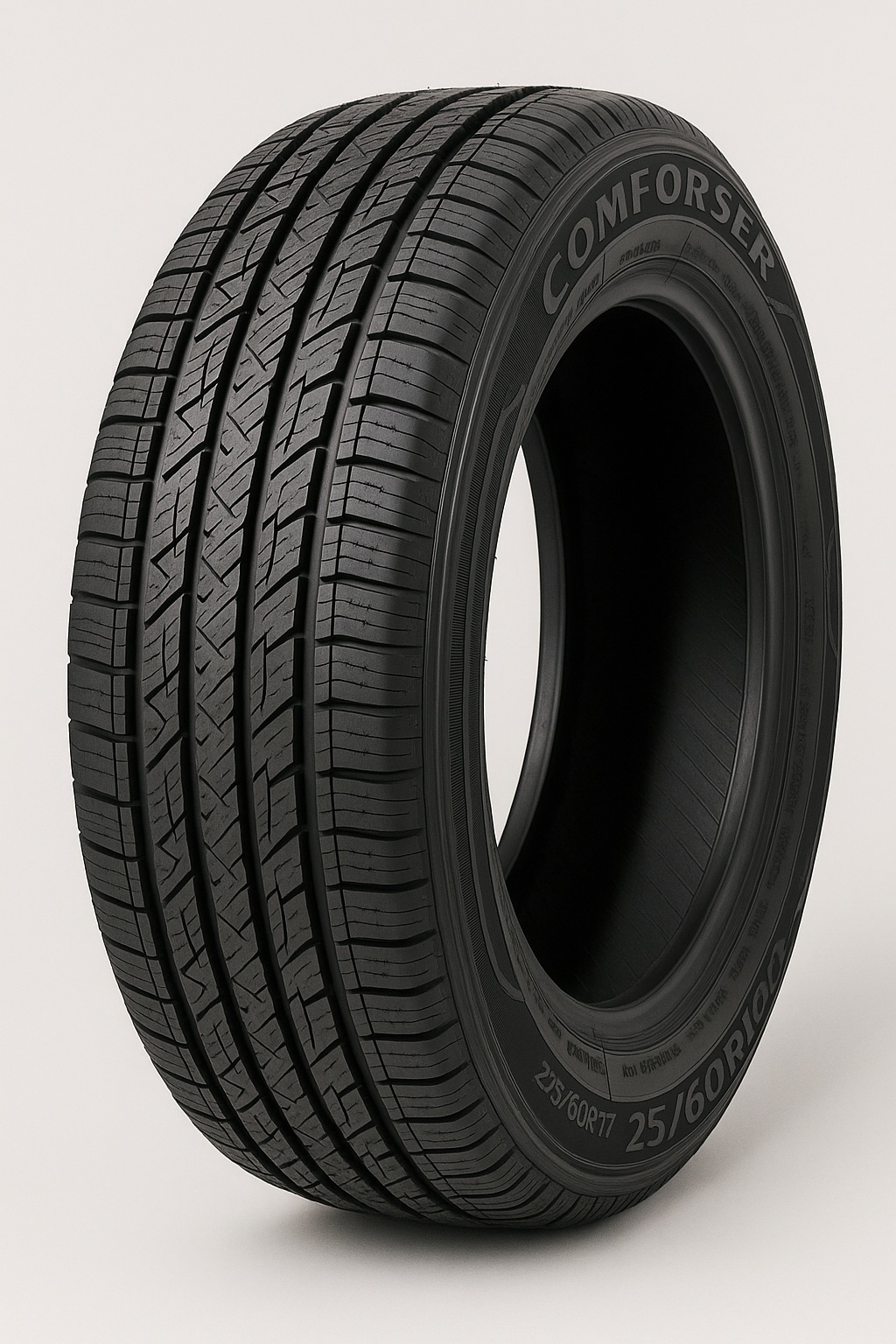
🟢 4 x 225/60R17 Comforser tyres 🟢 Wheel alignment while he was here
A proper job, done properly.
Why People Travel for Tyres: Wexford to Halifax
You might wonder why people cross borders and seas just for tyres — but once you’ve spent decades in this trade, the answer is simple:
Honesty, fair prices, and proper workmanship.
It doesn’t matter if you’re from Mixenden, Mirfield, or County Wexford — people know when they’re getting looked after. And once they know, they come back. Even if “coming back” involves a ferry, two motorways, and a visit to family.
What really makes me proud is that the chap trusted us enough to include a wheel alignment too. Anyone can sell a set of tyres, but taking the time to make sure the steering and tyre wear are spot on… that’s where the real value comes in.
Extra Paragraph – Wexford Customer Story: Wexford to Halifax
A similar thing happened only a week or so later when another long-standing customer got in touch — this time from Wexford in the Republic of Ireland. He’d bought a Kia Sportage after moving across the Irish Sea but still preferred to sort his tyres here in Halifax when visiting family. Prices in Ireland can be eye-watering compared to the UK, so he took the opportunity to call into Pellon Tyre & Autocentre for a full set of 225/60R17 Comforser tyres and a wheel alignment before heading back to the ferry. Wexford is a beautiful place — rolling farmland, coastal lanes, and proper rural driving — so he wanted tyres that offered good grip, durability, and value for money. Even after adding the travel costs, he told us he still saved a tidy sum by coming to Halifax, and more importantly, he knew the job would be done properly. It’s great to see customers who’ve moved abroad still choosing to come “home” to us for their tyres.
A Few Words About Comforser Tyres: Wexford to Halifax
Comforser tyres have become a popular choice for drivers who want decent performance without paying top-end prices. They’re what I call a solid mid-range tyre — not dirt cheap, but very good value for the money. Over the years we’ve fitted loads of them here at Pellon Tyres, especially on family cars, SUVs and crossovers like the Kia Sportage.
They offer a comfortable ride (the clue is in the name) and good wet-weather grip, and they tend to wear evenly when looked after with proper alignment — something we always recommend. For customers who rack up plenty of motorway or rural miles, they’re a sensible option that doesn’t break the bank. That’s exactly why our Wexford customer went for a full set: reliable, affordable, and ideal for the mixed driving you get on Irish roads.
That’s the Pellon way.
The document titled Wexford to Halifax addresses the importance of sourcing tyres in Halifax, particularly for Kia Sportage vehicles. Consumers seeking affordable options may explore tyre prices in the UK, including competitive deals from Pellon Tyres Halifax. Additionally, the comparison of tyre prices between Ireland and the UK could influence purchasing decisions, prompting travel for tyres if advantageous. Ensuring proper wheel alignment in Halifax is also essential for optimal vehicle performance, alongside the pursuit of cheap tyres in Yorkshire and Comforser tyres to meet diverse needs.
https://www.pellonautocentre.com/wp-content/uploads/2024/07/pellon-tyres-logo-509x321.jpg00Eric Robertshttps://www.pellonautocentre.com/wp-content/uploads/2024/07/pellon-tyres-logo-509x321.jpgEric Roberts2025-11-22 15:17:422025-11-22 16:11:02Wexford to Halifax
Halifax to the Isle of Arran – A Customer Who Never Forgot Pellon Tyres
Every now and again something happens at the garage that reminds me why I’ve loved this trade for so long. We’re used to customers popping in from Sowerby Bridge, Elland or perhaps the odd one from Leeds who works in Halifax – but this week brought a surprise that really made my day.
Early on Monday morning, the phone rang. My manager, Debbie, answered, expecting the usual run of winter tyres and MOT bookings. Instead, the chap on the other end started by saying:
“I used to live in Halifax… about thirteen years ago… but I’m phoning you from the Isle of Arran.”
Now, the Isle of Arran isn’t exactly round the corner. It’s a beautiful Scottish island, rugged, hilly, windswept and totally different from our Yorkshire valleys. But despite being miles away, this customer remembered Pellon Tyres as the place he trusted most for honest advice and fair prices.
You can’t buy loyalty like that.
Halifax to the Isle of Arran
Choosing the Right Tyres for Island Life: Halifax to the Isle of Arran
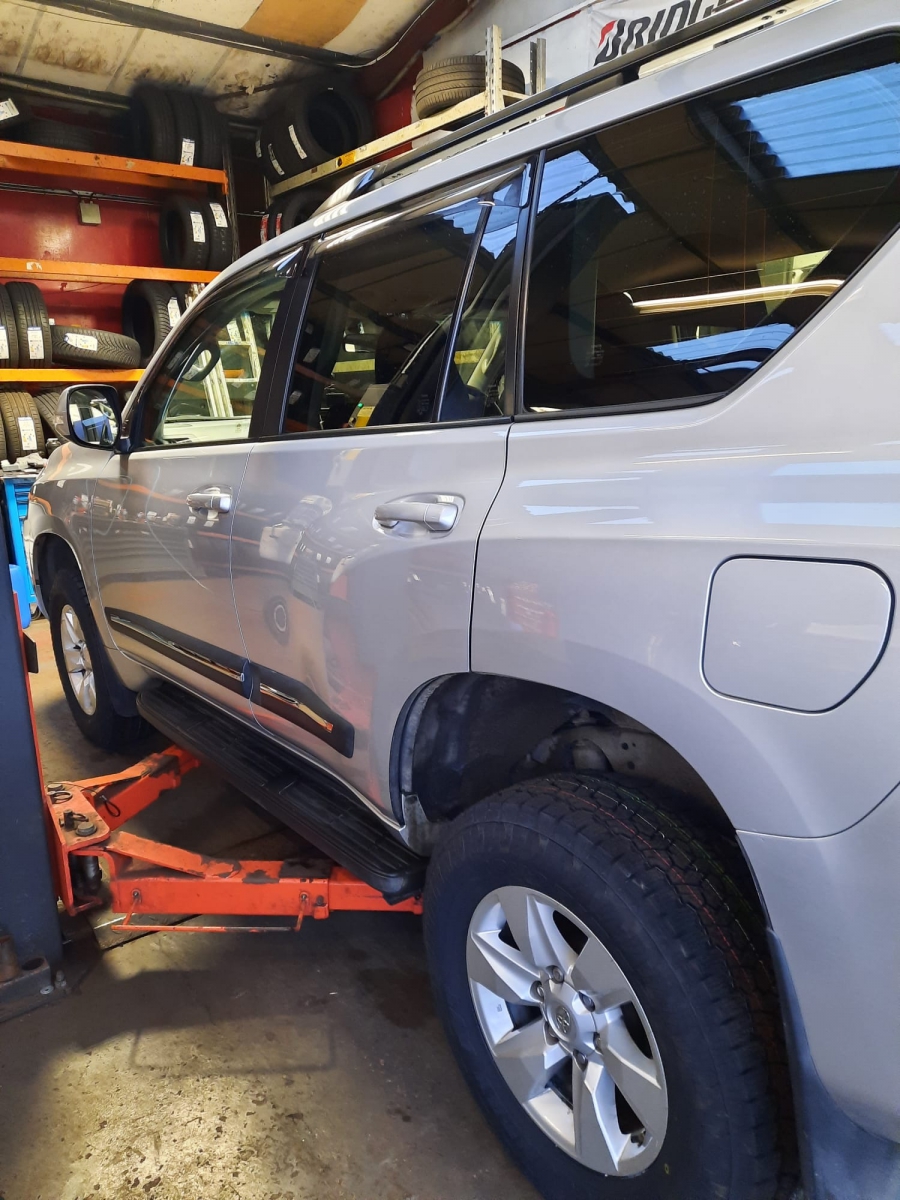
He went on to explain that he now works outdoors on the island, often in fields and on rough terrain, and drives a Toyota Land Cruiser — the ideal vehicle for that kind of lifestyle. The only problem was finding the right tyres for such varied conditions.
Local prices on Arran were steep, and the choice wasn’t great. So he did what many people do: he rang his old trusted garage back in Halifax for advice.
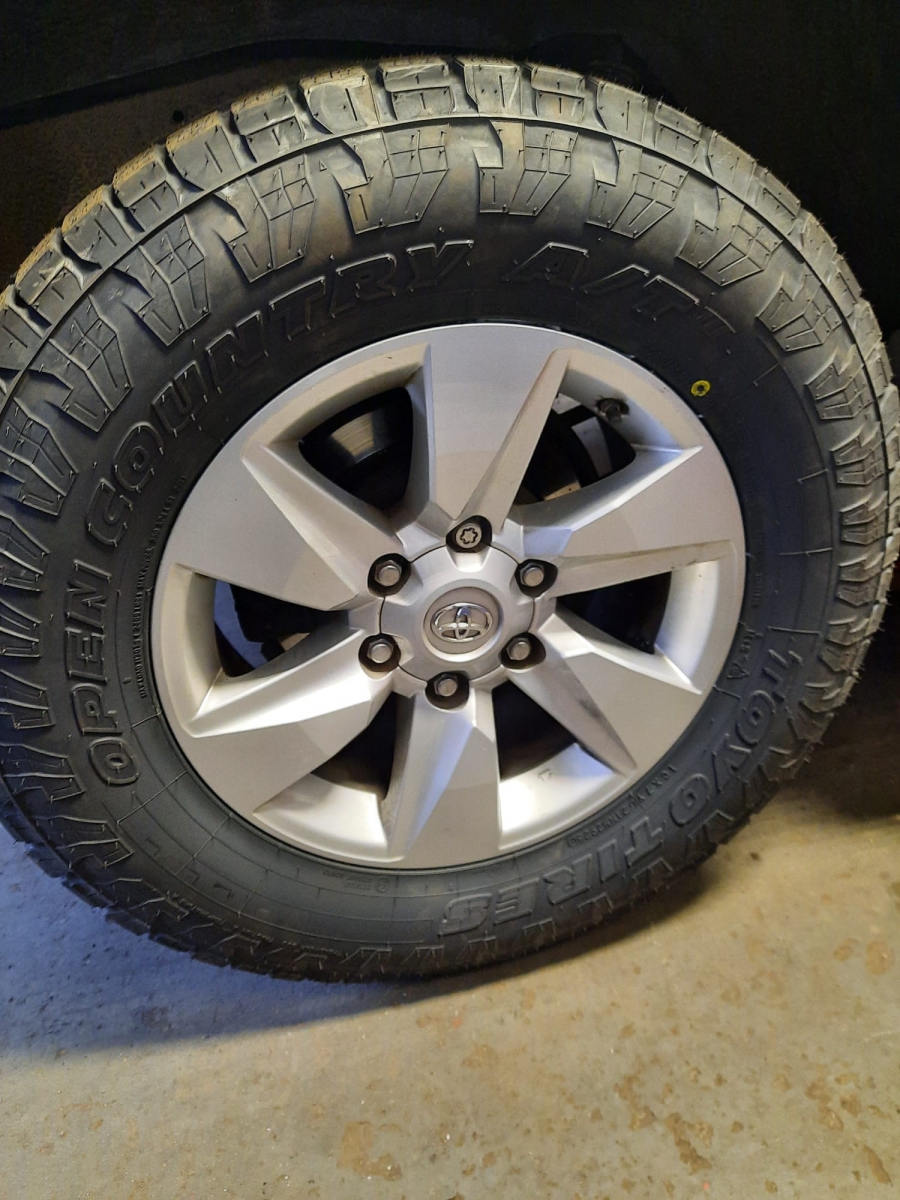
After a proper chat with the lads in the office and going through all the options, he settled on the Toyo Open Country A/T 265/65R17—a cracking all-terrain tyre that’s perfect for the mix of fields, farm tracks and steep island roads. Not a full-blown winter tyre, but with enough bite and strength to cope with the rugged landscape.
A proper working tyre for a proper working vehicle.
And While He Was At It… Another Set for His Other Car! Halifax to the Isle of Arran
A couple of days later, he rang back again—not only did he want the Toyos for the Land Cruiser, but he also wanted a pair of Yokohama Geolandar 225/55R18 for his other car.
Why? Simple:
Even with the delivery cost, our price was cheaper than buying tyres on the island.
Times may change, electric cars may come and go, but one thing stays the same: Yorkshire folk (even the ones who’ve migrated north of Hadrian’s Wall!) never forget where they get good value for money.
A Little Bit of Halifax on a Scottish Island: Halifax to the Isle of Arran
I love stories like this because they show what proper, old-fashioned customer service can lead to. This chap hasn’t lived in Halifax for more than a decade, but he still remembered the friendly welcome, fair pricing and honest advice he got when he used us years ago.
We always say that tyres aren’t just black round things — they’re a lifeline. They keep you safe whether you’re coming down the steep cobbles of Halifax Old Town, trundling up the A629 to Keighley, or crossing a misty moor track on the Isle of Arran.
And it’s good to know that our little garage on Pellon Lane is still the place people turn to… even if they now live on a remote island surrounded by seals, cliffs and the wild Atlantic!
If You Need Tyre Advice – Whether You’re in Halifax or Honolulu – Give Us a Bell
Whether you’re just up the road in Mixenden or you’ve moved halfway across the UK, we’re always here to help. We’ve supplied tyres to customers in France, Spain, Scotland, and now Arran—but nothing beats the warm feeling of a Halifax lad remembering where he got looked after properly.
If you need advice on all-terrain tyres, winter tyres or just something sensible for everyday use, pop in or give us a ring:
https://www.pellonautocentre.com/wp-content/uploads/2024/07/pellon-tyres-logo-509x321.jpg00Eric Robertshttps://www.pellonautocentre.com/wp-content/uploads/2024/07/pellon-tyres-logo-509x321.jpgEric Roberts2025-11-22 10:57:222025-11-22 11:28:21Halifax to the Isle of Arran
Can Your Car Insurance Be Affected by the Tyres You Have on Your Car?
Most drivers never give their tyres a second thought beyond making sure they’re legal and have a half-decent amount of tread. But here’s something many don’t realise—your car insurance can be affected by the tyres you fit, and in some cases it can even invalidate a claim. It sounds a bit over the top, but insurers take tyres very seriously, and for good reason.
Safety First — and Insurers Know It: Winter Tyres Insurance
Your tyres are the only part of your car that actually touch the road, so anything that affects grip, stability, or stopping distance will naturally be a concern for insurers. If a crash happens and your tyres are found to be illegal, unsafe, or unsuitable for your vehicle, the insurer can argue that the car wasn’t being used in a roadworthy condition.
That can lead to reduced payouts — or, in the worst case, no payout at all.
This is the big one. If your tyres don’t meet the legal requirements, you’re technically driving a vehicle that isn’t roadworthy. That includes:
Tread depth below 1.6mm across the central 75%
Bulges, cuts, cords showing, or structural damage
Wrong tyre size or load rating for your car
Mixed tyres that aren’t allowed (for example: mixing cross-ply and radial)
If you were involved in an accident and the police or insurer found any of the above, you could find your claim refused — and even pick up points, fines, or both.
Modifications: Bigger Wheels, Off-Road Tyres & AT Tyres
In recent years a trend has grown for fitting:
Oversized wheels
All-terrain (AT) tyres
Mud-terrain tyres
Custom aftermarket sizes
These aren’t illegal — but many insurers class them as modifications. And they absolutely must be declared.
If the car came from the factory on road tyres and you’ve swapped to chunky AT tyres (very common in Land Rovers, Hilux, and SUV models), an insurer may see that as:
A performance change
A handling change
A risk factor
A replacement cost increase
Failing to declare a modification, even an innocent one, can void a policy.
Here at Pellon Tyres we see this a lot — customers upgrading to AT tyres for farming work, rural living, or winter safety, without realising they have to tell their insurance company.
Most insurers are absolutely fine with it once you’ve told them. But if you don’t tell them… you could be asking for trouble.
Cheap Part-Worn Tyres — Another Risk Area: Winter Tyres Insurance
Many insurance assessors frown on part-worn tyres. Strictly speaking, they’re legal if properly tested and stamped — but many aren’t. If your car is inspected after a crash and it’s found to be on unsafe or incorrectly marked part-worns, an insurer can argue “negligence”.
Again, this can reduce or invalidate a claim entirely.
Seasonal Tyres — Winter & All-Season Tyres Are Fine
A common question we get asked in Halifax is whether swapping to winter tyres affects insurance. The answer is simple:
No — as long as the tyre size and load/speed rating match the vehicle requirements.
Most UK insurers actively support winter tyres because they improve safety in cold weather. Just make sure the tyres are:
Correctly rated
Fitted as a full set
Not oversized
Final Advice — Simple Steps to Keep Your Insurance Safe: Winter Tyres Insurance
To keep yourself fully covered:
Always fit the correct-sized tyres
Maintain at least 1.6mm tread depth (preferably 2 mm+)
Avoid mixing random tyre types
Declare any upgrades, AT tyres, or wheel size changes
Avoid dodgy part-worn tyres
Keep your tyres inflated correctly
Insurance companies want a roadworthy car. As long as your tyres are legal, properly fitted, and correctly declared, you’ll never have a problem.
So, I always find it strange to hear my customers say, “Will my car be insured if I fit winter tyres?” I used to think that they were joking at first. But for some reason, they were very serious. Apparently, it was something that they had read in a national newspaper. When I checked this out, it said that if you modify or change your car from the original specs,. So, then you should inform your insurance company. Subsequently, you could not be insured in case you had an accident.
I suspect that this covers thousands of motorists. Importantly, driving about today, “with what they would consider minor adjustments” to their cars. Of course, such as fitting winter tyres or a “go faster stripe” down the side.
There is no doubt that winter tyres do affect your car’s performance. However, only for the better! By making the car drive with better control and brakes. Especially in winter weather, from rain to ice and snow. As long as you stick to the same size and the advised load rating for your car. Then you should be fine and proud to fit the winter tyres.
Insurance companies should give you “discount” for fitting winter tyres – Winter Tyres Insurance
Even this year, our customers have asked about the effect winter tyres can have on their insurance. So I thought that I would look into it a little deeper and write an article about the subject. In my opinion, I think that you should get a rebate from your insurance company. Of course, if you make your car safer by fitting winters to it. In fact, the big debate for me is, “Are cars with illegally worn tyres insured?” and the answer is no. But I will look at that in a future article.
The problem has also become an issue with the insurers themselves. Consequently, after a deluge of enquiries from worried car owners. Strangely, they thought that they would not be insured if they fitted these tyres to their car. According to the Association of British Insurers (ABI), the problem has been taken up with its members. So, now over 90% have agreed that they will not increase premiums. Happily, for their customers, they fit the correct winter tyres on their vehicles.
Winter tyres much safer – Winter Tyres Insurance
They also agreed to fit winters to their car. So, it made for better road safety over the winter period. In fact, many of the other European countries make it a law to fit winters between November and March of the following year, so why should the British motorists be penalised?
A statement from the ABI says, “Often motor insurers will not charge an additional premium when their insured customers use winter tyres, provided that they meet and are fitted in accordance with the vehicle manufacturers’ specifications and are in a roadworthy condition.”
If you are unsure about your own insurance company’s stance on the matter, then you can either ring them up or go to the ABI website, where insurers who comply with the “good to fit winter tyres” rule are listed. The web address is “ABI a guide to winter tyres“.
Winter tyres will not incur additional insurance costs.
As I stated earlier in this article,. So, the insurance companies often increased the cost of your insurance if you modified your car in any way and did not inform them; things like an upgraded, modified engine spring to mind. They regarded you as being more likely to have an accident if you had modified your car, and your car may have become a bigger target for car thieves, so an extra premium would have been charged.
At first when winter tyres became more popular, the insurance companies gave out mixed messages, but the ABI can now confirm that winter tyres are a safety issue and are a great improvement when fitted to your car during the winter period.
My own advice would be to inform your insurance company that you are fitting winter tyres. You will not have to pay any extra premiums. Some companies do require you to inform them; a list can be found on the ABI website. Nick Starling, ABI’s director of general insurance, said, “Insurers do not want to penalise motorists who take steps, like fitting winter tyres, to improve their safety on dangerous winter roads. Last year cold weather came early, and there was some uncertainty for customers about the insurance implications of fitting winter tyres. This commitment clarifies the position for motorists.”
Always fit the same size or a size recommended by your tyre dealer if a direct replacement cannot be found.
A good tyre retailer will have a website where you can legally convert important information, and insurance providers ought to accept it.anies. Some insurance companies, such as Tesco and The Co-operative Insurance Company, state that you are alright to fit winters, but you should not oversize them. Oversizing tyres is not a good thing anyway?
Pellon Tyre and Auto-Centre offers car and van servicing and repairs to all makes of vehicles. Finally, we are still the Nokian tyre dealers for the Calderdale area of Yorkshire.
We may request cookies to be set on your device. We use cookies to let us know when you visit our websites, how you interact with us, to enrich your user experience, and to customize your relationship with our website.
Click on the different category headings to find out more. You can also change some of your preferences. Note that blocking some types of cookies may impact your experience on our websites and the services we are able to offer.
Essential Website Cookies
These cookies are strictly necessary to provide you with services available through our website and to use some of its features.
Because these cookies are strictly necessary to deliver the website, refusing them will have impact how our site functions. You always can block or delete cookies by changing your browser settings and force blocking all cookies on this website. But this will always prompt you to accept/refuse cookies when revisiting our site.
We fully respect if you want to refuse cookies but to avoid asking you again and again kindly allow us to store a cookie for that. You are free to opt out any time or opt in for other cookies to get a better experience. If you refuse cookies we will remove all set cookies in our domain.
We provide you with a list of stored cookies on your computer in our domain so you can check what we stored. Due to security reasons we are not able to show or modify cookies from other domains. You can check these in your browser security settings.
Other external services
We also use different external services like Google Webfonts, Google Maps, and external Video providers. Since these providers may collect personal data like your IP address we allow you to block them here. Please be aware that this might heavily reduce the functionality and appearance of our site. Changes will take effect once you reload the page.