How the UK Tyre Trade Changed
How the UK Tyre Trade Changed
Table of Contents
How the UK Tyre Trade Changed
How the UK Tyre Trade Changed – From Buying Direct to a Warehouse the Size of Halifax!
Sometimes something happens in business that suddenly takes you back fifty years.
That’s exactly what happened to me recently.
I had been looking at the possibility of buying tyres by the container load again. There were some interesting prices available, and, being an old tyre man, my mind immediately started working.
Could we buy a container ourselves?
Could we cut out some of the middleman’s margin?
Could Pellon Tyres make more money by buying in bulk?
It all sounded rather familiar.
Then the penny dropped.
I’d been here before!
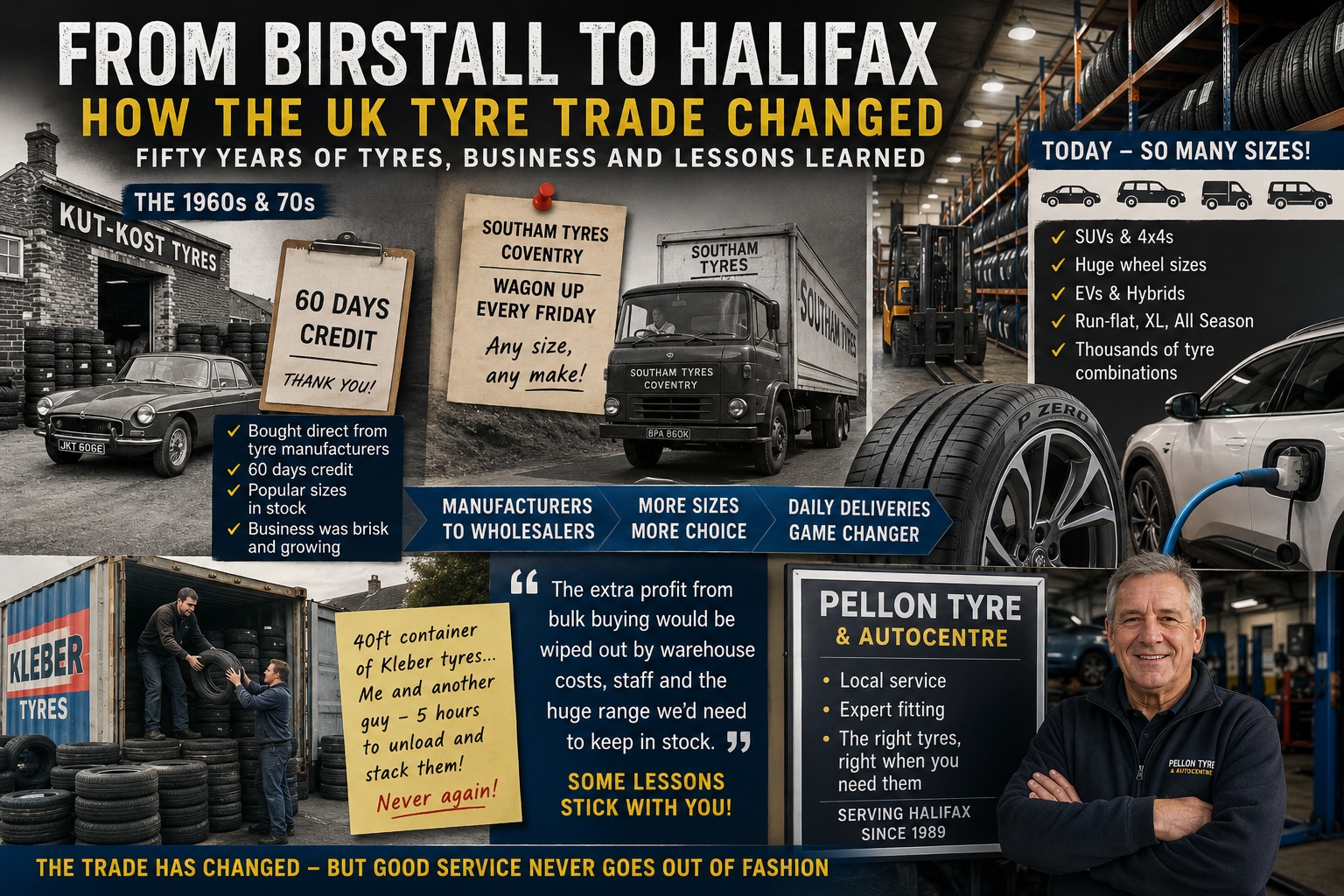
And it took me right back to my days running Kut-Kost Tyres at Birstall, near Leeds, long before Pellon Tyres came along.
The Tyre Trade Was Very Different in the 1960s and 70s
Back in the late 1960s and throughout the 1970s, the tyre trade was a very different world.
Independent tyre retailers like ourselves could develop good relationships directly with the major tyre manufacturers.
I knew many of the tyre representatives personally, and if you were doing reasonable business and paying your bills, manufacturers wanted your account.
One of the greatest advantages was credit.
We could often buy tyres directly from a manufacturer and receive around 60 days to pay for them.
For a young businessman trying to grow a tyre company, this was fantastic.
It effectively helped finance our stock without having to keep going cap in hand to the bank.
We would order the tyres, put them into stock and, because business was brisk, hopefully sell most of them before the manufacturer’s invoice became due.
The customers paid us.
We paid the tyre manufacturer.
And the profit helped us buy more stock and grow the business.
It was a simple system, but it worked.
We Didn’t Need Hundreds of Different Tyre Sizes: How the UK Tyre Trade Changed
There was another reason why this worked so well.
Cars were much simpler.
There simply weren’t the enormous number of tyre sizes and specifications that we have today.
We could identify our popular sizes and keep plenty of them in stock.
If you had the right tyres on the rack when the customer drove in, you got the sale.
Simple as that.
But the motor industry was beginning to change.
Car manufacturers were modernising their factories and design processes, and new models and variations were appearing increasingly quickly.
More cars meant more wheel sizes.
More wheel sizes meant more tyre sizes.
And gradually it became impossible for an independent tyre retailer to stock everything customers might ask for.
That created a massive opportunity for another part of our industry.
Along Came the Big Tyre Wholesalers
Tyre wholesalers weren’t entirely new, of course, but they were becoming increasingly important.
Names such as Reg Bond of Pocklington and Motorsave spring immediately to my mind from those days.
These businesses realised something very important.
Instead of every tyre depot attempting to carry every possible tyre, the wholesaler could carry the stock for all of us.
And then came the real game-changer.
Daily tyre deliveries.
Suddenly we didn’t need an unusual tyre sitting on our racks for six months, waiting for the right customer.
We could stock our fast-moving sizes and buy the less common tyres from the wholesaler when we actually needed them.
It was brilliant.
We were still growing as tyre retailers, but the wholesalers were growing even faster.
The wholesalers started buying from around the world. How the UK Tyre Trade Changed
As these tyre wholesalers became larger, their buying power increased enormously.
They weren’t buying twenty tyres here and fifty tyres there.
They could buy containers.
And increasingly those containers could come from tyre manufacturers and factories around the world.
The wholesaler could negotiate the large-volume buying price because they had something we independent tyre retailers didn’t have.
Scale.
They had the warehouses.
They had the staff.
They had the delivery vehicles.
Most importantly, they could spread a huge range of tyres across hundreds or thousands of customers.
That changed the economics of the tyre trade.
Southam Tyres Came Up From Coventry Every Friday
Another company I particularly remember was Southam Tyres in Coventry.
They would send a waggon up into Yorkshire every Friday.
We could order practically any size or make we required, and on Friday the waggon would arrive.
Think about that compared with today’s world.
There was no sitting at a computer and checking half a dozen suppliers in seconds.
No sophisticated online stock system showing thousands of tyres.
No next-morning internet ordering.
You built relationships with suppliers and their representatives.
You knew when the delivery waggon was coming.
And you organised your stock accordingly.
Friday meant the Southam waggon!
It was a completely different way of doing business.
Eventually, we bought more from the wholesalers. How the UK Tyre Trade Changed
As the wholesalers became better and their ranges became larger, something inevitably happened.
Our relationships with the tyre manufacturers gradually became less important.
Why buy fifty or a hundred of one tyre from a manufacturer when the wholesaler could sell you exactly what you needed?
If you wanted four of one size, two of another and six of something completely different, that wasn’t a problem.
The wholesaler had them.
Consequently, independent tyre retailers like ourselves gradually bought more and more of our stock through wholesale distribution.
Looking back, it was an enormous change in the structure of our industry.
At the time, though, we were simply getting on with running our businesses.
We Even Had a Go at Wholesaling Ourselves!
Of course, being ambitious young businessmen, we looked at what was happening and thought:
Why can’t we do a bit of wholesaling ourselves?
So we rented a small warehouse in nearby Morley.
In theory it sounded like a good idea.
Buy larger quantities.
Get a better price.
Sell some through our own tyre depot.
Wholesale the rest to other tyre dealers.
Easy!
Except it wasn’t.
The warehouse needed staffing.
The stock needed managing.
Tyres needed unloading, stacking and moving around.
Then you needed customers and deliveries.
All of these things cost money.
We were tyre retailers trying to run a wholesale operation on the side.
Eventually I realised that the cost and effort involved simply didn’t make enough sense.
But one particular episode remains firmly lodged in my memory.
The 40-Foot Container of Kleber Tyres: How the UK Tyre Trade Changed
At one point I bought a 40-foot container full of Kleber tyres.
It probably looked like a fantastic deal when I bought them.
Then the container arrived.
Somebody had to unload it!
That somebody turned out to be me and another poor bloke who probably wondered what he’d done to deserve it.
We started pulling tyres out.
And pulling tyres out.
And pulling more tyres out.
Every tyre had to be unloaded and then properly stacked in the warehouse.
It took the two of us about five hours.
By the time we reached the back of that container, I was absolutely shattered.
I remember thinking:
Never again!
And for many years, that was that.
Fast Forward Nearly Fifty Years
Then recently something rather strange happened.
I started looking at containers of tyres again.
There were some interesting prices available, particularly on larger premium tyre sizes.
The old tyre dealer inside me woke up!
I started doing the calculations.
If we bought direct in sufficient quantities, perhaps there was extra margin available.
And then I remembered my younger self unloading that container of Klebers.
But there was now an even bigger problem.
The modern tyre market has gone mad with sizes!
Modern cars have completely changed the equation. How the UK Tyre Trade Changed
Walk around a car park today and look at the wheels.
The variety is incredible.
We have small hatchbacks, large SUVs, crossovers, sports cars, vans, hybrids and electric vehicles.
Eighteen-inch wheels have become completely ordinary.
We regularly see 19, 20, 21 and 22-inch tyres.
Then it isn’t simply about tyre diameter.
We have different widths and profiles.
Different load indexes.
Different speed ratings.
XL reinforced tyres.
Run-flat tyres.
Then we have tyres developed or approved for particular vehicle manufacturers.
And now we have the continuing growth of electric vehicles.
Electric Cars Have Added Another Layer
EVs haven’t created all this complexity by themselves, but they have certainly added another dimension.
Electric cars can be considerably heavier because of their battery packs.
They can also produce enormous amounts of torque immediately.
Tyre manufacturers have therefore developed products designed to cope with these characteristics, including different load capabilities, compounds and constructions.
Add these to all the tyres already required by petrol, diesel and hybrid vehicles, and the number of possible combinations becomes enormous.
I looked at it and thought:
We’d need a warehouse the size of Halifax to stock everything!
A Cheap Tyre Isn’t Cheap If It Sits There for Three Years
And this is the part that matters when you’re running a business.
Let’s say I can save a substantial amount per tyre by purchasing a container.
On paper that looks like extra profit.
But what happens if I sell only some of them quickly?
The rest are sitting on my warehouse racks.
I’ve already paid for them.
That money is tied up.
Then I need the building to store them.
I need insurance.
Business rates may be involved.
Lighting and other running costs have to be paid.
Somebody has to unload the tyres.
Somebody has to stack them.
Somebody has to manage the stock.
And eventually somebody has to sell them.
Suddenly that fantastic container price isn’t looking quite so fantastic.
We Have a Massive Wholesaler Just Down the Road! How the UK Tyre Trade Changed
Then came the final part of my little journey back into tyre wholesaling.
We have major tyre distribution facilities only a few miles from us.
And that made me think.
Why on earth would I try to recreate their warehouse at Pellon?
They carry an enormous selection of tyres.
They employ the warehouse staff.
They operate the distribution system.
They carry the cost of having slower-moving tyre sizes sitting on racks.
And we can concentrate on what Pellon Tyre and Autocentre has always been good at.
Looking after our customers.
Perhaps the Wholesalers Were Right All Along
It made me smile when I finally put all this together.
Nearly fifty years ago, tyre wholesalers grew because independent retailers couldn’t possibly stock every tyre motorists were beginning to need.
I recognised that and started buying more from them.
I even tried wholesaling myself and eventually decided it wasn’t really for me.
Then, almost half a century later, I found myself looking at another 40-foot container of tyres!
Some things never change.
But fortunately age and experience occasionally teach us something.
I remembered the Kleber container.
I remembered the Morley warehouse.
I remembered the staff costs.
And then I looked at the incredible number of modern tyre sizes we deal with today.
Eric, you’ve learned this lesson once already!
From Birstall to Halifax – I’ve Watched the Tyre Trade Change
I’ve been fortunate enough to experience an extraordinary period in the British motor trade.
From Kut-Kost Tyres at Birstall in the days when we bought directly from tyre manufacturers on 60-day accounts, through the growth of the great tyre wholesalers, and eventually to Pellon Tyre and Autocentre here in Halifax.
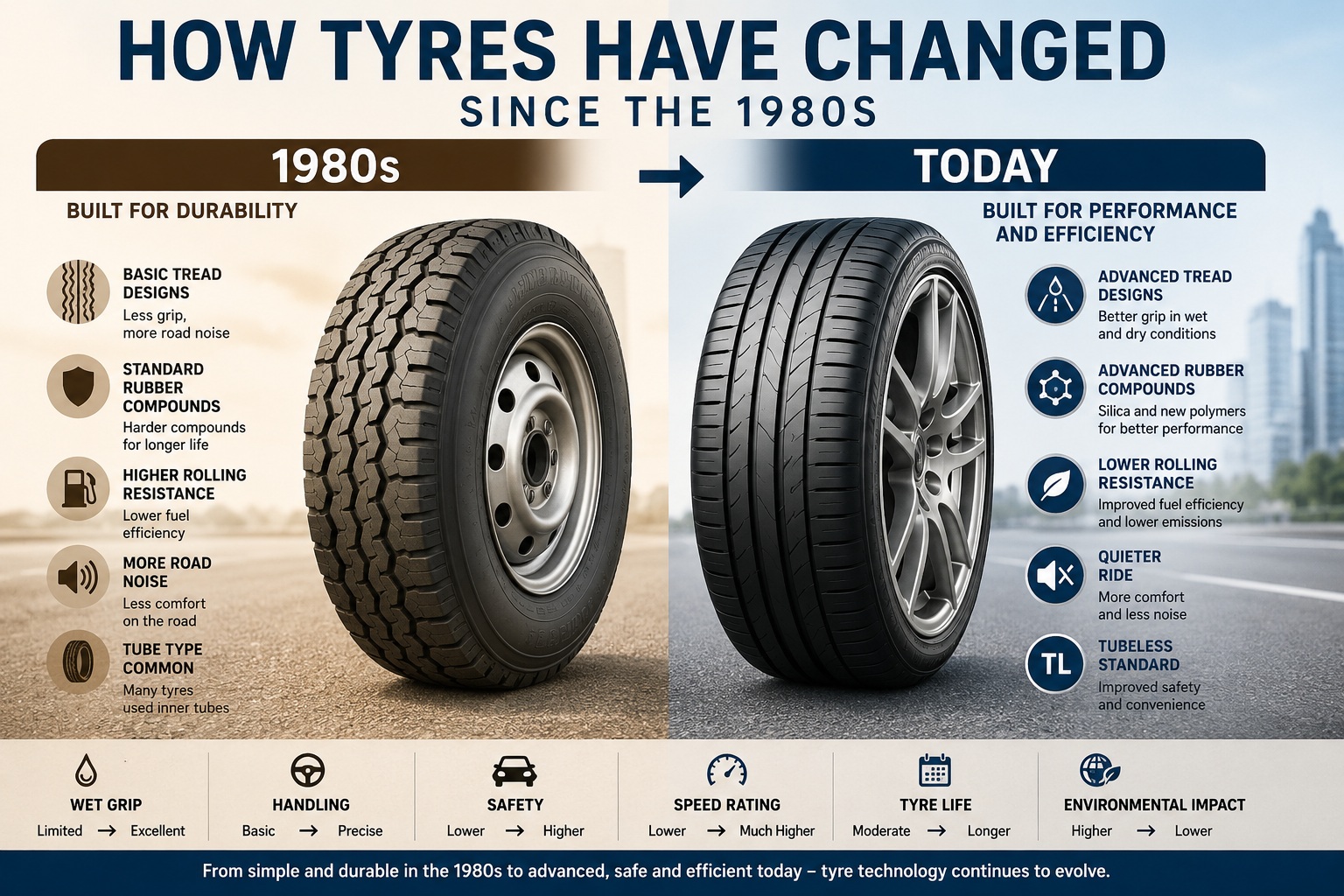
I’ve watched steel-belted radial tyres become commonplace.
I’ve watched wheel sizes grow enormously.
I’ve seen run-flat tyres arrive, followed by increasingly sophisticated winter and all-season products.
I’ve seen SUVs take over our roads.
Now we’re watching electric vehicles create yet another generation of tyre technology.
And throughout all those changes, one basic business lesson has remained remarkably consistent.
You don’t necessarily make more money simply because you buy something cheaper.
The true cost includes storing it, handling it, financing it and eventually finding somebody who wants to buy it.
Stick to What You’re Good At: How the UK Tyre Trade Changed
So am I going back into importing containers of tyres?
I don’t think so!
The young Eric might have seen the buying price and jumped straight in.
The older Eric remembers spending five hours unloading that container of Kleber tyres!
Today I’m quite happy to let the enormous tyre wholesalers carry thousands upon thousands of different tyres in their warehouses.
We’ll keep sensible stocks of the tyres we know we’re going to sell and use the tremendous distribution network that the modern tyre industry has built around us.
Then Pellon Tyres can concentrate on being a tyre retailer and garage, which is what we’ve successfully done here in Halifax since 1989.
Sometimes progress means embracing the latest technology.
And sometimes progress simply means remembering a lesson you learned fifty years ago.
Although I must admit…
For a few days there, I was rather tempted by that container!