ABS Braking Systems Today
Table of Contents
ABS Braking Systems Today
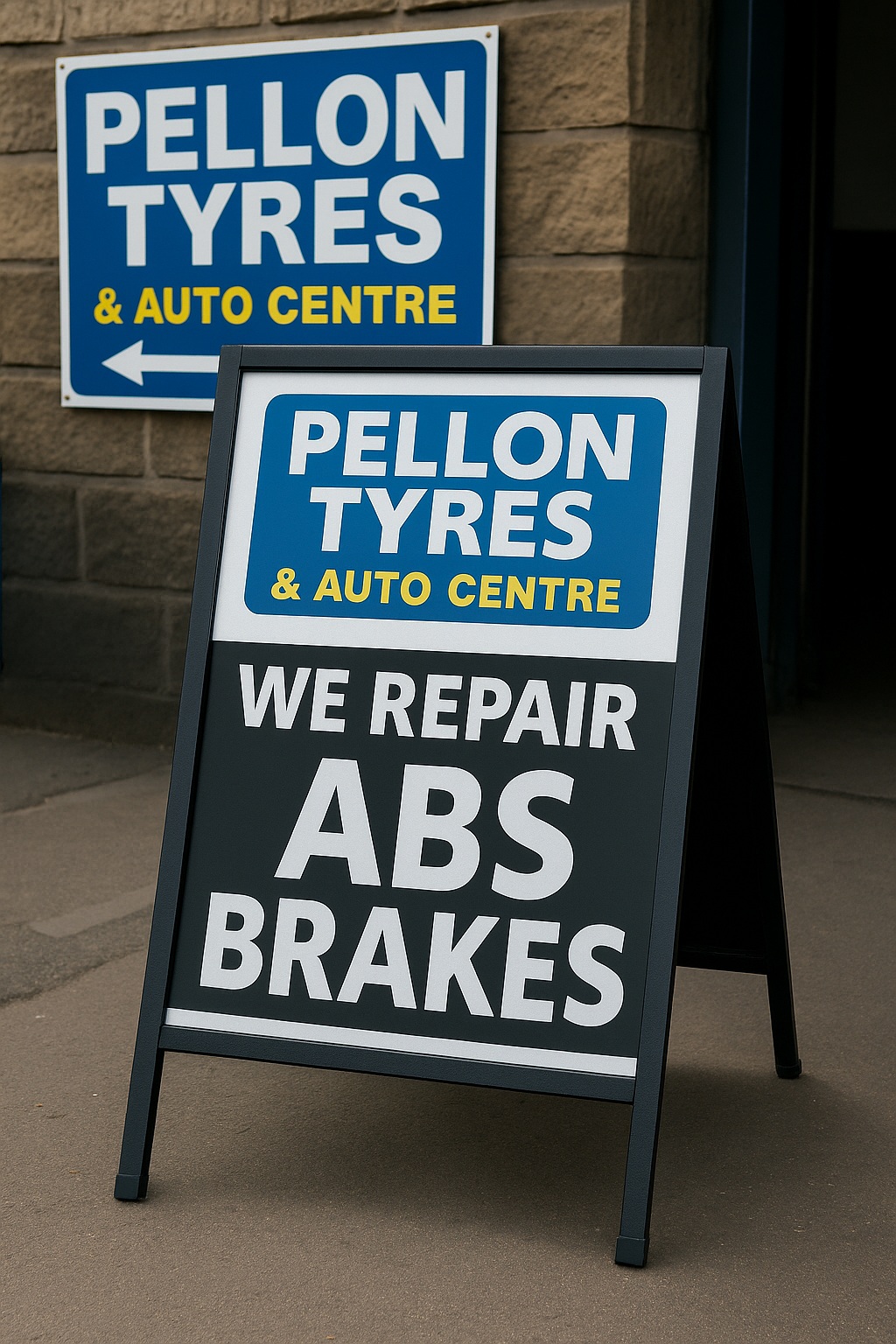
ABS Braking Systems Today—How Modern Cars Keep You Safe on the Road
When ABS braking systems first appeared on mainstream cars, most drivers thought they were a bit of a gimmick. These days they’re an essential part of a car’s safety system, working quietly in the background every time you hit the pedal. Yet many drivers still aren’t sure how ABS actually works or what affects its performance. As someone who sees brake issues, tyre wear, and ABS faults every single week at Pellon Tyres in Halifax, I thought it was time to take a closer look.
What ABS Actually Does: ABS Braking Systems Today
ABS (Anti-lock Braking System) is designed to stop your wheels from locking when you brake hard. Locking wheels means skidding, and skidding means zero steering control.
ABS steps in by rapidly pulsing the brake pressure on each wheel—far quicker than a human could pump the pedal—so the wheels keep turning just enough to maintain grip.
In real terms this gives you two big advantages:
You can steer while braking, avoiding hazards.
Your car often stops quicker and in a straight line on most road surfaces.
In today’s traffic, that can easily be the difference between a near miss and a major accident.
Modern ABS – Smarter, Faster, and Linked to Other Systems
Today’s ABS isn’t a standalone gadget. It’s linked to a whole host of systems:
Traction control, preventing wheel spin
Electronic Stability Control (ESC), keeping the car stable in a skid
Brake Force Distribution, balancing braking across all wheels
Automatic Emergency Braking on newer cars
The wheel-speed sensors and control units are far more accurate than they used to be, and modern systems can monitor individual wheel grip in milliseconds.
Even electric cars rely heavily on ABS integration to work alongside regenerative braking, so the system has become more important than ever.
When ABS Can Feel Different: ABS Braking Systems Today
Most of the time ABS gives you shorter stopping distances, but there are situations where you’ll feel it working harder:
Loose gravel and deep snow—a locked wheel can dig in, so ABS may take slightly longer to stop, but it gives you steering control.
Polished ice—ABS prevents total lock-up, but grip is still almost zero.
Big mismatches in tyres — worn, mixed, or cheap tyres confuse the sensors and reduce efficiency.
That last point is a big one — because your tyres and your ABS are a team, and if the tyres can’t grip, ABS can’t do its job properly.
Tyres and ABS: Why the Right Rubber Matters
ABS relies on the tyres maintaining contact with the road. That means:
Good tread depth
Correct tyre pressures
Correct tyre size (especially on cars with fancy electronics)
Matching tyres on each axle
At Pellon Tyres in Halifax, we regularly see cars where the ABS is fighting a losing battle because the tyres are poor quality or badly worn. Regular checks, wheel alignment, and choosing a proper brand — not the nameless budget stuff — make a huge difference.
If you drive in winter or spend time on hilly Yorkshire roads, you’ll feel the benefit of fitting a quality all-weather or winter tyre, which gives the ABS system the grip it needs in bad conditions.
Looking After Your ABS System: ABS Braking Systems Today
ABS systems are reliable but not indestructible. Here’s what to keep an eye on:
ABS warning light on your dashboard — don’t ignore it
Corroded or damaged wheel-speed sensors
Broken wiring after pothole impacts Incorrect tyre sizes confusing the readings
Low brake fluid
If your ABS light is on, your car will still brake—but without the safety net. It’s worth popping into Pellon Tyres for a quick check rather than risking an emergency.
ABS Braking FAQ: ABS Braking Systems Today
1. Does my car fail its MOT if the ABS light stays on?
Yes. If the ABS warning light is illuminated, the car will fail its MOT because the system is classed as a major safety feature.
2. Is ABS supposed to buzz or vibrate when it activates?
Yes. A pulsing feeling through the pedal is normal — it means the ABS is kicking in and preventing wheel lock.
3. Can worn tyres affect how well the ABS works?
Absolutely. Low tread, uneven wear, or cheap part-worn tyres can all stop ABS from gripping properly on wet roads.
4. Is it safe to drive with the ABS light on?
The car may still brake normally, but the anti-lock function isn’t working. Braking distance increases, especially in wet weather.
ABS Matters More in Halifax Than You Might Think
With our steep hills, tight back roads, and long wet spells, ABS plays a huge part in stopping safely. Whether you’re coming down Boothtown Road in the rain or braking on black ice towards Sowerby Bridge, a properly working ABS system can make the difference between a clean stop and a collision.
Why Choose Pellon Tyres?
- Honest, down-to-earth service you can trust
- Fast turnaround on all ABS brake repairs
- Expert technicians with decades of experience
- High-quality parts at sensible Yorkshire prices
- Local, friendly, and always happy to help
- Lucas Premium Batteries
- Change wipers during drier months
- Hyundai Drive Rubbers Replaced
- Heat Causes More Tyre blowouts
- Dishonest MOT testers
Need tyres or brake repairs in Halifax? Call Pellon Tyres on 01422 35314 or visit us on Pellon Lane.