Wheel Balancing is Important
Table of Contents
Wheel Balancing is Important
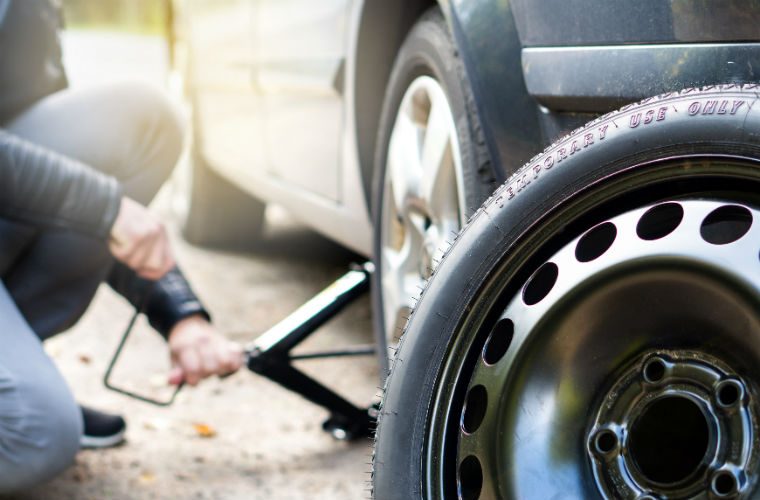
Wheel Balancing is Important
Wheel balancing is important because it keeps your tyres, bearings, and suspension system in order.
Source: affordableautohopkins.com
This is a short but to-the-point article about the importance of having your wheels balanced. So, it is something that we in the tyre trade keep harping on about, but nevertheless, it is important. Most of us have witnessed our wheels out of balance and having wheel wobble problems. Mainly when the steering wheel starts shaking while driving down the motorway.
https://www.pellonautocentre.com/centrelesswheels.htm
Wheel balancing will give you a better ride – Wheel Balancing is important.
Balancing is one of the things in motoring terms that we take for granted. When I first started working in the tyre industry, we had a small piece of equipment. That we would use to balance the wheels whenever we fitted a new tyre.
This was known as a bubble balancer, and that is exactly what it was. You would sit with a wheel on top of the balancer and a bubble. Similar to the ones in a spirit level. This would tell you when the wheel was out of balance by the tilt on the wheel and we had to counteract this at the opposite side by adding lead weights.
When the wheel was level and the bubble was dead central, the job was done, and the wheel was fitted onto the car. The cars in those days were things like Ford Poplars and Morris 1000s and so did not travel very far or go very fast.
The Sit on Balancer was our first electric balancer. Wheel Balancing is Important
There are different types of out of balance, “static balance”, and vertical shaking that can come from a heavy spot on the tyre. This is what we would try to cure on our bubble balancer. This could also be cured on the next machine that came into use.
The machine was a sit-on machine known as an on-car wheel balancing machine made by “Repco”, and we would jack up the car, put the machine against the car wheel, and we would then spin the electrically driven machine up to high speed. While the wheel was spinning, a strobe light would make it look like the wheel was in a still position. We would then stop the machine with a type of brake and put a counterbalance weight on the wheel depending on where the tyres valve could be seen.
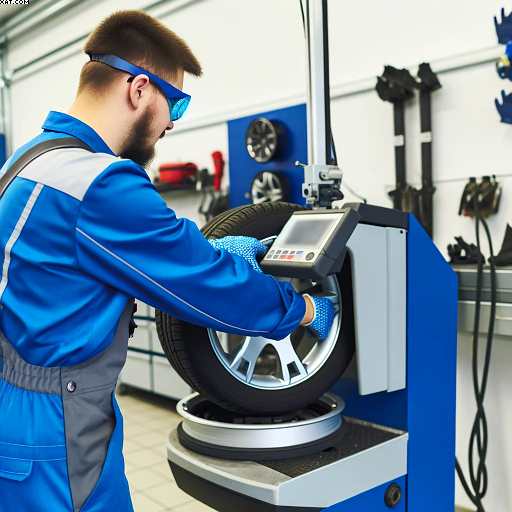
This method of balancing was horrific. Wheel Balancing is Important
The older guys in the industry. Will remember the fact that the wheels would shake violently. Then the vibrations would shake the cars to bits. Of course, whilst the poor customer looked on with terror in his eyes. This reminds me of the “roller brake tester” used on the modern MOT test. When the car gets shaken to bits, have a brake test.
This method of balancing was not for the faint-hearted, and I was glad to see the back of them.
The next set of wheel balancers were the forerunners to today’s sophisticated machines. We would put the wheel on a spindle and spin it by hand. These balancers would correct “static”
and “dynamic” out of balancing. The modern wheel balancer is equipped with many sensors and can pick up balancing problems at high and low speeds. These are necessary for today’s high-speed cars and, of course, give the car drivers a smooth ride (that’s if your wheels are balanced, of course).
On a regular basis, in my opinion, is at least once a month. Most members of one of the independent tyre organisations will check your wheel alignment and wheel balancing for free and will only charge you if the car is out of alignment and requires adjusting.
Wheel Balancing is part of having a new tyre fitted
Of course, today wheel balancing is important, and we balance your wheels as a matter of fact when you buy new tyres or have a puncture repaired. So, if you need a wheel balance just as a matter of fact and your steering wheel starts to shake at, say, 50 mph, then this is because you may have lost a balance weight or your tyre has become out of shape due to, perhaps, a “slipped belt”, which can be caused by a nail or screw damaging the steel belt in your tyre, putting the tyre out of shape and causing the wheel to be out of balance.
Finally, another thing that can give you a similar experience is if your wheel bearing has gone. Pellon Tyre and Auto-centre offers car and van servicing and repairs to all makes of vehicles.
2025 History of Wheel Balancers Throughout My Career in the tyre trade
A Brief History of Wheel Balancers – From the Early Days to the Digital Age
Wheel balancing is one of those garage jobs most drivers don’t think twice about today, but anyone who’s been in the motor trade as long as you and I knows it wasn’t always this simple. Modern digital balancers can pinpoint an imbalance down to the exact gram, yet back in the early days it was a very different world — more guesswork, more vibration, and more customers coming back complaining their steering wheel was dancing about at 50 mph.
I still remember when the first proper balancing machines started appearing in British garages. They were big, noisy, and almost agricultural compared with the sleek electronic kit we have now. But by heck, they changed everything. Let’s take a look at how the technology has evolved over the years.
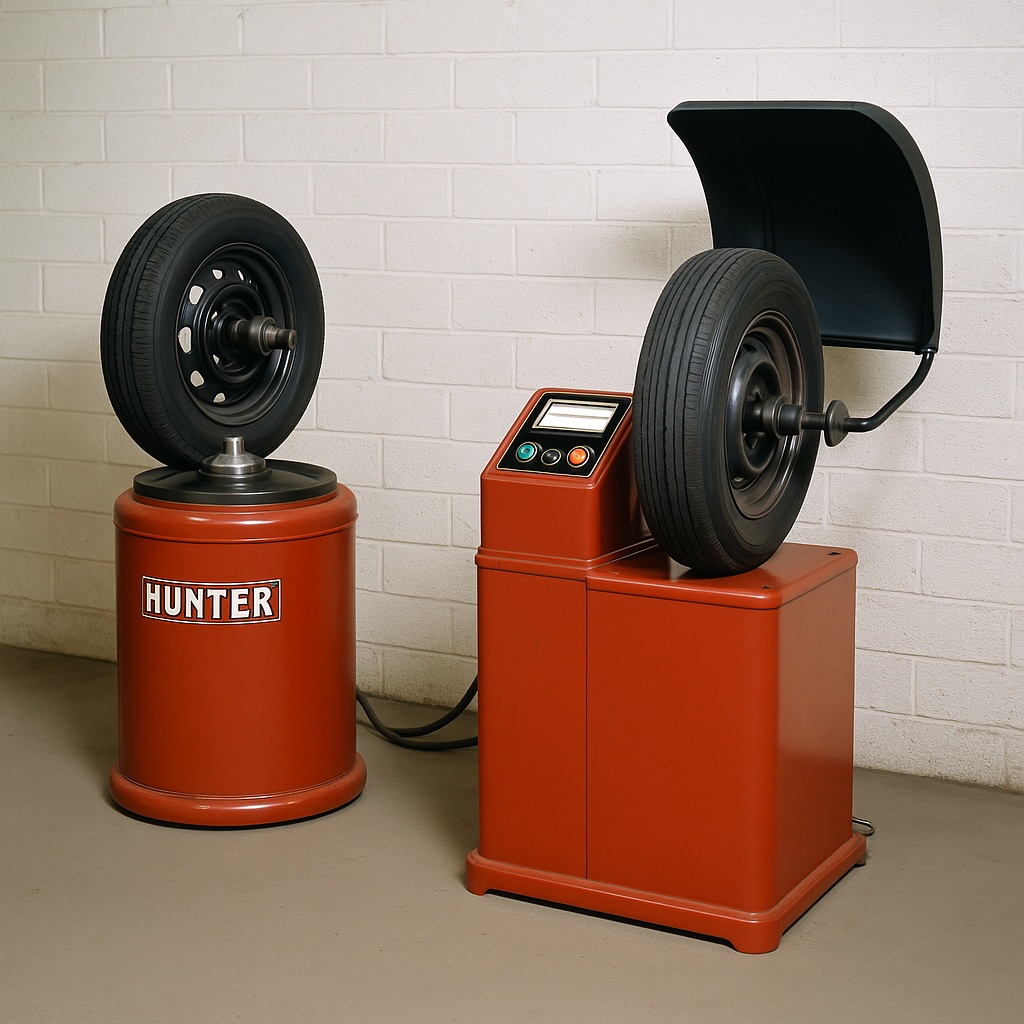
The Early Days – Static Balancing and Bubble Balancers: Wheel Balancing is Important
Before electronic machines became common, garages relied on static balancing. Tyres were mounted on a spindle and placed on a simple balancing stand — if one side dipped, that’s where the weight needed to be added.
Then came the famous “bubble balancer”. Every older mechanic will remember these: a flat circular plate with a spirit-level-style bubble in the middle. You’d place the wheel on the plate and watch where the bubble shifted. It wasn’t perfect, but it was miles better than nothing, and for the slower, narrower tyres of the 1950s and 60s it did the trick.
Of course, once cars started going faster and tyres got wider, this old kit began to struggle. Drivers complained of vibration at speed — especially on the new motorway network — and that pushed the industry to invent something better.
The Arrival of Dynamic Wheel Balancers (1970s–1980s)
This is where things really changed. When dynamic wheel balancers first arrived in UK garages, it felt like stepping into the future. These early machines spun the wheel at speed and measured both static and dynamic imbalance — meaning they could tell whether the wheel needed weights on the inside, outside, or both.
You’ll remember the noise they made — a proper whirring roar as the wheel came up to speed, then that distinctive “beep” while you waited for the dial or lights to settle. They weren’t always accurate, and some needed adjusting more often than a carburettor, but they were a revelation at the time.
For garages like ours, dynamic balancing meant happier customers, fewer comebacks, and far better road manners on everything from Ford Cortinas to Vauxhall Cavaliers.
The Digital Revolution (1990s–2000s)
By the time the 1990s rolled in, tyre technology was moving fast. Low-profile tyres, alloy wheels, bigger rims — they all demanded better balancing.
This is when fully digital wheel balancers started appearing.
- Electronic sensors replaced mechanical gauges
- Digital readouts told you exactly where to place the weights
- Self-calibration made the machines more accurate
- Spin times were quicker and far less noisy
These machines were a huge leap forward for garages. Instead of relying on the “feel” of the machine or a mechanic’s experience, the computer handled the technical bits, leaving the fitter to do the job quickly and accurately.
At Pellon Tyres, these machines soon became the beating heart of the workshop — especially as more drivers moved to alloy wheels and wider tyres that really showed up imbalances.
Modern Wheel Balancers – Precision for Today’s Cars: Wheel Balancing is Important
Today’s balancers are a different world altogether. Modern equipment includes:
- Laser positioning systems
- Automatic weight placement indicators
- Road-force simulation (to detect tyre deformities)
- On-screen diagnostics
- High-speed spin accuracy
Cars now run at higher speeds, with advanced suspension systems, driver-assist features and ultra-low-profile tyres. Even a slight imbalance can cause:
- Uneven tyre wear
- Steering shake
- Dashboard rattles
- Poor fuel economy
Which is why today’s equipment needs to be bang-on accurate.
The latest balancers don’t just balance wheels — they detect rim damage, tyre imperfections, and even advise tyre rotation patterns. Things have come a long way since the bubble balancer on a wooden bench!
From the Old Days to Today – A Mechanic’s Perspective
For those of us who’ve been around the trade since the early 1970s, it’s been fascinating to watch the progression. From the early days of static balancing and bubble plates to the digital accuracy of today, wheel balancing has quietly become one of the most important jobs in a garage.
The customers rarely see the magic behind the scenes, but they certainly notice the difference when it’s not done right. And garages like Pellon Tyres take pride in doing it properly — with the right equipment, the right training, and the right Yorkshire attitude of “let’s get it sorted”.