The Disappearing Spare Wheel
Table of Contents
The Disappearing Spare Wheel
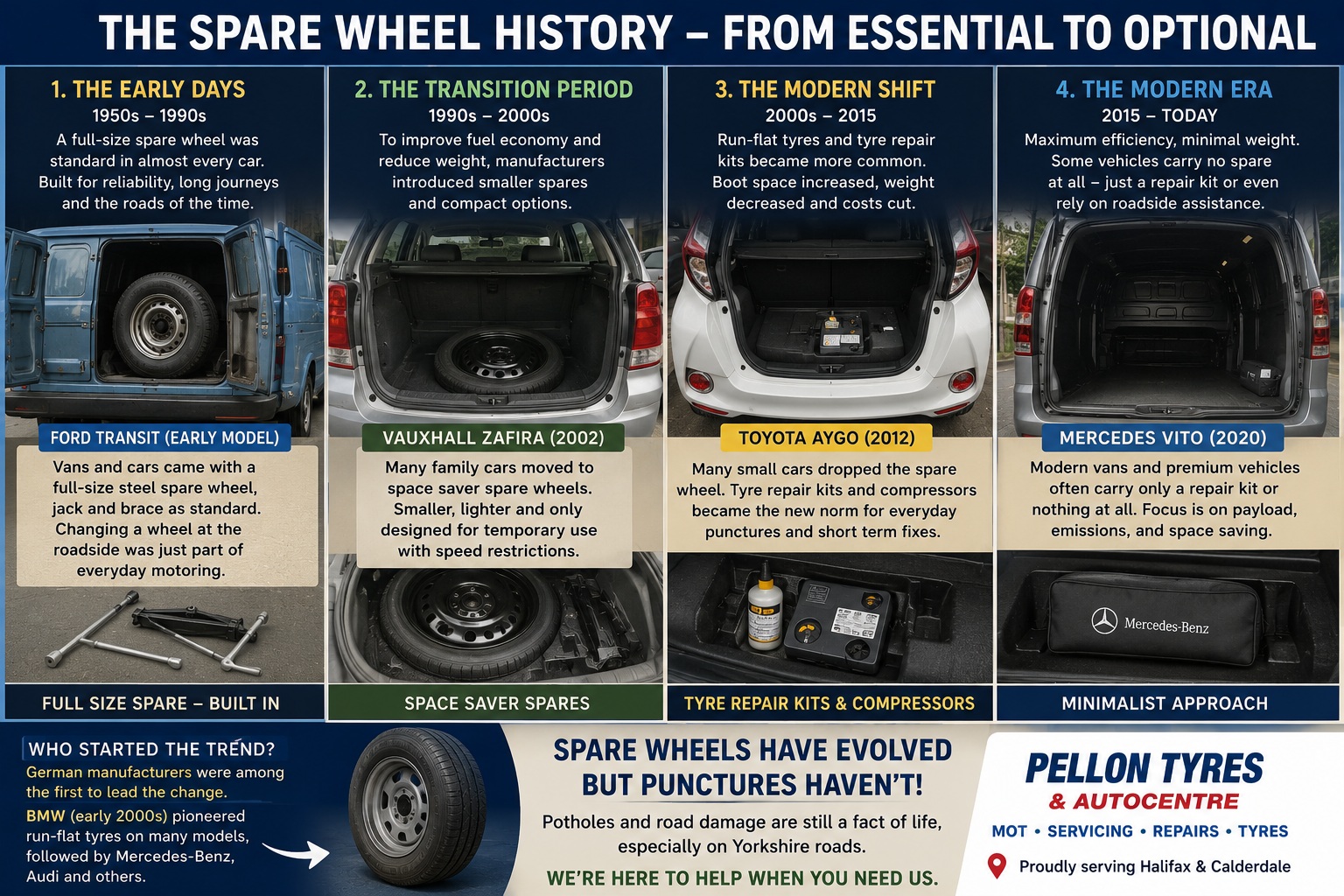
The Disappearing Spare Wheel
The Disappearing Spare Wheel – Why Modern Cars No Longer Carry One
One thing that still surprises many motorists visiting Pellon Tyre and Autocentre is discovering that their car does not actually have a spare wheel at all.
Over the years at Pellon Tyres, we have seen increasing numbers of drivers arrive after suffering a puncture only to discover there is no proper spare wheel hidden under the boot floor. Instead, many modern vehicles now come equipped with:
- tyre inflation kits
- cans of tyre sealant
- space-saver wheels
- or sometimes nothing more than a compressor
For older motorists especially, this still feels strange because for decades a spare wheel was simply part of every car.
So why did manufacturers start removing them, and which vehicles helped begin the trend?
When Every Car Carried a Spare Wheel
For many years, carrying a full-size spare wheel was considered completely normal.
Drivers travelling around Yorkshire in the 1960s, 70s and 80s would rarely think twice about it. Whether you were driving across the Pennines towards Lancashire or heading into the Yorkshire Dales, the spare wheel was simply there in case of trouble.
Back then punctures were also much more common than they are today.
Roads around Halifax and Calderdale were often rougher, and older tyres were far more vulnerable to damage from the following:
- potholes
- sharp stones
- worn road surfaces
Many motorists even carried:
- spare inner tubes
- tyre levers
- jacks
- repair kits
Changing a wheel at the roadside was simply part of motoring life.
So Who Started Removing Spare Wheels? The Disappearing Spare Wheel
The gradual disappearance of the spare wheel began during the late 1990s and early 2000s.
European car manufacturers were among the first to heavily reduce spare wheel provision, mainly to:
- reduce vehicle weight
- improve fuel economy
- lower emissions
- create more boot space
- cut manufacturing costs
One of the early trends came from German manufacturers including BMW and Mercedes-Benz, who increasingly fitted run-flat tyres instead of conventional spare wheels.
Run-flat tyres were designed to allow drivers to continue travelling for a short distance after a puncture without immediately stopping.
Soon afterwards, many mainstream manufacturers followed the same approach.
Cars Commonly Supplied Without Proper Spare Wheels
Today, many vehicles are supplied with either a temporary repair kit or a small emergency inflation compressor.
Some well-known examples include:
- Ford Fiesta
- Volkswagen Golf
- BMW 3 Series
- MINI Hatch
- Nissan Qashqai
- Tesla Model 3
Electric vehicles in particular rarely carry spare wheels because manufacturers want to maximise battery space and reduce weight wherever possible.
Some premium vehicles now rely entirely on tyre repair foam and roadside assistance services.
The Problem with Tyre Inflation Kits: The Disappearing Spare Wheel
While tyre inflation kits can sometimes work for small punctures, they are far from perfect.
At Pellon Tyres, we regularly see situations where:
- sidewall damage cannot be repaired
- large punctures defeat the sealant
- compressors fail to inflate the tyre properly
- tyre foam creates a mess inside the tyre
Unfortunately, once sealant has been used, some tyres become impossible to repair safely afterwards.
This can turn what may have been a simple puncture repair into a complete tyre replacement.
Yorkshire Roads and Pothole Problems
The disappearance of spare wheels becomes even more frustrating on roads around Halifax and Calderdale.
Steep hills, rough road surfaces and potholes can cause sudden tyre damage that no inflation kit can fix.
We regularly see:
- split tyre sidewalls
- cracked alloy wheels
- damaged low-profile tyres
- blowouts caused by potholes
In these situations, a proper spare wheel would often get the motorist safely home.
Without one, many drivers now rely completely on recovery services.
Space Saver Wheels – Better Than Nothing: The Disappearing Spare Wheel
Some manufacturers still provide space-saver spare wheels.
These smaller emergency wheels are designed purely for temporary use and usually carry speed restrictions.
Although not ideal, they are often far more useful than sealant kits, especially in rural areas where mobile signal or roadside recovery may be limited.
Many motorists around Yorkshire still prefer having some form of physical spare wheel available, particularly when travelling long distances.
Why Manufacturers Continue the Trend
Despite complaints from motorists, spare wheels continue disappearing for several reasons.
Manufacturers remain focused on:
- reducing emissions
- improving fuel economy
- lowering production costs
- increasing luggage space
- reducing vehicle weight
Modern tyre technology has also improved significantly, meaning punctures are generally less common than years ago.
However, when punctures do happen, many drivers suddenly realise how much they miss having a spare wheel.
Some drivers are buying spare wheels separately. The Disappearing Spare Wheel
One growing trend we now see at Pellon Tyres is customers purchasing spare wheel kits after buying the vehicle.
Many motorists simply feel more comfortable knowing they have the following:
- a jack
- wheel brace
- proper spare wheel
especially when travelling longer distances or driving in more remote parts of Yorkshire.
Some vehicles are even designed with hidden spare wheel wells despite no spare wheel actually being supplied by the manufacturer.
The Future of Spare Wheels
As electric vehicles and hybrid cars continue growing in popularity, spare wheels may become even rarer.
Manufacturers are increasingly relying on:
- advanced tyre technology
- roadside assistance packages
- run-flat systems
- tyre monitoring systems
Whether motorists fully accept the disappearance of the spare wheel remains another question entirely.
Many drivers still feel reassured knowing a proper spare wheel is sitting safely in the boot.
Final Thoughts: The Disappearing Spare Wheel
The disappearance of the spare wheel is one of those motoring changes many people barely noticed until they actually suffered a puncture.
What once seemed a basic part of every vehicle has quietly disappeared from many modern cars.
Here in Halifax and Calderdale, where rough roads and potholes remain a constant problem, many motorists still prefer the old-fashioned reassurance of carrying a spare wheel.
At Pellon Tyre and Autocentre, we continue helping customers deal with punctures, tyre damage and the modern reality of cars arriving with no spare wheel at all.