Goodyear Tyres Use Rice Husks
Goodyear Tyres Use Rice Husks
Table of Contents
Goodyear Tyres Use Rice Husks
Goodyear Tyres and Rice Husks – How an Agricultural Waste Product Is Helping Build Better Tyres
The tyre industry has changed beyond recognition during my lifetime. When I first entered the motor trade more than sixty years ago, tyre manufacturing was largely about producing strong, durable tyres that would last as long as possible. Environmental concerns were rarely discussed, and few people gave much thought to where the raw materials came from.
Fast forward to today, and things are very different.
Modern tyre manufacturers are constantly searching for new ways to improve performance while reducing their impact on the environment. One of the most fascinating developments I’ve come across is Goodyear’s research into using rice husks as an alternative source of silica – a vital ingredient in modern tyre production.
At first glance, it sounds almost unbelievable.
What on earth have rice fields got to do with the tyres on your family car?
As it turns out, quite a lot.
What Are Rice Husks? Goodyear Tyres Use Rice Husks
Rice is one of the world’s most important food crops, with millions of tonnes harvested every year across Asia and many other parts of the world.
Once the grains have been removed, the outer protective covering – known as the rice husk – is left behind.
For many years these husks were simply regarded as agricultural waste. Huge quantities were either burnt or disposed of in landfill.
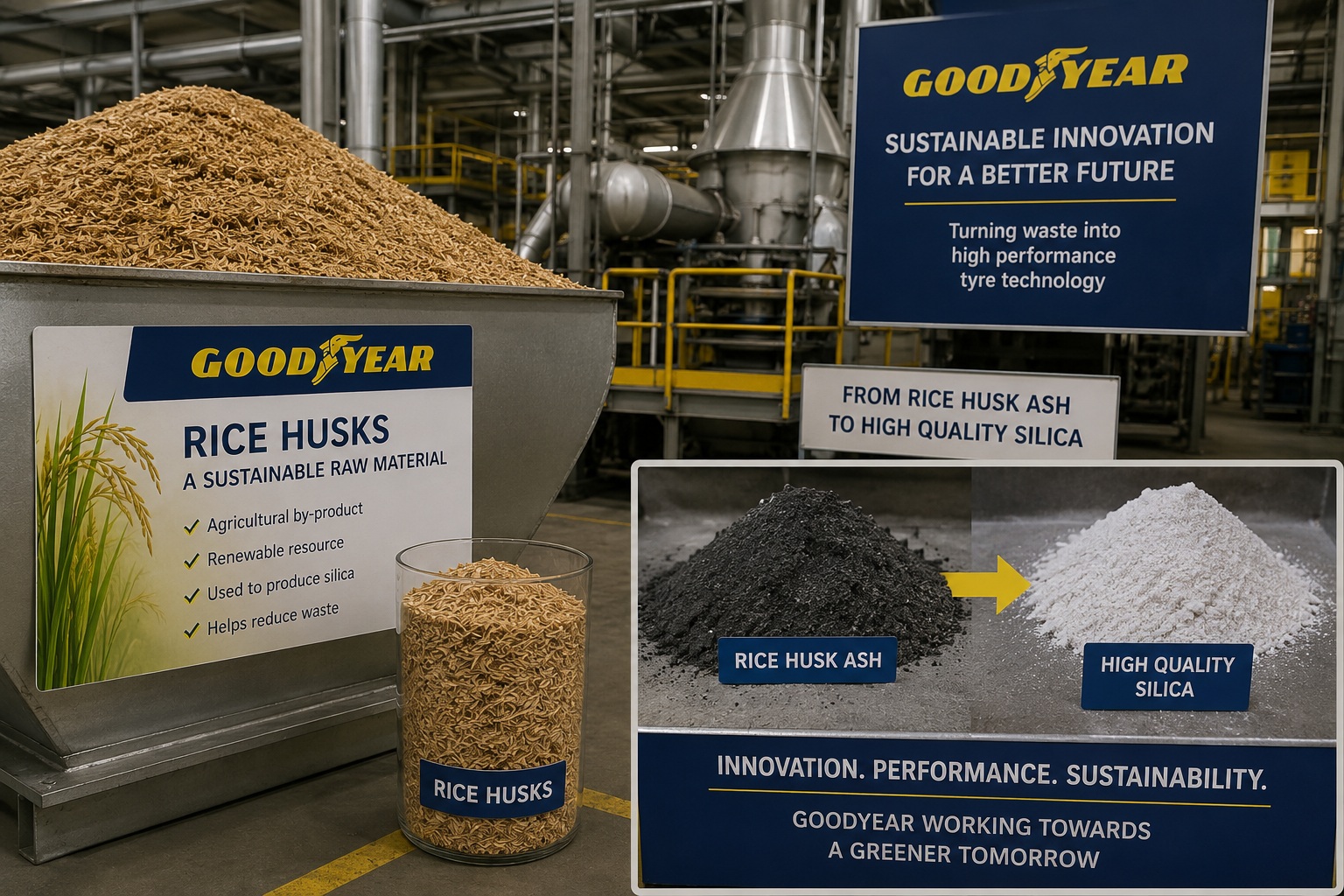
However, engineers soon discovered that when rice husks are burned under carefully controlled conditions, the ash contains large amounts of high-quality silica.
Instead of allowing this valuable material to go to waste, Goodyear began investigating whether it could be used in tyre manufacturing.
Why Is Silica So Important?
Many motorists have probably never heard of silica, but it’s one of the most important ingredients in a modern tyre.
Silica is blended into the rubber compound to improve several key areas of performance.
It helps tyres grip the road more effectively, particularly in wet weather. It also reduces rolling resistance, which means your engine doesn’t have to work quite as hard to keep the vehicle moving.
Lower rolling resistance can improve fuel economy in petrol and diesel vehicles and help electric vehicles travel further on a single charge.
Silica also improves durability, helping tyres remain flexible over a wide range of temperatures while extending their service life.
That’s why virtually every premium tyre manufacturer now uses sophisticated silica compounds in many of their products.
Turning Waste into Something Valuable: Goodyear Tyres Use Rice Husks
This is the part of the story that I find particularly impressive.
Rather than mining more natural resources, Goodyear has looked at a waste product that already exists in enormous quantities.
Rice husk ash can be processed to produce high-quality silica suitable for tyre manufacturing.
It is a classic example of the circular economy in action – taking something that was once thrown away and transforming it into a valuable raw material.
Not only does this reduce waste going to landfill, but it also lessens the demand for traditional silica production.
Everyone benefits.
Goodyear’s Long History of Innovation
Goodyear has never been a company afraid to try new ideas.
Over the years they have introduced countless innovations designed to improve tyre safety, durability and fuel efficiency.
Another excellent example was their development of soybean oil technology, replacing millions of gallons of petroleum-based oils traditionally used in tyre compounds.
Using soybean oil helps tyres remain more flexible over a wider range of temperatures while reducing dependence on fossil fuel-based materials.
It’s encouraging to see one of the world’s largest tyre manufacturers continuing to invest heavily in sustainable technology.
Cleaner Factories Than Ever Before: Goodyear Tyres Use Rice Husks
One thing I’ve noticed during my own career is just how dramatically tyre manufacturing has changed.
Over the years I’ve been fortunate enough to visit several tyre factories, including Goodyear’s impressive manufacturing facilities.
Many years ago tyre factories were often dark, noisy places where environmental standards were nowhere near what they are today.
Modern tyre plants are completely different.
The factories are bright, incredibly clean and highly automated. Environmental controls are strict, waste is carefully managed and recycling plays a much bigger part in everyday production.
People are often surprised when I tell them you could almost eat your dinner off the floor in many modern tyre factories!
That says a great deal about how far the industry has progressed.
What Does This Mean for UK Drivers?
Although we don’t grow rice here in Yorkshire, developments like these still benefit British motorists.
Every improvement in tyre technology has the potential to deliver:
- Better wet weather grip.
- Improved fuel economy.
- Lower rolling resistance.
- Longer tyre life.
- Reduced environmental impact.
As garages like Pellon Tyres fit thousands of tyres every year, it’s exciting to see manufacturers continually finding new ways to make their products both safer and greener.
Tyre Technology Never Stands Still: Goodyear Tyres Use Rice Husks
Many people assume that tyres are simply round pieces of black rubber.
In reality, they are among the most technically advanced components fitted to any vehicle.
Modern tyres contain dozens of carefully engineered materials working together to deliver grip, comfort, safety and efficiency.
Manufacturers continue researching renewable materials, recycled compounds and environmentally friendly production methods that would have been unimaginable when I first started fitting tyres all those years ago.
Looking Towards the Future
As someone who has spent a lifetime in the tyre industry, I find these developments genuinely fascinating.
The tyre trade has given me a wonderful career and allowed me to witness enormous changes in vehicle technology.
Who would have imagined, sixty years ago, that agricultural waste from rice fields on the other side of the world could one day help produce the tyres fitted to family cars here in Halifax?
It just goes to show that innovation can come from the most unexpected places.
Here at Pellon Tyres, we’re proud to supply quality tyres from manufacturers that continue investing in safer, cleaner and more sustainable technology.
Whether it’s Goodyear, Michelin, Continental, Falken or many of the other leading brands we supply, one thing is certain – tyre technology will continue to evolve, making our journeys safer, more economical and kinder to the environment.
The next time you’re driving through the beautiful countryside of Calderdale, spare a thought for just how much engineering and innovation is contained within the four tyres keeping your car safely on the road. It’s remarkable to think that a simple rice husk, once considered little more than waste, could now be playing a small but important part in the future of motoring.

Leave a Reply
Want to join the discussion?Feel free to contribute!