Busy Workshop at Pellon – VW Tiguan with Braking Problem
It’s all go at Pellon Tyres at the moment as we head towards the Easter break. Alongside the usual mix of servicing and tyres, we had a steady flow of repair work coming through the doors.
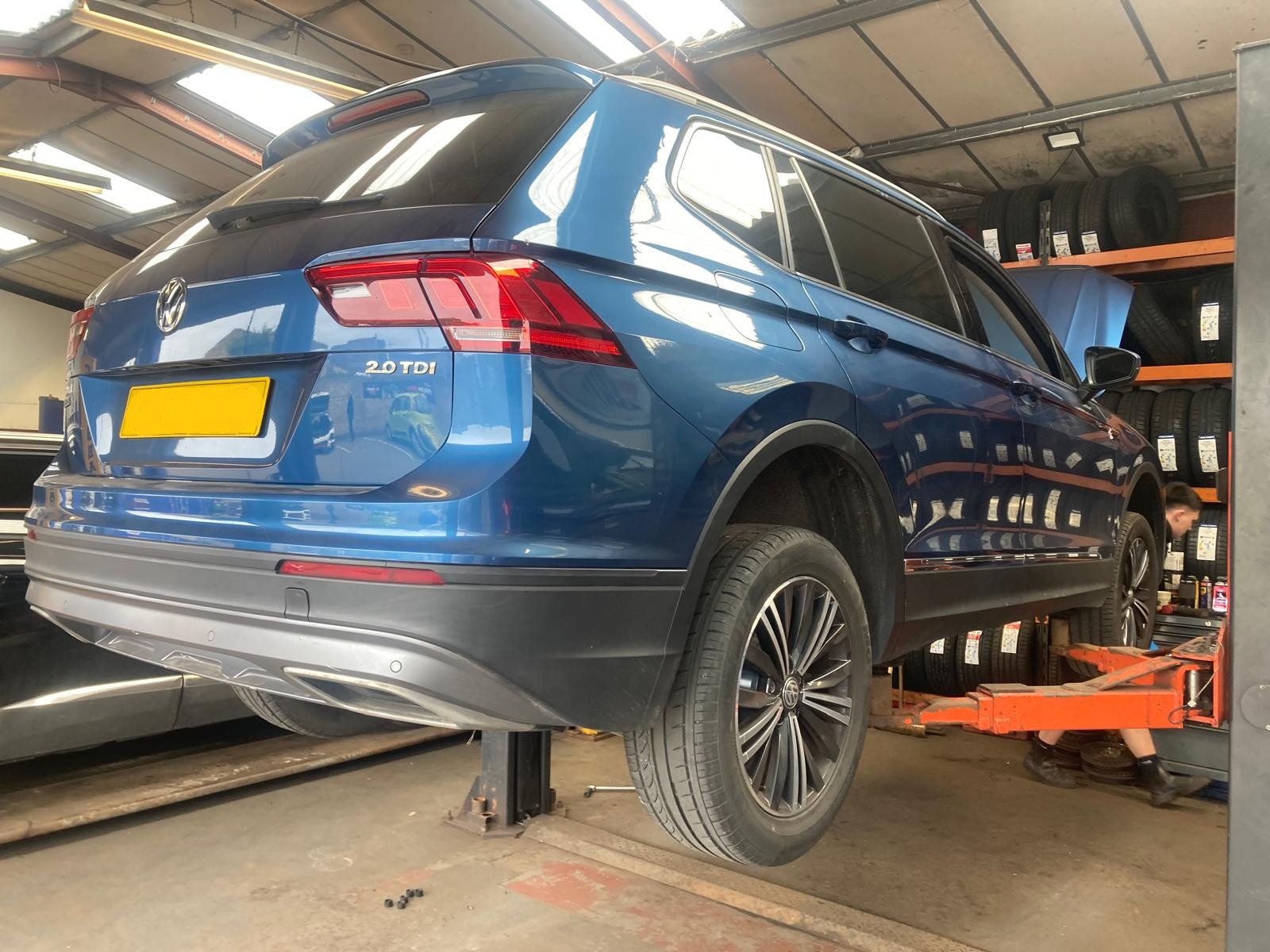
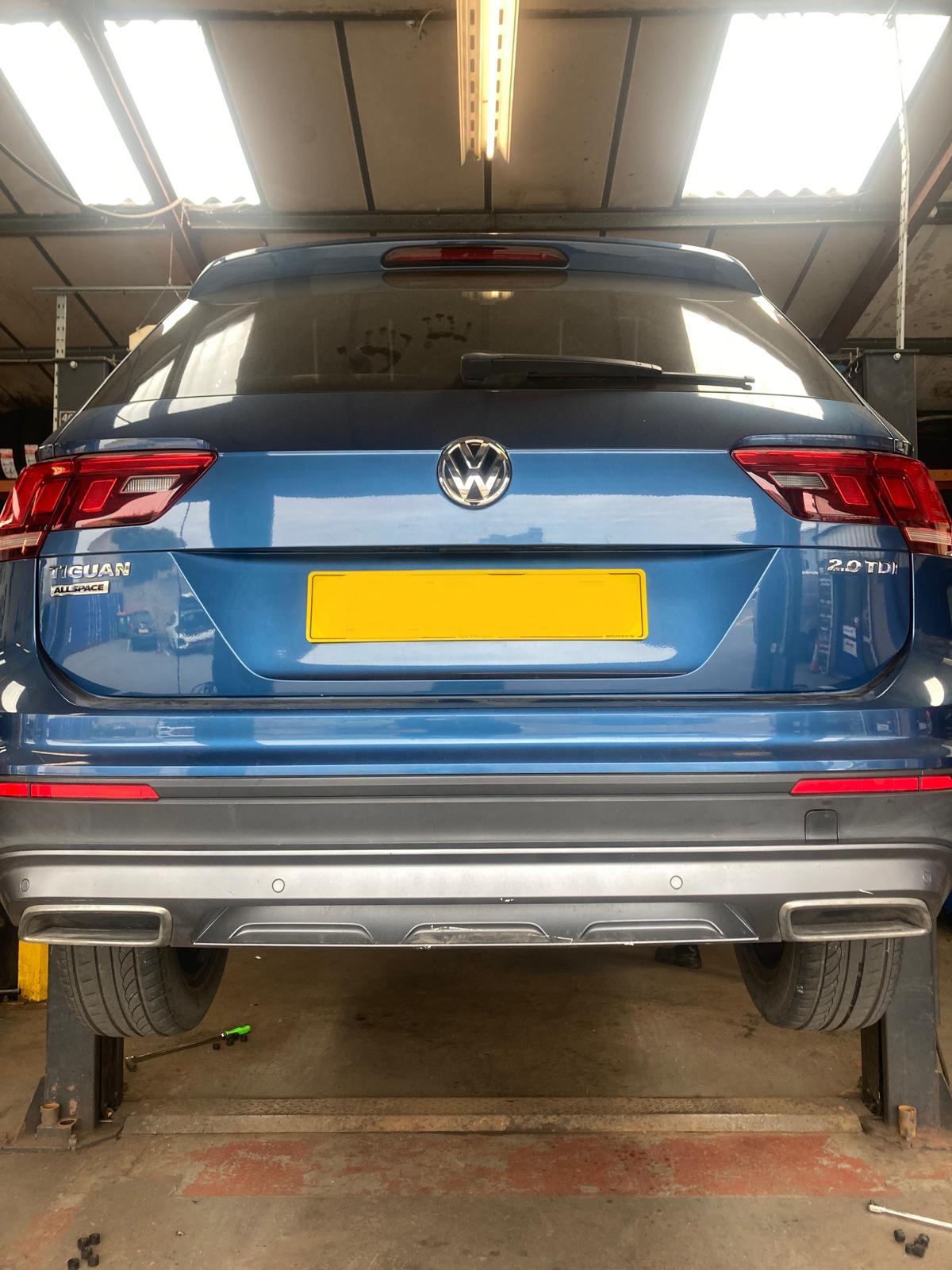
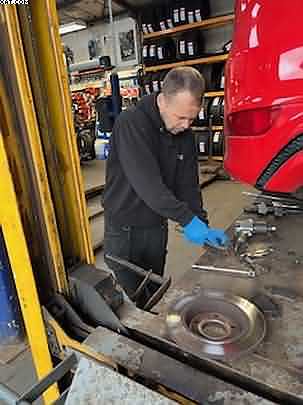
At the same time as we were sorting the Fiat, another job came in—a Volkswagen Tiguan with a serious braking issue.
Now this one was a bit more concerning.
🚙 The VW Tiguan – A Solid Family Motor: VW Tiguan with Braking Problem
4
The Tiguan is a popular choice around Halifax and Calderdale—plenty of them about, especially with families needing something a bit bigger for school runs, shopping, and trips out on the top.
They’re known for:
Comfort and space
Good road handling
Solid German build
But like any vehicle, when it comes to brakes, wear and tear must never be ignored.
VW Tiguan with Braking Problem
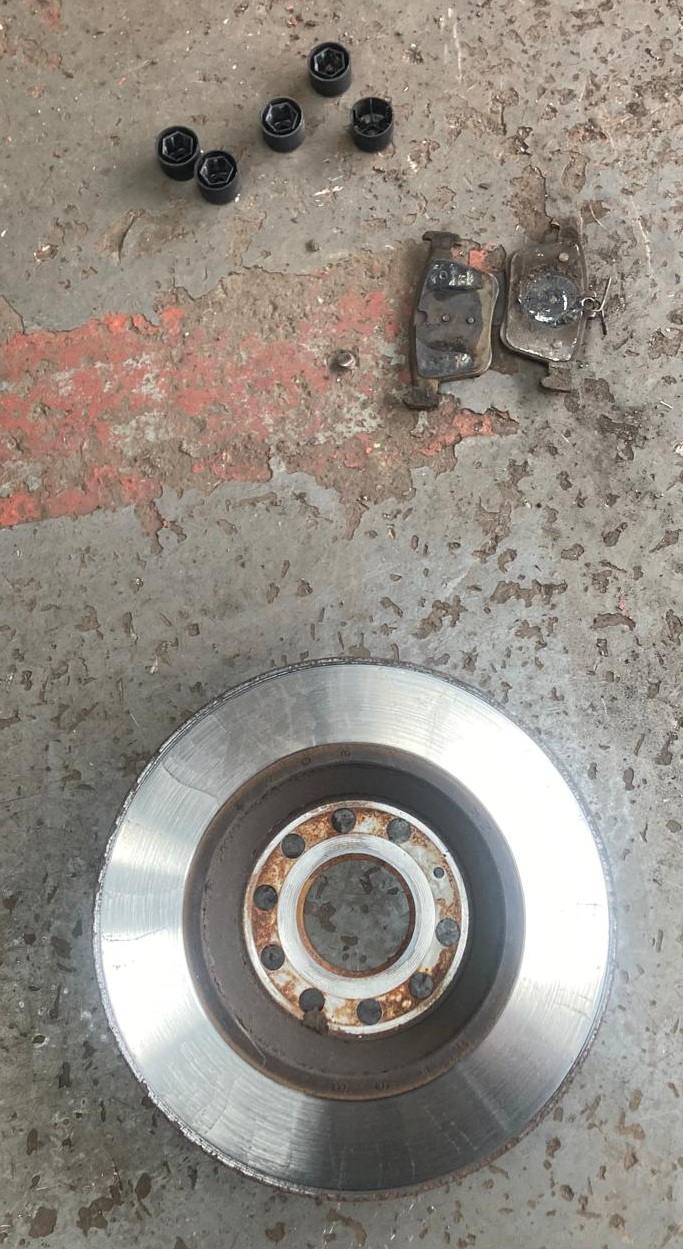
🔧 What We Found – Cracked Brake Discs
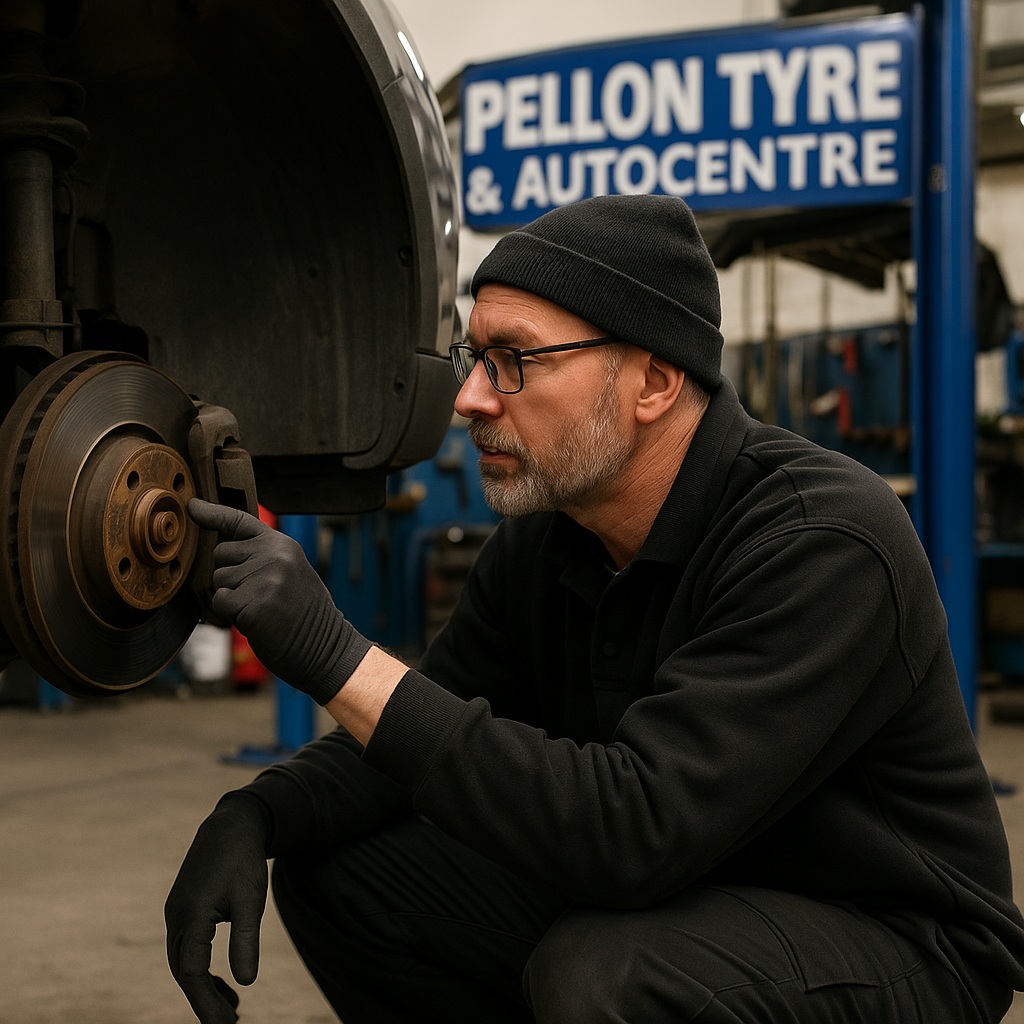
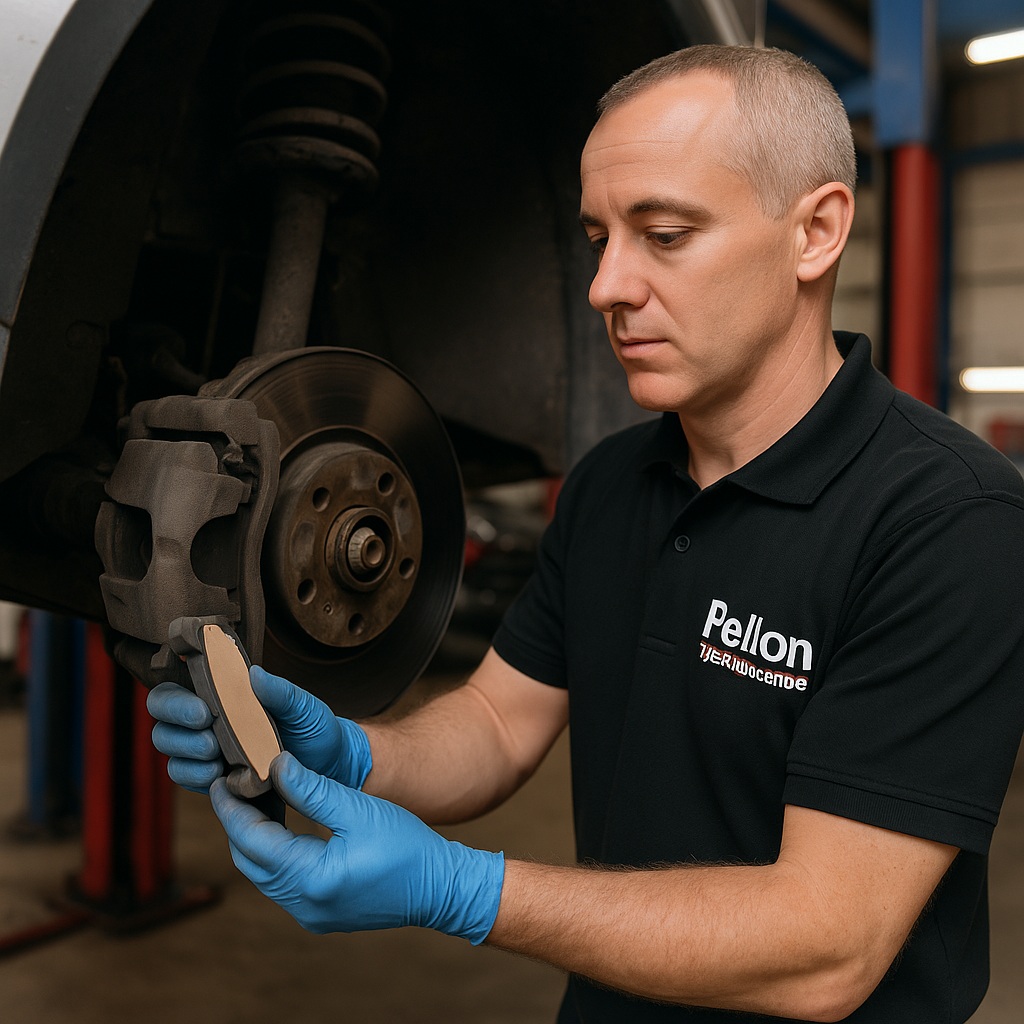
After carrying out a full brake inspection, the problem became clear straight away.
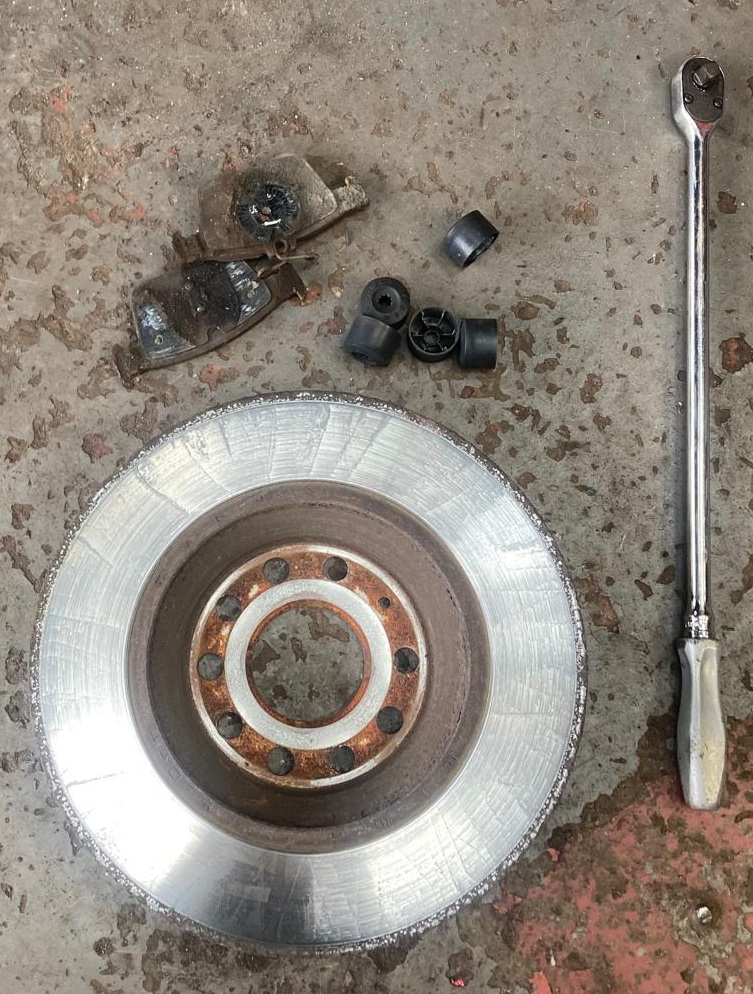
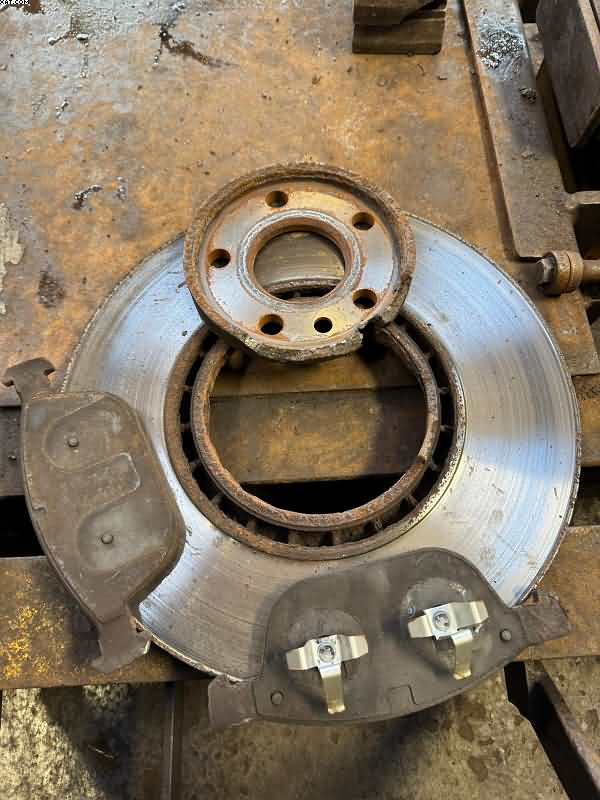
The brake discs were badly cracked
Pads were worn down
Overall braking performance was compromised
To be honest, they were in a dangerous condition and needed sorting immediately.
Cracked discs are not something you want to take chances with. Once they start to fracture, they can:
Lose braking efficiency
Cause vibration through the steering
In worst cases, fail under heavy braking
⚠️ What Causes Brake Discs to Crack? VW Tiguan with Braking Problem
It’s not something we see every day, but it does happen—and there are a few common reasons.
1. Heat Build-Up
Brakes get extremely hot, especially the following:
On long downhill runs (plenty of those around Calderdale!)
Heavy braking in traffic
If the discs heat up and cool down too quickly, they can develop stress cracks.
old cracked and worn out disc
2. Worn Brake Pads
When pads are worn down:
Metal starts contacting metal
Extra heat is generated
Discs suffer damage much quicker
3. Poor Quality Parts: VW Tiguan with Braking Problem
Not all brake parts are equal.
Cheaper discs can:
Wear faster
Be more prone to cracking under stress
That’s why we always stick to reliable, quality parts.
Full check to make sure everything was working as it should
Once completed, the Tiguan was back to braking properly—safe and ready for the road again.
📸 Another Job Recorded
As with all our work, we took photos of the worn and cracked discs before replacement.
It’s something we’ve always believed in:
Customers can see exactly what was wrong
Clear proof of the work carried out
Builds trust—something that matters more than ever
👍 A Timely Repair Before Easter
This was one of those jobs that came in at just the right time. With Easter trips coming up, the last thing anyone needs is braking trouble.
It’s a good reminder—if something doesn’t feel right when braking:
Don’t ignore it
Get it checked early
A Bit of Local Thought
We always notice a pattern this time of year—cars getting checked over before heading off, whether it’s a run to the coast or visiting family across Yorkshire.
And with the kind of hills we’ve got around Calderdale, your brakes really do take a hammering. Keeping them in top condition isn’t just maintenance—it’s essential.
Final Word: VW Tiguan with Braking Problem
Brakes are one thing you should never take chances with.
If you hear grinding, feel vibration, or the car just doesn’t stop like it should, get it looked at straight away.
At Pellon Tyres, we’ll always give you an honest assessment and get you safely back on the road.
https://www.pellonautocentre.com/wp-content/uploads/2024/07/pellon-tyres-logo-509x321.jpg00Eric Robertshttps://www.pellonautocentre.com/wp-content/uploads/2024/07/pellon-tyres-logo-509x321.jpgEric Roberts2026-03-30 14:26:552026-03-30 14:28:25VW Tiguan with Braking Problem
A Recent MOT Failure – The Little Fault That Could Have Been Dangerous
Running a busy garage like Pellon Tyre and Autocentre in Halifax means that we see all sorts of vehicles every day. Some come in for routine servicing, some for tyres, and others arrive for their annual MOT test.
Most cars pass without too much trouble, but occasionally we come across a vehicle that reminds us just how important the MOT test really is.
Earlier this week we had one such case.
The Car Arrives for Its MOT Test: A Recent MOT Failure
The customer arrived with a small family hatchback that had been running well by their own admission. In fact, the driver told us that they were fairly confident the car would pass its MOT without any problems.
At Pellon Tyres in Halifax, our MOT tester Dale always carries out the checks in a calm and methodical way. We believe that doing things properly is the only way to keep customers safe on the road.
The vehicle went up on the ramp, and the inspection began.
At first glance, everything looked fairly normal.
But as we often say in the garage world, it’s what you can’t see straight away that sometimes matters the most.
A Recent MOT Failure
A Serious Brake Problem Discovered: A Recent MOT Failure
During the brake inspection, Dale noticed something that immediately caught his attention.
The rear brake discs were badly worn and heavily corroded.
Now, a lot of drivers don’t realise that brake discs can rust and deteriorate over time, especially if the car is used mainly for short local journeys around town.
Halifax, like many Yorkshire towns, has plenty of hills, damp weather, and the occasional salty winter road. All of this can take its toll on braking components.
In this particular case, the corrosion had reached a point where the braking surface was no longer safe. The brake pads were also unevenly worn and were no longer making full contact with the discs.
Under MOT regulations, this meant the car could not pass the test.
Brakes are, without question, one of the most critical safety systems on any vehicle.
When a driver presses the brake pedal, they expect the car to stop smoothly and safely. If the discs or pads are worn out, stopping distances can increase dramatically.
In wet weather, which we see plenty of here in West Yorkshire, worn brakes can become even more dangerous.
This is exactly why the MOT test exists—to identify problems before they lead to an accident.
Explaining the Problem to the Customer: A Recent MOT Failure
We always try to explain faults clearly to customers so they understand exactly what has happened.
In this case, the driver was surprised because they hadn’t noticed any obvious braking issues.
However, brake wear often happens gradually. Drivers become used to the way the car feels, so they may not notice the deterioration over time.
Once we showed the customer the worn discs and pads, they could immediately see why the MOT had failed.
Carrying Out the Repairs
Fortunately, the repair itself was fairly straightforward.
We fitted:
• New rear brake discs • New rear brake pads • A full brake system inspection
Once the work was completed, the vehicle went back through the MOT retest and passed without any further problems.
All of these areas are inspected during the MOT test and can affect your vehicle’s safety.
A Garage with a Long Local History
Pellon Tyre and Autocentre has been serving motorists in Halifax and the surrounding Yorkshire area since 1989.
Over the years we have seen thousands of vehicles pass through our workshop, from small city cars to large vans and family SUVs.
Every MOT test tells its own story, and occasionally we come across faults that remind us just how important regular checks really are.
Final Thoughts
The good news in this case was that the problem was found during the MOT test rather than during an emergency stop on the road.
After the brake repairs, the customer left with a vehicle that was safe, reliable, and fully road legal again. And that, at the end of the day, is exactly what the MOT system is designed to achieve
Brakes Grinding – Why You Should Never Ignore That Awful Noise
Every now and again, a car rolls into Pellon Tyre & Autocentre that genuinely makes you stop, stare, and wonder how on earth it was still moving. One unforgettable example was a Skoda that arrived with the driver casually saying, “My brakes feel a bit spongy.” A bit spongy? When we whipped the wheels off, the front brake discs were completely shattered — broken into several pieces. It looked like someone had attacked them with a hammer. Honestly, I’ve been in the motor trade for decades, and this was one of the worst cases of brake neglect I’ve ever seen.
Believe me, letting your brakes reach that state isn’t just unwise — it’s downright dangerous. When brakes start grinding, they’re already crying out for help.
What Does Brake Grinding Actually Mean? Brakes Grinding Problem
If you’ve ever heard that horrible metal-on-metal scraping noise while slowing down, you’ll know exactly what I’m talking about. It’s like dragging a shovel across concrete — enough to set your teeth on edge.
But grinding brakes aren’t just embarrassing. They’re warning you that something is badly worn or broken.
Common Reasons Brakes Start Grinding
Here are the main culprits we see daily in Halifax, Huddersfield, Bradford and beyond:
1. Worn-Out Brake Pads
This is by far the most common reason. Brake pads naturally wear down over time. If they’re not checked regularly, the friction material disappears completely, leaving only the metal backing plate. That metal then grinds directly onto your brake discs — which not only causes noise but also destroys the discs in no time.
2. Stones or Road Debris in the Caliper: Brakes Grinding Problem
Yorkshire’s roads aren’t the cleanest. One rogue stone flicked up from a pothole can lodge itself between the pad and disc, making an awful grinding or scraping sound.
3. Rust and Corrosion
With our damp weather and gritted winter roads, brake discs can corrode fairly quickly. Overnight moisture often creates surface rust, which can cause grinding until it wears away. But if corrosion becomes severe, the disc surface becomes rough and uneven — and that’s when grinding turns into a permanent problem.
4. Damaged Brake Hardware
Springs, clips and slides can loosen or seize over time. When they fail, the pad doesn’t sit straight, and you get uneven wear and noise.
5. Faulty or Seized Callipers: Brakes Grinding Problem
If a calliper sticks, the pads can constantly rub on the disc — get too hot — and start grinding. Sometimes you’ll even smell burning.
How Grinding Brakes Affect Safety
Grinding isn’t just annoying; it seriously reduces your stopping power. You’ll experience:
longer braking distances
steering pull to one side
overheating brakes
risk of brake failure altogether
Not what you want when driving down the steep hills of Halifax or through tight bends in Hebden Bridge.
Ignoring grinding brakes is like ignoring chest pain — it won’t fix itself. It only gets worse.
Brake Grinding in Everyday UK Cars
We see it a lot on:
Ford Fiesta & Focus
Vauxhall Astra & Corsa
Peugeot 207/208
VW Golf & Polo
Particularly after winter, when potholes have had a good go at everything underneath.
Some cars still run rear drum brakes, too. A grinding noise from the back often means:
worn brake shoes
rust built up inside the drum
broken springs or adjusters
All simple fixes — as long as you don’t leave them until the parts are destroyed.
Brakes Grinding Problem
How We Diagnose Brakes Grinding Problem at Pellon Tyres
One of our favourite tricks is the Co-op car park test. We take the customer’s car around the wide open area by the store in Pellon with the window down. At low speed, every creak, scrape and grind becomes crystal clear.
Most brake problems are solved the same day, and drivers leave absolutely gobsmacked at how quiet their car suddenly is.
Prevention: Stop Grinding Before It Starts
A little bit of TLC goes a very long way. Here’s what we always recommend:
Have your brakes checked at least once a year
Get noises investigated early
Avoid cheap, unbranded brake pads
Make sure your brake fluid is changed every 2–3 years
Keep an eye on dashboard warnings
It’s no different from checking the weather before heading to Blackpool—you avoid hassle by being prepared.
Final Thoughts – Don’t Ignore the Signs
If your brakes start grinding, don’t turn the radio up and pretend you didn’t hear it. It’s your car saying, “Help me!”
A quick inspection now could save you hundreds of pounds later — and more importantly, keep you and your family safe on our unpredictable Yorkshire roads.
And remember… The only grinding noise you should hear on your travels is the coffee machine at your favourite café.
If your brakes are making odd noises, pop into Pellon Tyre & Autocentre, Halifax. We’ll sort you out and get you safely back on the road.
How Local Roads Make Brake Problems Worse
One thing many motorists don’t realise is just how much local driving conditions affect brake wear. Here in Halifax, with our steep hills, tight bends, and constant stop–start traffic, your brakes work twice as hard as they do in flatter parts of the UK.
Coming down the tops from Queensbury, Ripponden Bank, or even the hill into Sowerby Bridge puts enormous strain on discs and pads. If your brakes are already worn or low-quality, that extra heat buildup can finish them off pretty quickly.
It’s one of the reasons why we see so many grinding and screeching cases in our workshop — Yorkshire roads are stunning, but they’re brutal on braking systems!
Why Cheap Pads and Discs Can Cost More in the Long Run
Another point worth mentioning is the false economy of buying cheap no-name brake pads or discs. We’ve seen plenty over the years, and they often deteriorate far quicker than decent branded ones.
Some budget pads use hard, poor-quality materials that crumble or glaze under heat, which then causes even more grinding, vibration, and long stopping distances. When you compare that with a quality set fitted properly, the difference in safety — and lifespan — is massive.
Spending a little extra now can save you a fortune later, not to mention keeping you and your family safer on the road. At Pellon Tyres, we always recommend using trusted, well-made parts, because your brakes are the last thing you want to gamble with.
Why Regular Brake Checks Could Save You This Winter
(by Eric Roberts – Pellon Tyre and Autocentre, Halifax)
When winter rolls in across West Yorkshire, most of us think about tyres, batteries, and the usual cold-weather checks. But there’s one vital part of your car that often gets overlooked — the brakes. Here at Pellon Tyre and Autocentre in Halifax, we see plenty of drivers come in for winter servicing only to find their brake pads or discs are dangerously worn. It’s something that could easily have been spotted sooner.
The Problem with Winter Braking: Winter-Brake-Checks
Cold, wet, and salty roads create the perfect recipe for corrosion and wear. When moisture and road salt mix, brake discs can rust quickly, leading to uneven braking and vibration through the pedal. Add in a layer of winter grime, and your brakes have to work much harder to stop the car safely.
Halifax’s hilly roads don’t help either—the constant stop-start driving, especially around places like Boothtown and Mixenden, means your brake system is always under pressure.
That’s why it’s so important to have your brakes checked regularly, especially before the temperature drops.
Signs Your Brakes Need Attention: Winter-Brake-Checks
You don’t need to be a mechanic to know when something’s not quite right. Keep an ear and an eye out for:
Squealing or grinding noises when braking – often the first sign of worn pads.
Vibration through the pedal or steering wheel – could be warped brake discs.
Longer stopping distances – worn pads or contaminated brake fluid can cause this.
A soft or spongy pedal – may indicate air or moisture in the brake lines.
Brake warning light on the dashboard – don’t ignore it!
If you spot any of these, it’s time to get them checked before they turn into something more serious — or costly.
Why Regular Brake Checks Make Sense
A quick brake inspection can reveal small issues before they become major ones. At Pellon Tyres, our trained technicians check the thickness of your pads and discs, inspect for corrosion, and make sure the braking system is working evenly across all four wheels.
It’s all part of keeping your car safe and reliable — and potentially saving you a hefty repair bill later on.
For example, replacing a full set of discs and pads can be pricey, but catching a worn pad early might only need a simple replacement. Prevention really is cheaper than cure.
The Link Between Servicing and Brakes: Winter-Brake-Checks
During a full car service, your brakes are checked as standard, but it’s always worth asking for a more detailed inspection if you drive a lot or tow regularly. We often see customers who’ve had their car serviced elsewhere, only to find the brakes were given a quick glance rather than a proper check.
At Pellon Autocentre, we take the time to do things properly — whether it’s checking brake fluid levels, testing handbrake operation, or inspecting the callipers for sticking or corrosion.
With snow and ice always a possibility in West Yorkshire, good brakes are as important as good tyres. Combine a set of reliable winter tyres with a properly maintained brake system, and you’ll be ready for whatever the weather throws at you.
At Pellon Tyre and Autocentre, we’ve been keeping Halifax motorists safe since 1989—from batteries and tyres to brakes and MOTs, we do the lot under one roof.
So before the frost sets in, why not pop down for a quick brake check? It might just save you a nasty scare on a slippery morning.
Brake Servicing in the Calderdale Area – Including Electric and Hybrid Cars
If there’s one thing you don’t want to take chances with on the roads of Calderdale, it’s your brakes. From the steep climbs out of Hebden Bridge to the winding drops into Sowerby Bridge, your brakes are working overtime. Whether you drive a petrol, diesel, hybrid, or fully electric car, keeping your braking system in top shape is essential for safety — and it could save you a small fortune down the line.
Here at Pellon Tyre and Autocentre in Halifax, we’ve been keeping local drivers safe on these hills for decades, and brake servicing is one of our daily jobs.
Why Regular Brake Servicing Matters: Brake Servicing in the Calderdale Area
Your brakes take a beating — especially around Calderdale’s hilly roads and stop-start town traffic. Over time, brake pads wear down, discs can corrode, and brake fluid absorbs moisture, all of which reduce braking performance.
Many people only think about their brakes when they start to hear a squeal or grinding noise, but regular servicing helps avoid those nasty surprises. Our technicians check:
Brake pads and discs for wear or corrosion
Brake callipers and sliders for sticking or seizing (a common issue in UK weather)
Brake fluid condition – it should be changed roughly every two years
Handbrake or electronic parking brake operation
If you drive up and down Halifax’s hills daily, that constant pressure means your brakes are doing double duty — regular checks are vital for safety.
Electric and Hybrid Car Brakes – What’s Different? Brake Servicing in the Calderdale Area
A lot of people assume electric and hybrid cars barely use their brakes, and while that’s partly true, it’s also what causes other issues!
Most EVs and hybrids use regenerative braking — where the motor helps slow the car and recovers energy for the battery. That means the physical brakes (the pads and discs) are used less often. Sounds great, right?
Well, not entirely. Because they’re used less, the discs and callipers don’t heat up enough to burn off moisture. Over time, that leads to rust and corrosion, especially in our damp Calderdale climate. We often see electric cars come in with seized rear brakes or corroded discs that make horrible grinding noises.
That’s why even electric and hybrid cars still need a proper brake inspection every year — especially before winter. At Pellon Autocentre, our lads are trained and equipped to handle EV and hybrid brake systems, including those with electronic parking brakes and advanced diagnostic systems.
Signs Your Brakes Might Need Attention: Brake Servicing in the Calderdale Area
If you notice any of these, it’s time to pop in for a check:
Squealing or grinding noises
Car pulling to one side under braking
Juddering or vibration when braking
A soft or spongy brake pedal
Warning lights on your dashboard
Don’t ignore them — the longer you wait, the more expensive it can become.
Brake Servicing – How We Do It
At Pellon Tyre and Autocentre, we use quality parts and modern equipment for every brake job. Whether it’s replacing pads, discs, or bleeding the hydraulic system, everything is done to manufacturer standards.
We’ll always give you a full explanation of what needs doing — no surprises, just honest advice. For EVs and hybrids, we check the condition of the regenerative systems and ensure your braking components aren’t seizing due to lack of use.
Our customers appreciate that we don’t just replace parts for the sake of it — if something can be cleaned, freed off, or repaired safely, we’ll do that first.
Local Knowledge, Local Roads- Brake Servicing in the Calderdale Area
Driving around Calderdale brings its own challenges — from the steep climbs up Pellon Lane to the twisting routes around Elland and Brighouse. Having well-maintained brakes gives you confidence and safety on every journey.
That’s why so many local motorists trust Pellon Tyre and Autocentre for their brake servicing and repairs. We’ve built our reputation on honesty, good value, and proper workmanship since 1989.
Book Your Brake Check Today
If you’re not sure when your brakes were last checked, drop by our garage in Halifax or book online at www.pellontyres.co.uk. Whether you drive a Ford Fiesta, a Toyota Hybrid, or a fully electric Nissan Leaf, our team has the right tools and know-how to keep you stopping safely on Calderdale’s hills.
https://www.pellonautocentre.com/wp-content/uploads/2024/07/pellon-tyres-logo-509x321.jpg00Eric Robertshttps://www.pellonautocentre.com/wp-content/uploads/2024/07/pellon-tyres-logo-509x321.jpgEric Roberts2025-10-04 11:07:332025-10-04 11:17:23Brake Servicing in the Calderdale Area
The Story of How Alex Resurrected a Ford Focus at Our Halifax Garage
Eric Roberts Says
Hi there! You’re in for a treat if you enjoy motoring stories or are an enthusiast about cars. Allow me to take you behind the scenes of a recent project that happened in our beautiful Halifax, where the intricacies of car maintenance collide with the rich history of our community.
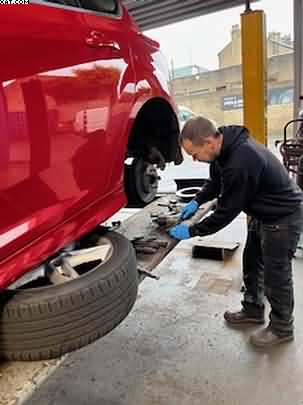
Since the loss of my dear wife Michelle, I have decided to become more proactive and spend a little more time visiting and blogging about my garage. Just the other day, I turned up with my mobile phone and took some pictures of my staff working on customer cars.
Alex is one of my long-term mechanics, and of course, he is a very experienced mechanic.Today Alex was working on a nice-looking red Ford Focus.
It began with a normal, breezy West Yorkshire morning.
Halifax’s streets were filled with people going about their daily business, and the air was clean. At that point, a Ford Focus drove into our garage. It was bright red and in good condition; indeed, it had the allure that Ford vehicles are known for. The owner, a man from the area, was eager to restore his car’s brakes to their former glory, and Alex is the perfect person to do so.
As some of you may know, Alex is somewhat of an automotive expert. His hands have worked on more customers vehicles than we’ve enjoyed hot dinners, and he has an excellent eye for detail. This Ford Focus required more than just a fast fix—a complete brake refurbishment. We’re talking about new discs and pads—the whole nine!
The procedure was quite careful. Brakes Job on Ford Focus
Alex began by evaluating the state of the old and perished brakes. It’s similar to archaeology; however, he was going through layers of deterioration rather than uncovering artefacts from the past. He discovered that the pads were completely worn out and the discs were far past their best due to years of use. It was obvious that this vehicle had seen some exciting times traversing Halifax’s hilly terrain.
Each of the new discs was spotless and shining. Brakes Job on Ford Focus
Alex fitted them with an accuracy that only came from years of practice. The pads followed, fitting snugly against the discs as though they had always been there. Seeing all the parts come together is a stunning sight, reminiscent of Halifax’s own Piece Hall makeover in that it takes something with history and breathes new life into it.
Now that the new brakes were installed, it was time for the crucial moment. Alex drove the Ford Focus to the end of Pellon Lane for a test drive. I wish you could have seen the smile that says, “It’s a job well done,” when he returned. With our tiny streets and steep inclines in Halifax, the car handled like a dream and stopped on a sixpence—exactly what you need.
Brakes Job on Ford Focus
There was more to this project than merely a car repair.
It was about giving someone in our community back a little bit of magic in their daily lives. This type of good workmanship fuels our enthusiasm for what we do at the garage. Every car that leaves our shop, whether it’s a Ford Focus or something else entirely, has a little piece of Halifax in it, which is a testament to the quality and care we stand for.
So keep in mind that Alex and our staff are prepared to work some garage magic on your cherished car the next time you hear a slight squeak or Noisy Car Brakes- from your car. Here in Halifax, we preserve the past by repairing cars one at a time. Be careful when driving!
https://www.pellonautocentre.com/wp-content/uploads/2024/07/pellon-tyres-logo-509x321.jpg00Eric Robertshttps://www.pellonautocentre.com/wp-content/uploads/2024/07/pellon-tyres-logo-509x321.jpgEric Roberts2025-09-12 07:40:032025-09-12 11:36:55Brakes Job on Ford Focus
Brake problems can be difficult to diagnose, but most drivers encounter these common symptoms: your brake pedal feels soft or mushy, and when braking, your foot
EricRoberts‘s insight:
Master cylinder brake fluid may need checking at regular intervals
This Brake Problems video and article written by Joyce Blay are well worth looking at. We in the garage and autocenter sectors are always advising motorists.
Of course, about how they should look after their cars. However, we cannot overstate the importance of the car’s braking system. including how important it is to have your brakes checked. By a professional mechanic or your local garage to avoid future brake problems.
The levels that are checked under your bonnet (hood) Importantly, you will include the level in your master cylinder. The lack of brake fluid in the brake master cylinders will lead to spongy brakes, which, if not corrected, will result in brake problems and even brake failure.
Brake Problems – Brake Problems
So have these levels checked, and if required, you may need a complete brake fluid change. Periodically, the car manufacturers advise doing this as well. So it is well worth checking to see what intervals this job should be done at.
Also, if you are topping up the master cylinder yourself, make sure you use the recommended type of fluid for your model; some are different from others, and your user’s manual will tell you which fluid to use. These procedures may help eliminate any braking problems in the future!
brake revolution
Of course, as time has gone by, brakes have become much more complicated. So one of the big advances has been the introduction of ABS to our braking systems. It is important to realise that in my lifetime, braking systems have improved beyond recognition. That is to say that when I was an apprentice mechanic, most regular cars only had drum brakes fitted front and rear.
Later cars that were in the upper-class bracket, such as Mercedes, were fitted with disc brakes at the front. Developments were coming out of the racing car circuits.
Consequently, technology would be passed from the racing circuit onto everyday regular cars. Motor racing sped up the development of all aspects of modern cars. Up to the latest developments! including the introduction of the AEB (Automatic Emergency Braking). So, this system will detect a potential vehicle impact and automatically apply the braking system.
Brake Problems
How Vehicle Brakes Have Improved for Safer Driving: A Braking Revolution
Hi to everybody! How do we all feel? Do you want to talk about automobile brakes? I realise it’s not the most exciting topic, but bear with me. The rules of the game have significantly altered over the past several years, making our cars safer than ever. This is all because of some seriously cool developments in brake technology. Now hold on tight, and let’s begin!
A Long Time Ago – Brake Problems
I’m not that ancient, but I do recall a time when car brakes were less complicated. These were functional but not quite as efficient as what we have now. In the present, the surroundings are completely different. Current braking mechanisms resemble something from a science fiction movie.
The Revolution of ABS
ABS, or the Anti-lock Braking System, is likely familiar to you unless you’ve been living under a rock. Nowadays, it comes as standard in the majority of autos, and for good reason. Stop slipping and sliding like Bambi on ice. Even when you stomp on the brakes, ABS ensures that you stay in control of your car. Let me tell you, it’s changed the game.
Automated Emergency Braking: The Latest Trend
This is when things really start to heat up. AEB, or automatic emergency braking, is like having a personal guardian angel in your vehicle. This smart mechanism applies the brakes for you if it detects that a collision is imminent. Yes, your car has your back even if you’re too startled to respond. Incredible, isn’t it?
Technical Part – Brake Problems
All of this brake magic is based on sensors, computers, and real-time data, without getting into a physics lecture. To ensure that our cars are as secure as houses, car manufacturers have made significant R&D investments. And new developments keep happening. I wouldn’t be shocked if in the near future we had brakes that could somehow foretell the future!
Enhanced Road Safety in Halifax and Beyond
What impact does this have on us in Halifax? Really, quite a lot. Having a trustworthy braking system is important because of our twisting roads, our uneven terrain, and let’s not forget the legendary Yorkshire weather. I’ve noticed fewer brake-related problems in the automobiles that enter my garage, and that’s cause for celebration.
Brake Problems
Finishing up: Brake Problems
Okay, guys, that’s the skinny on how car brakes have developed to improve the safety and security of our drives. Driving appears to have a brighter and safer future thanks to technologies like ABS and automatic emergency braking.
Thank you for watching. You know where to find us if you have any worries concerning the brakes on your automobile. Keep those wheels—and brakes—turning safely, and be careful! 🚗
To be truthful, I am not sure how this is going to work, but I am sure that it will be another brake system success.
More Modern Brake Technology: What Drivers Should Know Today
As car technology keeps marching on, brakes haven’t just improved—they’ve completely transformed. Many drivers don’t realise just how much engineering goes into stopping a modern car safely.
Electronic Brakeforce Distribution (EBD) Brake Problems
You might not hear people talk about EBD down at the pub, but it’s fitted to most modern motors. It works hand-in-hand with ABS and automatically sends more braking force to the wheels that need it most. In simple terms: 👉 Heavy load in the boot? 👉 Kids in the back seats?
EBD adjusts everything instantly so the car stops in a stable, straight line. Years ago, you’d have felt the back end twitch or slide—not anymore.
Brake Assist (BA): Helping in a Panic
Most drivers think they brake hard in an emergency… But tests show many actually don’t press the pedal fully when they panic. That’s where Brake Assist steps in. The system senses sudden, sharp pedal movement and automatically applies maximum braking force even if you didn’t push all the way. This tiny difference can knock metres off stopping distances — a lifesaver when a dog runs into the road or someone slams on ahead of you on the Elland Bypass.
Regenerative Braking on Hybrids & EVs: Brake Problems
Electric cars have brought a new trick to the world of braking. Regenerative braking doesn’t just slow the car — it captures the energy and puts it back into the battery. In busy towns like Halifax, where it’s stop-start traffic between King Cross, Skircoat and Pellon Lane, regen braking actually gives EV drivers a decent bit of extra range. Brakes on EVs often last much longer too because the electric motors do a big chunk of the slowing down.
Brake pads aren’t just lumps of friction material anymore. Modern pads use:
Kevlar blends
Ceramic compounds
Low-metallic materials
These help reduce noise, dust, fading and wear — all things older cars struggled with. Even the brake discs have improved, with coated and vented designs now standard on many makes and models.
For us in West Yorkshire—hills, stop-start bends, and the odd emergency “Sheep in the road!” moment — these improvements make daily driving far safer.
Autonomous Braking & Radar Technology
Some newer cars, especially premium brands, now combine AEB with:
Front radar
Cameras
LIDAR systems
These don’t just brake for you — they track traffic, judge distance, and sometimes even tighten the seatbelts before impact. It’s a far cry from the old Ford Cortinas and Vivas we grew up with!
Why Good Brakes Matter More in Yorkshire
If you live around Halifax, Sowerby Bridge, Hebden Bridge or up towards Queensbury, you already know our roads aren’t exactly gentle. Steep hills, tight bends, potholes, wet leaves and grit all make braking performance even more important. Every upgrade manufacturers make means fewer accidents, fewer MOT failures, and safer journeys for everyone.
The Future: Smarter Brakes on the Horizon
Engineers are already working on…
Brake-by-wire systems (no hydraulic fluid, fully electronic!)
Self-diagnosing brake pads that warn you before wear becomes serious
Heat-resistant discs designed specifically for electric vehicles
Give it another decade and stopping a car may rely more on computer power than pedal power
We may request cookies to be set on your device. We use cookies to let us know when you visit our websites, how you interact with us, to enrich your user experience, and to customize your relationship with our website.
Click on the different category headings to find out more. You can also change some of your preferences. Note that blocking some types of cookies may impact your experience on our websites and the services we are able to offer.
Essential Website Cookies
These cookies are strictly necessary to provide you with services available through our website and to use some of its features.
Because these cookies are strictly necessary to deliver the website, refusing them will have impact how our site functions. You always can block or delete cookies by changing your browser settings and force blocking all cookies on this website. But this will always prompt you to accept/refuse cookies when revisiting our site.
We fully respect if you want to refuse cookies but to avoid asking you again and again kindly allow us to store a cookie for that. You are free to opt out any time or opt in for other cookies to get a better experience. If you refuse cookies we will remove all set cookies in our domain.
We provide you with a list of stored cookies on your computer in our domain so you can check what we stored. Due to security reasons we are not able to show or modify cookies from other domains. You can check these in your browser security settings.
Other external services
We also use different external services like Google Webfonts, Google Maps, and external Video providers. Since these providers may collect personal data like your IP address we allow you to block them here. Please be aware that this might heavily reduce the functionality and appearance of our site. Changes will take effect once you reload the page.