The Future of MOT testing
The Future of MOT testing
Table of Contents
The Future of MOT testing
The Future of MOT Testing – How Modern Technology Is Changing the Garage Industry
When I first entered the motor trade during the 1960s, an MOT test was a very different affair from the one we carry out today at Pellon Tyres in Halifax.
Cars were much simpler.
There were no computers, no warning lights, no electric vehicles and certainly no advanced safety systems that could steer or brake the car for you.
Most faults could be found using experience, common sense and a good set of tools.
Fast forward sixty years, and the modern motor car has become one of the most advanced machines most of us will ever own.
Technology is changing rapidly, and naturally the MOT test has to evolve with it.
Over the next few years motorists will notice more changes as electric vehicles, hybrid technology and advanced driver assistance systems become increasingly common on Britain’s roads.
The MOT Continues to Evolve: The Future of MOT testing
Many motorists believe the MOT has remained largely unchanged over the years.
In reality, it has continually evolved to reflect the changing technology fitted to modern vehicles.
Every few years new checks are introduced while older testing methods are updated.
The aim has always remained exactly the same.
To ensure vehicles meet the minimum legal standards for road safety and environmental protection.
As technology advances, MOT testers must also continue learning and adapting.
Electric Vehicles Bring New Challenges
Electric vehicles are becoming increasingly common throughout Halifax and Calderdale.
Although they require less routine servicing than many petrol or diesel cars, they introduce completely new safety considerations.
Unlike conventional vehicles, electric cars contain high-voltage battery systems capable of producing potentially dangerous voltages.
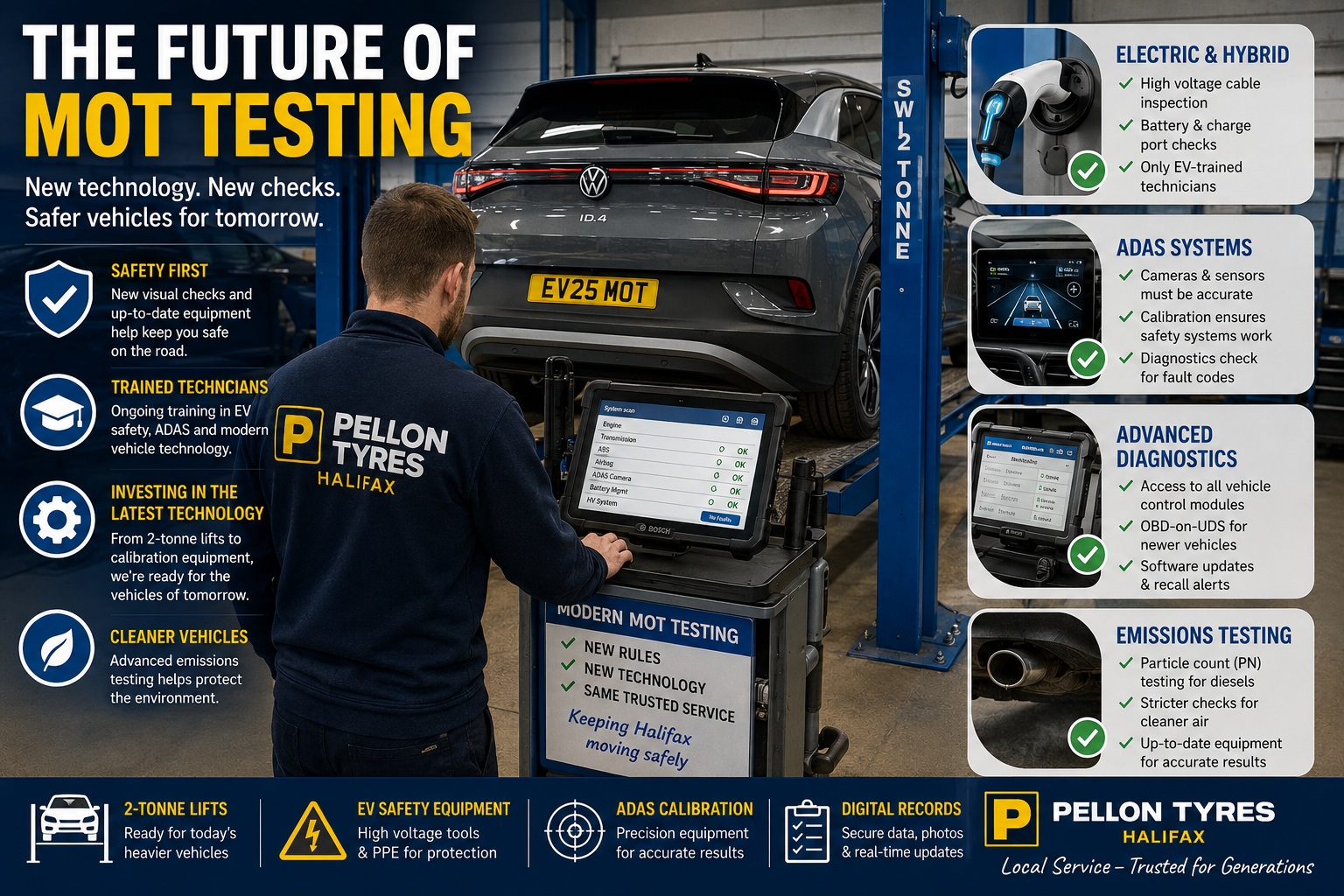
For this reason, MOT testers are now expected to carry out additional visual inspections on electric and hybrid vehicles.
These include checking:
- High-voltage cables.
- Battery casings.
- Charging sockets.
- Electrical connectors.
Fortunately, these are visual inspections only.
If any serious damage is discovered, specialist repairs should only be carried out by technicians trained to work safely on high-voltage systems.
Bigger Cars Mean Bigger Equipment: The Future of MOT testing
Another interesting change is the increasing weight of modern vehicles.
Electric cars often weigh several hundred kilograms more than equivalent petrol models because of their large battery packs.
This means garages must ensure their lifting equipment is suitable for today’s heavier vehicles.
Many workshops, including ours at Pellon Tyres, continually invest in new equipment to keep pace with changes in the motor industry.
Advanced Driver Assistance Systems
One of the biggest technological developments in recent years has been the arrival of Advanced Driver Assistance Systems, usually shortened to ADAS.
These systems include features such as the following:
- Lane-keeping assistance.
- Automatic emergency braking.
- Adaptive cruise control.
- Traffic sign recognition.
- Parking cameras.
- Radar sensors.
Many drivers don’t even realise just how much technology is helping them every time they drive.
These systems rely upon cameras and radar sensors being positioned with incredible accuracy.
Even very small changes following accident repairs, suspension work or wheel alignment can affect how they operate.
Why Calibration Matters: The Future of MOT testing
Many people assume replacing a windscreen or carrying out suspension repairs is simply a matter of fitting new parts.
Unfortunately, modern vehicles are rarely that simple.
Once certain components have been replaced, cameras and sensors often require recalibration.
Without this process, safety systems may not perform exactly as the manufacturer intended.
As these systems become more common, specialist calibration equipment is becoming an increasingly important part of many modern workshops.
Vehicle Diagnostics Continue to Grow
When I first became a mechanic, diagnosis usually involved listening carefully to an engine, checking ignition timing or adjusting a carburettor.
Today many faults are identified using sophisticated diagnostic computers.
Modern vehicles contain dozens of electronic control units communicating with one another every second.
These computers monitor almost every aspect of vehicle operation.
Professional diagnostic equipment allows technicians to identify faults quickly while reducing unnecessary parts replacement.
Technology has certainly transformed the way garages work.
Cleaner Vehicles for the Future: The Future of MOT testing
Environmental standards continue becoming stricter.
Diesel particulate filters, catalytic converters and advanced emissions systems all help reduce pollution.
As vehicle technology develops further, emissions testing will almost certainly continue evolving alongside it.
Future testing equipment may become capable of identifying faults that would previously have gone unnoticed.
This benefits everyone by helping ensure vehicles remain cleaner and more environmentally friendly.
Training Never Stops
One thing that has remained constant throughout my career is the need to keep learning.
When I entered the tyre trade, radial tyres were still relatively new.
Since then we have seen fuel injection, ABS braking systems, airbags, hybrid vehicles and now fully electric cars.
Every stage has required garages to invest in training.
At Pellon Tyres we believe that investing in knowledge is just as important as investing in equipment.
The motor industry never stands still.
Neither do we.
Honest Advice for Our Customers: The Future of MOT testing
Sometimes customers ask whether all this new technology makes motoring more complicated.
The honest answer is yes.
Modern vehicles are far more sophisticated than ever before.
However, they are also safer, cleaner, more economical and generally more reliable.
As independent garage owners, our responsibility is to keep up with these developments while continuing to offer straightforward advice in plain English.
Most motorists simply want to know their vehicle is safe and roadworthy.
That’s exactly what we aim to provide.
Check out this TF1700 Naylor Sporty Car for MOT Test
Looking Ahead
The next few years are likely to bring even more changes to MOT testing.
Electric vehicles will continue growing in popularity.
Advanced safety systems will become even more sophisticated.
Diagnostic equipment will become more powerful.
Yet despite all these advances, one thing will never change.
Good workmanship, honest advice and attention to detail remain the foundations of every professional garage.
Here at Pellon Tyres in Halifax, we have watched the motor industry change dramatically over the past six decades.
From simple family saloons to today’s highly connected electric vehicles, it has been an incredible journey.
Whatever technology arrives next, our commitment remains exactly the same.
To provide friendly, professional service and keep motorists across Halifax and Calderdale safely on the road for many years to come.