
Wheel Balancing Uncovered
Table of Contents
Wheel Balancing Uncovered
Wheel Balancing Uncovered
Wheel Balancing – The Small Service That Makes a Big Difference
As tyre retailers here in Halifax, we often hear customers say:
“There’s a vibration through the steering wheel.”
or
“The car feels fine around town, but it starts shaking on the motorway.”
More often than not, the cause turns out to be something surprisingly simple – wheel balancing.
Wheel balancing is one of those garage services that often goes unnoticed when everything is working correctly. Yet it plays a major role in:
- driving comfort,
- tyre life,
- fuel economy,
- suspension wear,
- and overall vehicle safety.
In fact, it is one of the most important procedures we carry out whenever new tyres are fitted at Pellon Tyre and Autocentre.
What Is Wheel Balancing?
In simple terms, wheel balancing ensures that the weight of the wheel and tyre assembly is distributed evenly as it rotates.
Even a brand-new tyre and wheel will never be perfectly balanced naturally.
Tiny variations in:
- tyre construction,
- wheel manufacture,
- valve position,
- and mounting
can create small weight differences.
These differences may only amount to a few grams, but once a wheel is spinning at motorway speeds, those small imbalances become much more noticeable.
This is why we use specialist balancing equipment to identify exactly where corrective weights need to be fitted.
How Wheel Balancing Works: Wheel Balancing Uncovered
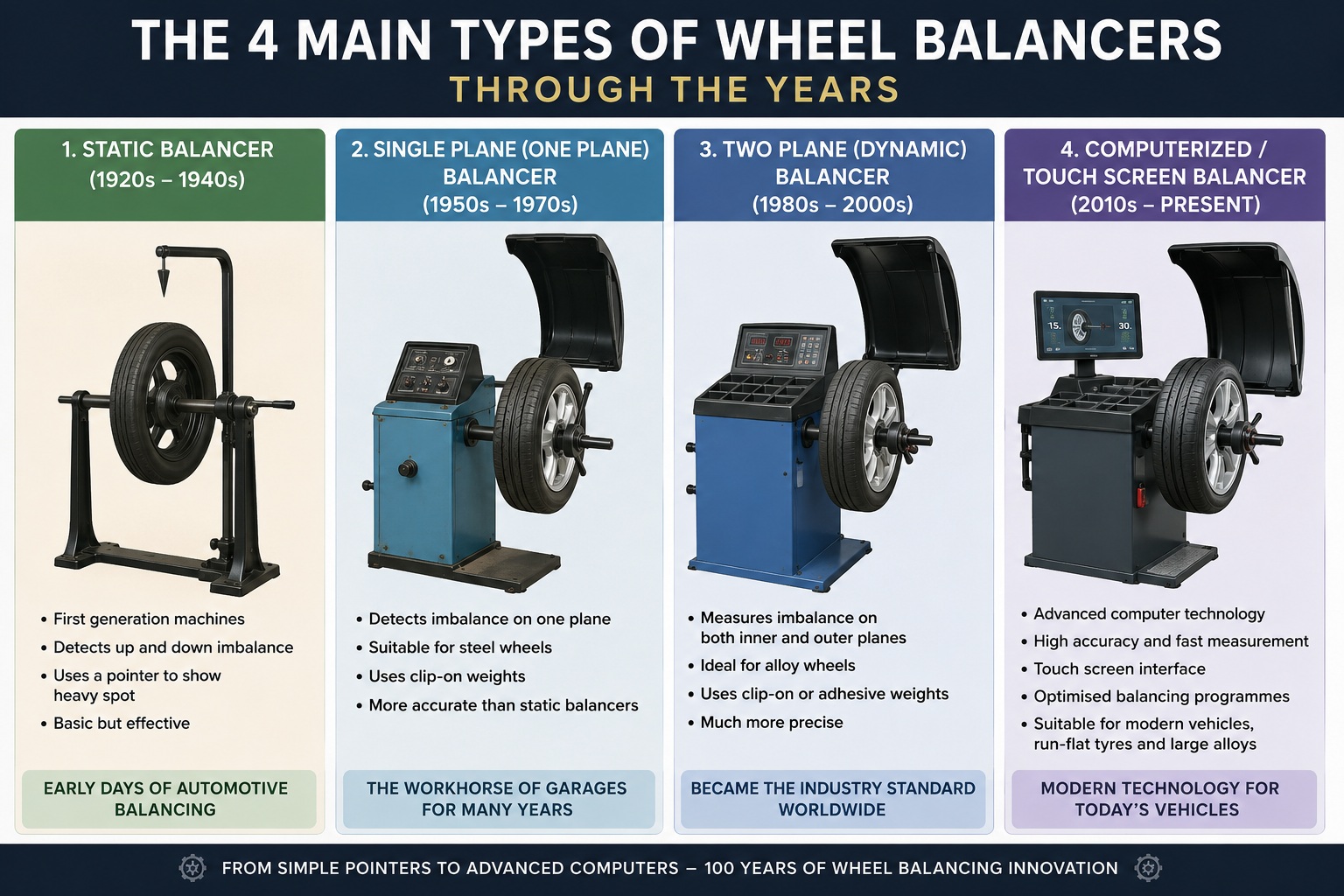
Modern balancing machines spin the wheel at speed and measure any imbalance.
The machine then tells the technician precisely:
- where the imbalance exists,
- and how much weight is required to correct it.
Small balancing weights are then attached to the wheel.
These weights may be:
- clip-on weights,
- adhesive weights,
- or specialist alloy wheel weights.
Once fitted correctly, the wheel rotates smoothly and evenly.
The Early Days of Wheel Balancing
When I first entered the tyre industry many years ago, wheel balancing was often considered an optional extra.
Many tyre depots charged separately for balancing.
Back then:
- vehicles travelled at lower speeds,
- roads were quieter,
- and many cars had simpler suspension systems.
Today things are very different.
Modern vehicles are capable of:
- higher motorway speeds,
- greater cornering forces,
- and far more precise steering.
As a result, wheel balancing has become an essential part of every tyre fitting job.
At Pellon Tyres, balancing is included whenever new tyres are fitted because it is simply part of doing the job properly.
Why Balanced Wheels Matter: Wheel Balancing Uncovered
A Smoother Driving Experience
The most obvious benefit is comfort.
Unbalanced wheels create vibrations that can often be felt through:
- the steering wheel,
- the seat,
- or even the entire vehicle.
Many drivers first notice the problem at speeds between:
- 50mph and 70mph.
A properly balanced wheel eliminates these vibrations and restores smooth driving.
Improved Tyre Life
Tyres are a significant investment.
Unbalanced wheels can cause tyres to wear unevenly.
Over time this can result in:
- flat spots,
- scalloping,
- feathering,
- and irregular tread wear.
By keeping wheels correctly balanced, tyres wear more evenly and often last considerably longer.
Better Fuel Economy
This surprises many motorists.
When wheels are out of balance, the vehicle must work harder to overcome the vibration and rolling resistance.
Whilst the savings may seem small individually, every improvement helps when fuel prices remain high.
Protection for Suspension Components
One of the biggest hidden costs of wheel imbalance is suspension wear.
Constant vibration places additional stress on:
- shock absorbers,
- springs,
- bushes,
- steering joints,
- wheel bearings,
- and suspension mountings.
Around Halifax and Calderdale, where roads can already be challenging, the last thing suspension components need is extra punishment from unbalanced wheels.
Why Yorkshire Roads Can Make Things Worse
Anyone who drives around:
- Halifax,
- Hebden Bridge,
- Brighouse,
- Elland,
- Sowerby Bridge,
- and the surrounding Calderdale area
knows that our roads are not always perfectly smooth.
The combination of:
- potholes,
- speed bumps,
- rough surfaces,
- steep hills,
- and occasional kerb impacts
can sometimes knock balancing weights off wheels.
This is one of the most common causes of wheel imbalance.
A vehicle can be perfectly balanced one day and vibrating the next simply because a small weight has become detached.
The Rise of Alloy Wheels: Wheel Balancing Uncovered
Another reason wheel balancing has become more important is the popularity of alloy wheels.
Years ago many vehicles were fitted with the following:
- steel wheels,
- smaller tyre sizes,
- and relatively tall tyre sidewalls.
Modern vehicles increasingly use:
- large alloy wheels,
- low-profile tyres,
- and wider tread patterns.
Whilst these look fantastic, they are also more sensitive to imbalance.
Even a tiny imbalance can be felt much more clearly on a modern vehicle than on an older car.
Common Symptoms of Wheel Imbalance
Many motorists are unsure whether they have a balancing problem.
Common warning signs include:
- Steering wheel vibration.
- Seat vibration.
- Dashboard shaking.
- Uneven tyre wear.
- Increased road noise.
- Vibration that appears at specific speeds.
If these symptoms occur, it is always worth having the wheels checked.
How Often Should Wheels Be Balanced? Wheel Balancing Uncovered
A good rule of thumb is to have wheel balancing checked:
- Whenever new tyres are fitted.
- If a wheel weight comes off.
- After hitting a severe pothole.
- If unusual vibrations develop.
- During routine tyre inspections.
Many manufacturers also recommend balancing checks every 6,000 to 10,000 miles.
Modern Technology Has Improved Things
Thankfully, tyre manufacturing has improved enormously.
Today’s tyre factories use:
- computer-controlled machinery,
- laser measurement systems,
- precision moulding techniques,
- and strict quality control procedures.
As a result, tyres are generally far more consistent than they were decades ago.
Similarly, wheel balancing machines have become incredibly accurate.
Modern equipment can detect even the smallest imbalance and help ensure a smooth ride.
Wheel Balancing Versus Wheel Alignment
Customers often confuse wheel balancing with wheel alignment.
They are completely different services.
Wheel balancing corrects:
- weight distribution around the wheel.
Wheel alignment corrects:
- steering angles,
- tracking,
- camber,
- and suspension geometry.
Both are important, but they solve different problems.
At Pellon Tyres, we regularly perform both services depending on the vehicle’s needs.
Why We Balance Every Wheel We Fit
At Pellon Tyres Halifax, wheel balancing is no longer viewed as an optional extra.
It is simply part of professional tyre fitting.
Every new tyre we fit is balanced before the vehicle leaves the workshop.
This ensures:
- smoother driving,
- better tyre life,
- improved comfort,
- and increased customer satisfaction.
It also means customers can drive away knowing their vehicle is performing exactly as it should.
Final Thoughts: Wheel Balancing Uncovered
Wheel balancing may not be the most glamorous part of vehicle maintenance, but it remains one of the most important.
A few grams of imbalance can create surprising problems once a vehicle reaches motorway speeds.
From improved comfort and tyre life to better suspension protection and safety, the benefits are significant.
At Pellon Tyre and Autocentre Halifax, we continue helping motorists throughout Calderdale enjoy smoother, safer and more comfortable driving by ensuring every wheel we fit is balanced correctly.
Because sometimes the smallest adjustments make the biggest difference.