Tyres Have Changed Since the 1980s
Tyres Have Changed Since the 1980s
Table of Contents
Tyres Have Changed Since the 1980s
How Tyres Have Changed Since the 1980s – Memories of an Old Yorkshire Tyre Man
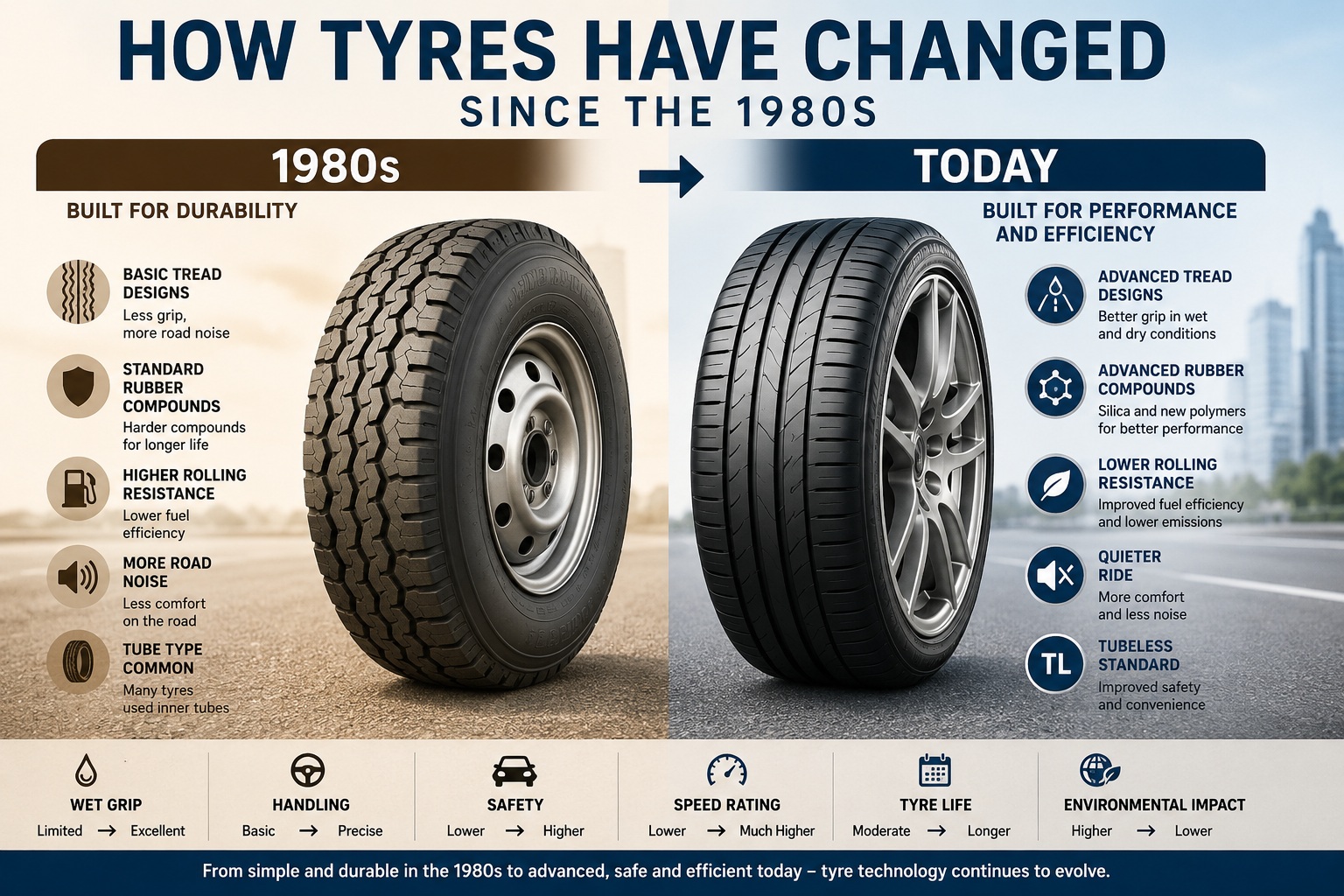
When I first started working with tyres, things were very different from the tyre trade that we know today.
I’ve been around tyres for most of my working life, and when we opened Pellon Tyre & Autocentre here in Halifax in 1989, the cars, the equipment and especially the tyres were a completely different world.
Sometimes when I look around our workshop today at the huge alloy wheels, low-profile tyres, TPMS valves and sophisticated wheel alignment equipment, I wonder what the young Eric would have thought about it all!
Back in the Days of 13-Inch Wheels: Tyres Have Changed Since the 1980s
Younger drivers might find this difficult to believe, but back in the 1980s a 13-inch tyre was completely normal.
Sizes such as 145R13, 155R13 and 165R13 were everyday bread-and-butter sizes for tyre depots across Britain.
Cars such as the Ford Escort, Austin Metro, Vauxhall Astra and Ford Fiesta ran around on tyres that look incredibly narrow compared with today’s standards.
A 15-inch wheel seemed quite large back then.
Today we regularly see family cars arriving at Pellon with 18, 19 and even 20-inch wheels.
The change has been enormous.
Remember When Tyres Had an Inner Tube?
Another thing younger motorists may not realise is that inner tubes were still part of everyday tyre fitting.
Tubeless tyres had already become established, of course, but we still dealt with tubes regularly, particularly on older cars and certain wheel types.
Puncture work could be a different business as well.
You learned how to find the tiny hole in an inner tube, repair it correctly and check the tyre carefully before putting everything back together.
There was a lot of skill involved, and like most things in the tyre trade, you learned by actually doing the job.
Cross-Ply to Radial Tyres: Tyres Have Changed Since the 1980s
One of the great changes in tyre history was the move from the old cross-ply construction to radial tyres.
Radials had become increasingly common well before the 1980s, but when I first entered the tyre trade you could still come across older cars fitted with cross-ply tyres.
The radial tyre transformed road holding, tyre life and general driving behaviour.
Today we take radial construction completely for granted.
Back then it represented a massive technological step forward.
Tyres Were Taller – Much Taller!
Look at a photograph of an ordinary family car from the 1970s or 1980s and then compare it with a modern car.
One of the first things you’ll notice is the amount of rubber between the wheel rim and the road.
Tyres had much deeper sidewalls.
Today we call these higher-profile tyres.
Modern cars have gone in completely the opposite direction.
Large alloy wheels combined with low-profile tyres have become fashionable and, in many cases, necessary to provide the handling characteristics expected from modern vehicles.
A tyre such as a 225/40R18 would once have looked like something belonging on an exotic sports car.
Now it’s an everyday tyre size.
Remember the Famous Tyre Names? Tyres Have Changed Since the 1980s
This is another part I enjoy remembering.
Over the years I’ve watched tyre manufacturers come and go, brands change ownership and tyre technology move forward at an incredible pace.
Names such as Michelin, Goodyear, Dunlop, Pirelli and Continental have been familiar to British motorists for generations.
Then there were brands and tyre patterns that immediately take me back to particular periods in my career.
Ask an old tyre man about some of the great tyre names of the past and you’ll probably keep him talking for hours!
I remember my own days working with Goodyear and being involved in rallying when motorsport played a huge part in developing and promoting tyre technology.
What manufacturers learned on rally stages and racing circuits eventually found its way onto the tyres ordinary motorists used on Britain’s roads.
Winter Tyres Have Changed Too
Growing up and working in Yorkshire certainly teaches you about bad weather.
Halifax and Calderdale aren’t exactly famous for being flat!
When snow arrives, our hills quickly show the difference between a vehicle that can find grip and one that can’t.
Winter tyre technology has improved enormously over the years.
Modern compounds remain flexible at lower temperatures, and sophisticated tread patterns help clear water, slush and snow.
We’ve also seen the enormous growth of the all-season tyre.
Products such as the Michelin CrossClimate range have changed the way many British motorists think about tyres.
For somewhere like Halifax, where we can have sunshine one minute and pouring rain shortly afterwards, a quality all-season tyre can make a great deal of sense.
Tyres Have Become Much More Sophisticated: Tyres Have Changed Since the 1980s
A modern tyre may still look like a round piece of black rubber, but there’s an incredible amount of engineering hidden inside it.
Modern tyre manufacturers work on:
- Wet braking performance
- Rolling resistance
- Fuel economy
- Road noise
- Comfort
- High-speed stability
- Aquaplaning resistance
- Wear characteristics
- Electric vehicle requirements
Compounds now contain incredibly sophisticated combinations of materials, including different forms of silica.
Computer modelling allows manufacturers to develop tread patterns in ways we couldn’t have imagined when I started in the trade.
Then Along Came Run-Flat Tyres
Run-flat tyres were another big development.
The idea was straightforward: if the tyre lost pressure, specially reinforced sidewalls could support the vehicle for a limited distance, allowing the driver to get somewhere safe rather than immediately stopping at the roadside.
BMW in particular became strongly associated with run-flat technology.
They certainly divided opinion amongst motorists and tyre fitters!
Some drivers liked the security they provided, while others preferred the comfort and characteristics of conventional tyres.
Whatever your opinion, they were another example of how far tyre engineering had moved.
TPMS Changed Things Again: Tyres Have Changed Since the 1980s
Then came Tyre Pressure Monitoring Systems – TPMS.
Once upon a time, checking tyre pressure meant getting the gauge out.
Now the car itself can tell the driver when tyre pressure drops.
That’s undoubtedly a useful safety development.
At Pellon Tyres we now routinely deal with TPMS valves and sensors – something that simply wasn’t part of the everyday tyre fitter’s job when we opened in 1989.
Electric Cars Are Changing Tyres Again
Just when you think the tyre industry has settled down, along come electric vehicles!
EVs present tyre manufacturers with another challenge.
Electric cars can be heavier because of their batteries, and electric motors can deliver their torque almost instantly.
Noise is important too.
When you remove the sound of a petrol or diesel engine, tyre and road noise become much more noticeable inside the car.
Manufacturers are therefore developing tyres specifically suited to electric and hybrid vehicles, concentrating on load capacity, rolling resistance, durability and noise.
The tyre continues to evolve.
Yet One Thing Hasn’t Changed: Tyres Have Changed Since the 1980s
After all these years, there’s one thing that hasn’t altered.
Those four patches of rubber are still the only parts of your car actually touching the road.
You can have ABS, traction control, stability control, cameras, radar and all the other technology fitted to a modern car.
But ultimately, it all depends on the tyres being able to grip the road.
That’s something I’ve believed throughout my working life.
From 13-Inch Steel Wheels to 20-Inch Alloys
When I look back to the 1980s, the transformation really is remarkable.
We’ve gone from little steel wheels and tall, narrow tyres to enormous alloys, ultra-low-profile tyres, run-flats, TPMS and tyres specifically designed around electric vehicles.
Yet here at Pellon Tyre & Autocentre in Halifax, we’re still doing fundamentally the same job.
A customer comes in.
We look at their tyres.
We give them our advice.
And importantly, if they don’t need replacing, we tell them.
That’s the way I’ve always believed an independent tyre business should operate.
Having spent most of my life in the tyre trade, I’m sometimes asked whether tyres really are better today.
Without hesitation, I’d say yes.
Modern tyres offer levels of wet grip, braking, handling and durability that we could only have dreamed about decades ago.
But I must admit there’s still something that makes me smile when I see an old photograph of an Ford Escort sitting on a set of little 13-inch wheels.
Perhaps that’s just the old tyre man in me! Anyhow, here is an interesting post about the history of car tyres
The tyre trade has given me a lifetime of memories.
And even after all these years, I’m still fascinated to see what comes next.