Where Did All The Scrap Yards Go
Table of Contents
Where Did All The Scrap Yards Go
Where Did All The Scrap Yards Go
Whatever Happened to the Old Scrap Yards? A Motoring Tradition That Quietly Disappeared
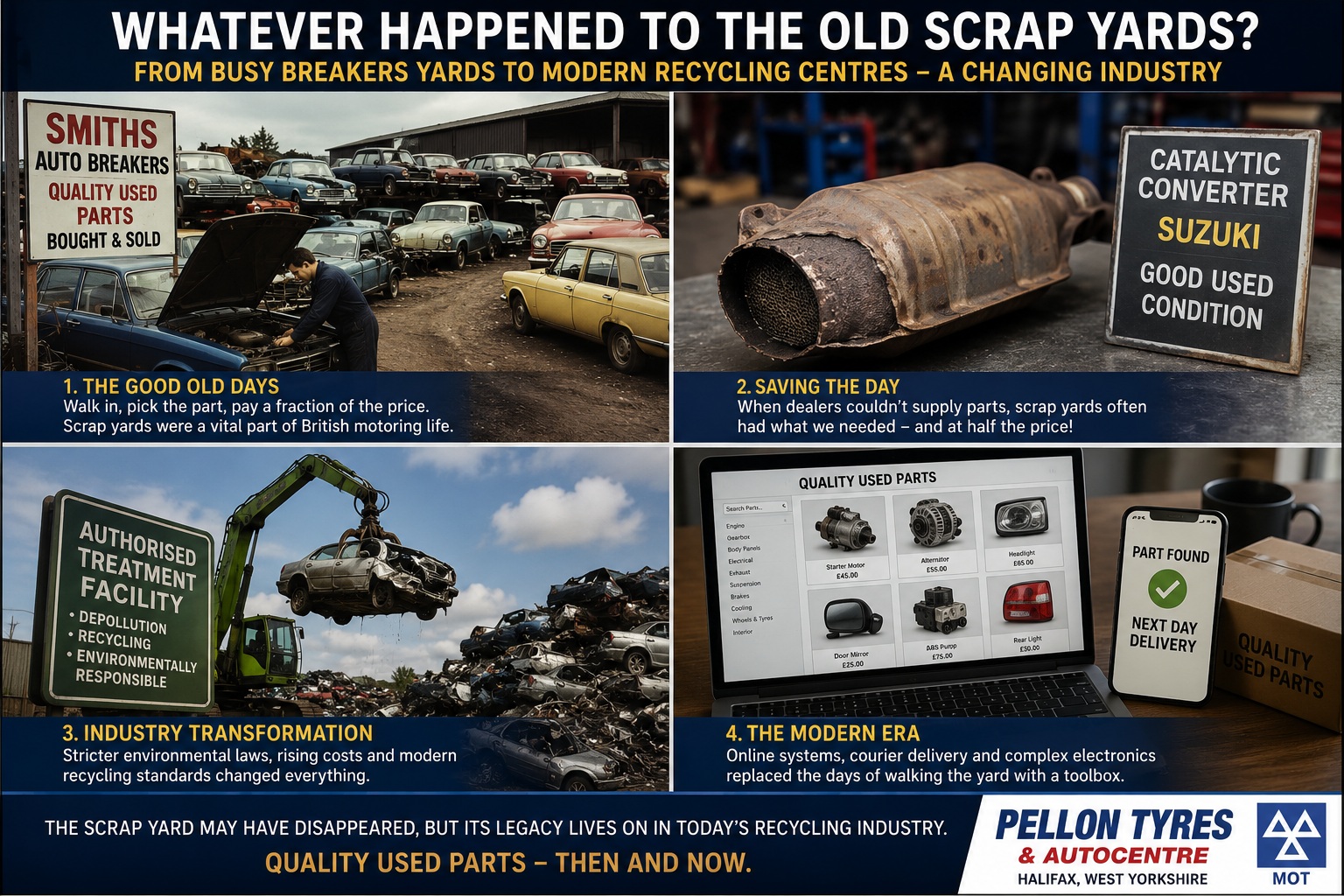
For many years, one of the most useful places in the motor trade was the good old-fashioned scrap yard.
Long before internet parts suppliers and online auction sites appeared, motorists and garages across Britain relied heavily on local car breakers to keep vehicles on the road. If you needed a difficult-to-find part quickly and cheaply, the local scrapyard was often the first place you tried.
Here at Pellon Tyre and Autocentre, we regularly used scrap yards years ago to help customers keep repair costs sensible. In many cases, second-hand parts could save motorists hundreds of pounds compared with buying new dealer parts.
Sometimes it was the only realistic option.
I still remember travelling all the way to Sunderland many years ago searching for a catalytic converter for a Suzuki because the dealer simply could not supply one at the time. Fortunately, the scrapyard had exactly what we needed, and at roughly half the price of a new part, the customer was absolutely delighted.
Back then, scrapyards often rescued motorists from difficult situations.
So what happened to them?
Because if you look around today, many of the old-style car breakers and self-service scrapyards have either disappeared completely or changed beyond recognition.
The Golden Age of the Traditional Scrap Yard: Where Did All The Scrap Yards Go
Years ago, almost every large town seemed to have at least one busy scrapyard.
Places around Yorkshire, Lancashire and the North East were full of them.
You could walk through rows of damaged or worn-out vehicles carrying your own tools, searching for:
- engines
- starter motors
- alternators
- doors
- mirrors
- gearboxes
- catalytic converters
- wheels
- suspension parts
Many motorists became surprisingly knowledgeable simply from wandering around scrap yards on Saturday mornings.
Older mechanics often knew exactly which yards specialised in certain makes of vehicle.
If you needed a Ford part, you went one place. If you wanted something unusual for an imported Japanese car, another yard might be better.
It became part of British motoring culture.
Why Scrap Yards Were So Important: Where Did All The Scrap Yards Go
Scrap yards served several very important purposes.
They:
- kept repair costs down
- provided hard-to-find parts
- recycled usable components
- helped older cars stay on the road
- supported local garages
For many working families around Halifax and Calderdale, scrapyards helped make motoring affordable.
If a car needed an expensive new part from the dealer, many customers simply could not justify the cost on an older vehicle.
A good second-hand part often solved the problem at a fraction of the price.
So Why Have So Many Scrap Yards Closed?
After looking at how the industry changed over the years, there is actually a very clear answer.
The closures mainly happened because several huge changes all arrived at the same time.
Modern Cars Became Much More Complex
One major reason is that modern vehicles are now far more complicated than older cars.
Years ago, many components were simple mechanical items that could easily be removed and reused.
Today’s vehicles contain:
- complex electronics
- coded modules
- security systems
- sensors
- computer-controlled components
Many modern parts now require specialist programming after installation.
This made traditional scrapyard part swapping far more difficult.
Strict Environmental Regulations Changed Everything
Environmental legislation also transformed the industry dramatically.
Modern scrapyards must now operate under extremely strict environmental and waste management rules.
Vehicles contain:
- oils
- coolants
- battery acid
- refrigerants
- hazardous materials
Proper disposal and depollution procedures are now tightly regulated.
The introduction of the Scrap Metal Dealers Act 2013 brought major licensing requirements, ID checks, cash payment bans and tighter enforcement rules.
While these rules improved environmental standards and reduced metal theft, they also increased costs significantly for smaller independent scrapyards.
Many smaller family-run businesses simply could not justify the expense.
Rising Land Values Changed the Industry: Where Did All The Scrap Yards Go
Another major factor was property development.
Many old scrapyards occupied valuable industrial land close to towns and cities.
Over time, the land itself often became worth more than the scrapyard business.
Across the UK, numerous old scrapyard sites were eventually redeveloped into the following:
- housing
- retail parks
- warehouses
- industrial units
This gradually reduced the number of traditional vehicle dismantlers.
Online Parts Systems Replaced Walking Around Yards
The internet also changed everything.
Today, many dismantlers operate through sophisticated online stock systems rather than allowing customers to wander around vehicle rows.
Parts are now:
- photographed
- catalogued
- barcoded
- listed online
- courier delivered nationwide
In many ways, the old-style self-service scrapyard evolved into a professional automotive recycling industry.
The traditional experience of walking through muddy rows of damaged cars with a toolbox has largely disappeared.
Cars Last Longer Than They Used To: Where Did All The Scrap Yards Go
Another interesting reason is that modern cars generally survive longer.
Years ago, rust destroyed huge numbers of vehicles relatively early in life.
Around Halifax in the 1970s and 1980s, rust was a massive killer of British cars due to salted winter roads and poor corrosion protection.
Today’s vehicles are far better protected against corrosion.
As a result:
- fewer younger cars reach scrapyards
- usable second-hand parts are scarcer
- dismantling economics changed
Manufacturer Supply Chains Improved
Back when we travelled to Sunderland for that Suzuki catalytic converter, dealer parts shortages were much more common.
Today, manufacturer parts distribution systems are usually far better organised.
Many genuine parts can now arrive overnight from large distribution centres.
Although supply problems still happen occasionally, especially after recent global shortages, dealerships are generally far better stocked than they were years ago.
The scrap industry became more professional.
One thing that should be said is that the modern vehicle recycling industry is actually far more professional and environmentally responsible than it used to be.
Modern authorised treatment facilities now recycle huge percentages of every vehicle safely and efficiently.
Large recycling companies invest heavily in:
- depollution systems
- recycling technology
- online inventory systems
- environmental compliance
The industry did not completely disappear — it evolved.
Family Succession Problems Also Played a Part
Interestingly, another issue mentioned within the recycling industry itself is that many older family-run scrapyards simply had nobody wanting to continue the business.
Younger generations often preferred cleaner or more modern industries.
The old scrapyard life was the following:
- physically demanding
- dirty
- heavily regulated
- increasingly expensive to run
Without younger family members taking over, many long-established businesses eventually closed.
The Final Conclusion – Where Did All The Scrap Yards Go
After looking at all the evidence, the answer becomes quite clear.
Traditional scrapyards mainly disappeared because:
- environmental regulations became much stricter
- modern cars became more electronic and complex
- online parts systems changed customer behaviour
- land values increased
- running costs became too high
- family succession declined
In truth, the old-fashioned self-service scrapyard slowly became economically impossible in its traditional form.
The industry itself did not vanish completely — it transformed into today’s modern vehicle recycling and online parts businesses.
But for many older motorists and mechanics around Halifax and Yorkshire, something important was lost along the way.
There was always something strangely fascinating about wandering around a traditional scrapyard searching for that elusive part which could get a customer back on the road at a sensible price.
Final Thoughts
The old scrapyard was once an important part of British motoring life.
It helped ordinary motorists keep older vehicles running affordably and gave garages practical solutions when new parts were unavailable or simply too expensive.
Although modern recycling centres are cleaner, safer and more efficient, many mechanics still remember the old days of searching through rows of vehicles looking for that one perfect second-hand part.
At Pellon Tyre and Autocentre, those memories remain part of how the motor trade evolved over the years.
Leave a Reply
Want to join the discussion?Feel free to contribute!