What happens to Scrap Tyres
What happens to Scrap Tyres
Table of Contents
What happens to Scrap Tyres
What happens to Scrap Tyres – Giving Yesterday’s Tyres a New Lease of Life
Every year, millions of tyres reach the end of their working lives, and one of the biggest challenges facing the tyre industry is deciding what to do with them once they’ve been removed from our cars.
Fortunately, things have changed enormously over the past twenty years.
When I first started fitting tyres over sixty years ago, worn tyres often ended up in landfill or simply piled up in huge waste dumps. Thankfully, those days are largely behind us. Today, the tyre industry has become far more environmentally responsible, with modern recycling techniques finding exciting new uses for old tyres that would otherwise become waste.
As someone who has spent a lifetime fitting tyres here at Pellon Tyres in Halifax, I find it fascinating to see how something that was once considered worthless is now being transformed into valuable new products.
Tyres Are Built to Last
Modern tyres are incredibly strong.
They have to withstand thousands of miles of driving, heavy braking, potholes, wet roads and changing weather conditions throughout the year.
That strength makes them brilliant for motorists, but it also means they don’t simply break down once they’ve been removed from a vehicle.
For that reason, responsible recycling is essential.
Modern Tyre Recycling: What happens to scrap tyres?
Today, the majority of scrap tyres collected from garages like Pellon Tyres are sent to specialist recycling facilities.
There, the tyres are carefully processed using powerful machinery that separates the rubber from the steel reinforcement and textile fibres.
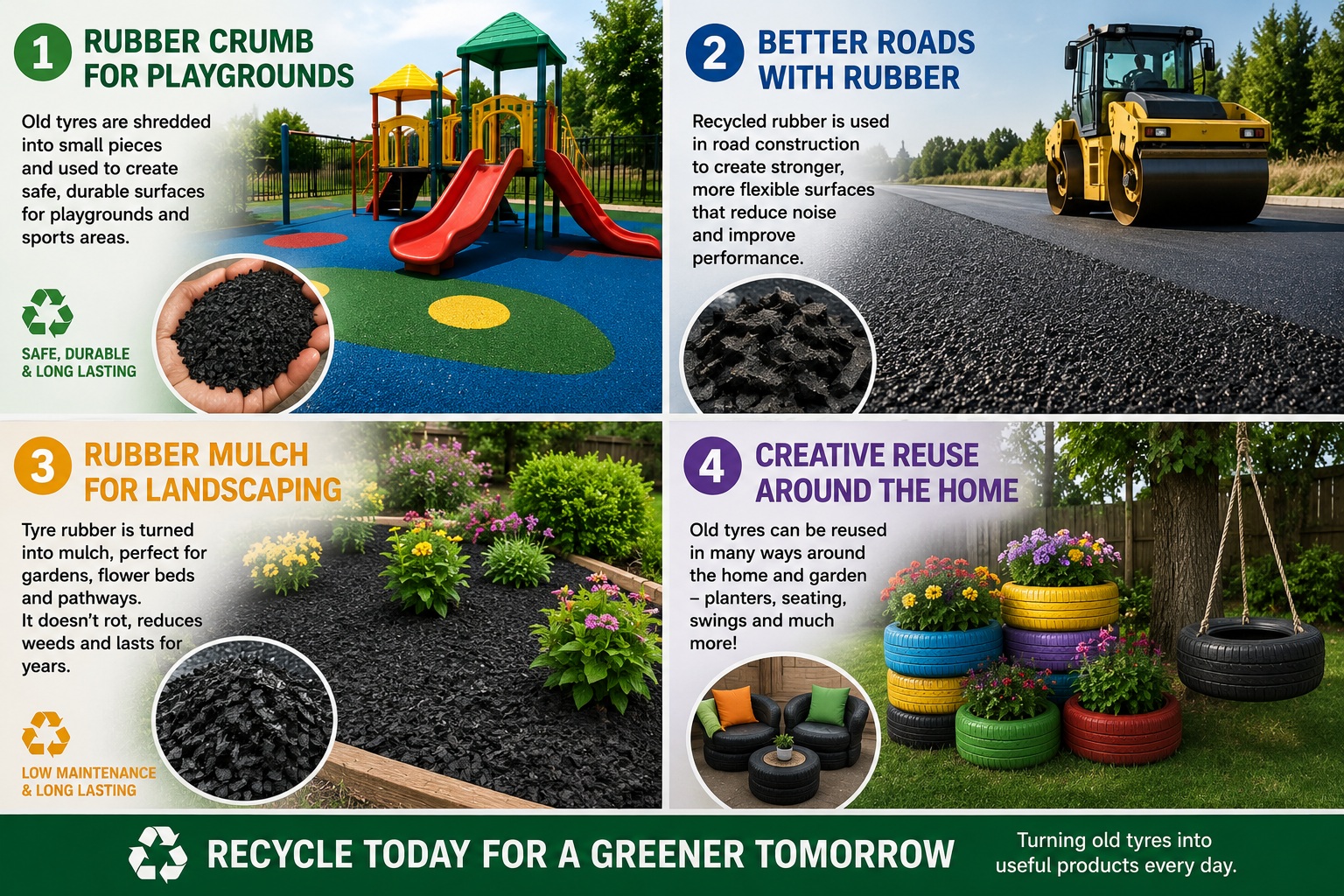
The recycled rubber can then be turned into hundreds of useful products.
Some of the most common include the following:
- Rubber crumb for sports pitches.
- Children’s playground safety surfaces.
- Equestrian arenas.
- Landscaping products.
- Rubber mats.
- Industrial flooring.
- Road surfacing.
- Construction materials.
It’s remarkable just how many second lives an old tyre can have.
Better Roads Through Recycling
One development I particularly like is the increasing use of recycled rubber in road construction.
Small pieces of recycled tyre rubber are blended into certain road surfaces.
The result can be:
- Reduced road noise.
- Improved flexibility.
- Better resistance to cracking.
- Longer-lasting road surfaces.
Considering the amount of traffic we see around Halifax and Calderdale every day, anything that helps roads last longer has to be good news.
Creative Uses at Home: What Happens to Scrap Tyres
Of course, not every old tyre has to be processed by industry.
Over the years I’ve seen some wonderfully imaginative ideas for reusing old tyres in gardens.
In fact, I’ve even painted a few tyres myself and used them around my own garden.
People often laugh and ask whether I ever get fed up of looking at tyres after spending all day at work.
The answer is no!
With a little imagination, an old tyre can become the following:
- A colourful flower planter.
- A raised vegetable bed.
- A garden feature.
- A swing for the grandchildren.
- A decorative pond surround.
- Outdoor seating.
- A compost bin.
- A wildlife habitat.
It’s amazing what a coat of paint and a little creativity can achieve.
Rubber Mulch Is Becoming More Popular
One of the fastest-growing uses for recycled tyres is rubber mulch.
Unlike traditional bark chippings, rubber mulch doesn’t rot away and requires very little maintenance.
It can be used around flower beds, pathways and children’s play areas where it provides a soft, durable surface.
Many local councils now use recycled rubber in parks because it offers excellent cushioning while making productive use of waste materials.
New Technologies Continue to Develop: What Happens to Scrap Tyres
The tyre industry never stands still.
Manufacturers and recycling companies are continually finding better ways to recover valuable materials from old tyres.
One particularly exciting process is known as pyrolysis.
Without becoming too technical, this involves heating tyres in a controlled environment without oxygen.
The process produces valuable materials that can be reused in manufacturing, helping reduce waste while recovering useful resources from worn-out tyres.
It’s another example of how innovation continues to improve the environmental performance of our industry.
Looking After Our Environment
At Pellon Tyres, we take our environmental responsibilities seriously.
Every tyre we remove from a customer’s vehicle is handled responsibly and collected through approved waste management companies.
Tyres should never be fly-tipped or burnt illegally.
Not only can this damage the environment, but it can also create serious pollution and safety risks.
Responsible disposal protects both our countryside and future generations.
Every Little Helps: What happens to Scrap Tyres
I’ve always believed that small improvements add up.
Whether it’s fitting fuel-efficient tyres, maintaining the correct tyre pressures, recycling worn tyres or finding new uses for old materials, every positive step helps reduce waste and protect our environment.
As motorists, we all have a part to play.
A Tyreman’s Thoughts
When I first entered the tyre trade, I never imagined I’d one day be writing about recycled playgrounds, quieter roads or environmentally friendly tyre recycling.
Yet here we are.
The tyre industry has transformed itself over the years, not only producing safer and better-performing tyres but also finding increasingly clever ways to recycle them once they’ve reached the end of their useful life.
It’s another example of how engineering, innovation and common sense can work together.
The next time you have a new set of tyres fitted at Pellon Tyres in Halifax, you can be reassured that your old tyres won’t simply become waste.
Instead, there’s every chance they’ll begin a brand-new life, helping to build safer roads, softer playgrounds or perhaps even brighten somebody’s garden with a splash of colour.
After all, even an old tyre deserves a second chance.
Check out our waste environmental procedures.