Goodyear Blue Streak Racing Tyres
Goodyear Blue Streak Racing Tyres
Table of Contents
Goodyear Blue Streak Racing Tyres
My Own Long Association with Goodyear Tyres and Motorsport
When I read that Goodyear is expanding its famous Blue Streak historic racing tyre range, it immediately brought back many memories from my own early days in the tyre trade.
As regular readers of my blog will know, I have been involved with tyres for over 60 years. During that time, I have seen enormous changes in tyre technology, from the old cross-ply tyres of my youth to the sophisticated radial, run-flat, winter and electric vehicle tyres that we fit today at Pellon Tyres here in Halifax.
However, some of my fondest memories go back to the days when I worked for Tyreservices in Huddersfield, which, at that time was owned by Goodyear.
Goodyear wasn’t simply another tyre manufacturer to me. I was actually involved with the company and its products during one of the most exciting periods in motorsport history.
In the 1970s, motorsport felt raw and exciting. Rally cars sounded incredible, drivers were real characters, and spectators could get remarkably close to the action.
I was fortunate enough to be involved in supporting the Goodyear rally scene, including some memorable winter rally events. These experiences helped build my lifelong respect for Goodyear as a tyre manufacturer.
So, when I read about the expansion of the legendary Goodyear Blue Streak racing tyre range, I couldn’t help thinking about how the past and present of the tyre industry have come together.
Goodyear isn’t simply looking back at its history. The company is making sure that some of the world’s greatest historic racing cars can continue competing on tyres appropriate for the eras in which those cars originally raced.
And for somebody like me, who remembers those days first-hand, I think that’s absolutely wonderful.
The Famous Goodyear Blue Streak Racing Tyres Return in a Much Bigger Way
Goodyear has announced a major expansion of its legendary Blue Streak range, strengthening its commitment to the rapidly growing world of historic motorsport.
The company has added 57 additional tyre sizes and specifications, significantly increasing the number of historic racing cars that can use Goodyear tyres.
The expanded range covers an incredible variety of machinery.
We’re talking about everything from pre-war Bentley, ERA and Alfa Romeo racing cars to the great sports cars and Formula cars of the 1950s, 60s and 70s.
Then there are legendary endurance racing machines such as the Porsche 917 and Ferrari 512, cars that fought some of the greatest battles ever seen at Le Mans and in the World Sportscar Championship.
Goodyear is also supporting the smaller, lightweight racing cars that frequently punched above their weight, including famous names such as Matra, Lola and Chevron.
For the more modern classics of the 1980s onwards, Goodyear is also expanding its historic Eagle range to support GT2, LMP2, LMP1 and Super Touring machinery.
To me, this is about far more than nostalgia.
These cars were built to be driven, and there’s something very special about seeing a genuine historic racing car being used as its designers intended rather than simply sitting silently in a museum.
My Days at Goodyear-Owned Tyreservices in Huddersfield: Goodyear Blue Streak Racing Tyres
My own association with Goodyear really developed during my days working at Tyreservices in Huddersfield.
At the time, Tyreservices was owned by Goodyear, and this brought me into much closer contact with the company’s products and motorsport activities.
I was a younger man then, full of enthusiasm for the tyre trade, although I don’t suppose I could possibly have imagined that all these years later I would still be writing about tyres in 2026!
Those days gave me experiences and memories that have stayed with me throughout my life.
Motorsport was an important part of tyre development. Manufacturers such as Goodyear used racing and rallying to push their tyres to the absolute limit.
On a racing circuit, tyres had to cope with extreme cornering forces, high speeds and enormous heat.
Rallying was perhaps even more challenging because conditions could change constantly. A tyre might face dry tarmac, standing water, mud, ice or snow, sometimes all during the same event.
For a young tyre man like myself, it was fascinating.
And I loved every minute of it.
Supporting Goodyear Rallying in the 1970s
Some of my strongest memories involve supporting rallying during the 1970s.
These were the days of proper rally cars and some incredibly talented drivers.
I remember being involved with winter rally events, including the Mintex and HRCR scene. On one memorable occasion, we were out through the night around Scarborough in the middle of winter.
Anybody who has been involved with rallying will know that it isn’t always glamorous!
There can be hours of waiting around in freezing weather, followed by frantic activity as cars arrive and tyres need attention. Then suddenly the cars disappear into the darkness again, leaving behind the smell of hot engines, petrol and tyres.
But there was a wonderful atmosphere.
Everybody was there because they loved motorsport.
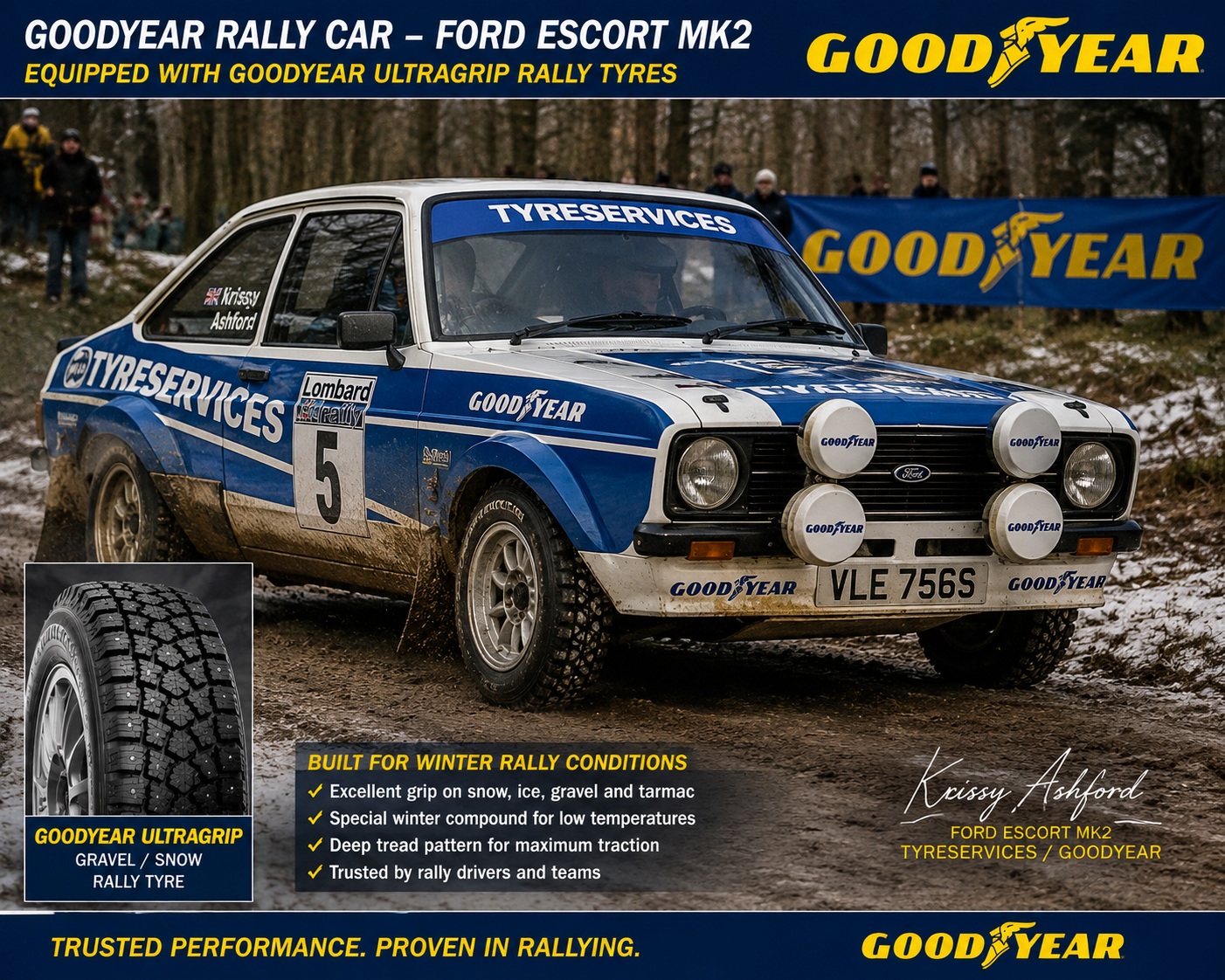
I also remember supporting Krissy Ashford, whose Ford Escort Mk2 carried Tyreservices and Goodyear support. The car was white with a distinctive blue stripe and looked exactly like a proper rally car should.
The Ford Escort Mk2 itself has become one of the great icons of rallying history.
Even today, decades later, these cars remain enormously popular in historic rallying, and good examples can be worth considerable amounts of money.
When I see an Escort Mk2 competing today, it immediately takes me back to those earlier days.
Goodyear’s Incredible Motorsport Record: Goodyear Blue Streak Racing Tyres
Goodyear has one of the greatest motorsport records of any tyre manufacturer in history.
The figures are astonishing.
The company achieved 368 Formula One victories, an extraordinary record from an era when Goodyear tyres were fitted to some of the greatest Formula One cars ever built.
Goodyear has also achieved 14 overall victories at the 24 Hours of Le Mans.
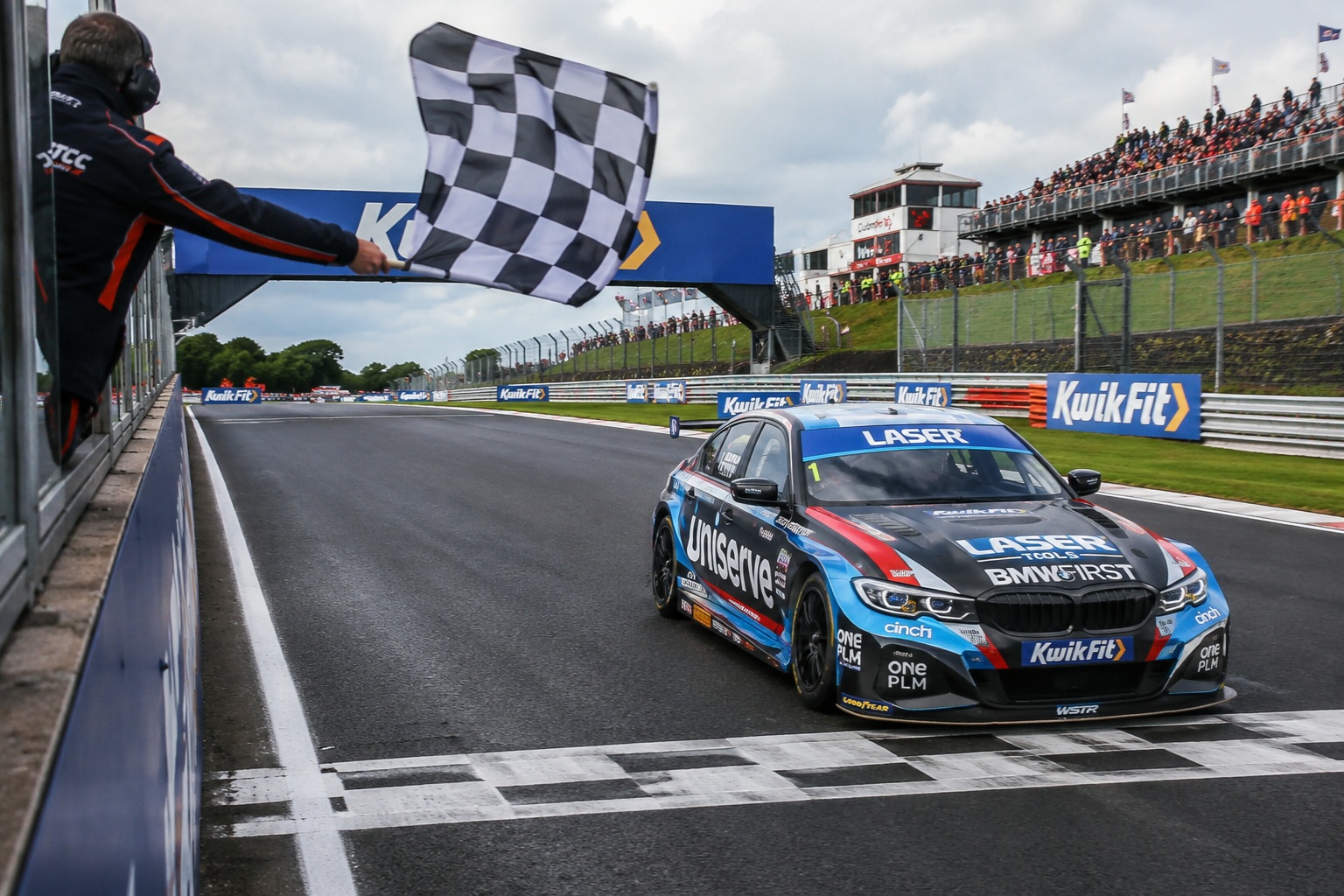
Here in Britain, the company has won more races in the British Touring Car Championship than any other tyre manufacturer since the championship began in 1958.
Then, of course, there is NASCAR.
Goodyear has supplied tyres to NASCAR for more than 70 years and has been the exclusive tyre supplier to NASCAR’s three national series since 1997.
When you look at that history, the expansion of the Blue Streak range makes perfect sense.
Goodyear has played an enormous part in motorsport history, and many legendary racing cars originally competed on its tyres.
Now, those same types of cars can continue racing on Goodyear tyres designed to preserve the authentic performance and appearance of their era.
The Great Porsche 917 and Ferrari 512 Battles
One part of the new Blue Streak expansion that particularly caught my attention is the availability of wider tyre specifications for the great sports racing cars of the 1960s and 1970s.
This was a golden age of endurance racing.
The Porsche 917 and Ferrari 512 became legendary rivals, competing at incredible speeds at circuits around the world.
The Porsche 917, in particular, is remembered as one of the greatest racing cars ever built. It was enormously powerful and frighteningly fast.
These weren’t racing cars filled with computers and electronic driver aids.
The drivers relied on their own skill, courage and feel for the car.
And, of course, everything ultimately depended on those four relatively small contact patches between the tyres and the racing surface.
That’s something I’ve always said throughout my life in the tyre trade.
No matter how powerful, expensive or sophisticated a car might be, the tyres are the only parts actually connecting it to the road.
That was true in the 1970s, and it’s still true today.
Keeping Historic Racing Authentic: Goodyear Blue Streak Racing Tyres
One of the most important aspects of the expanded Goodyear range is authenticity.
Historic racing isn’t simply about putting modern tyres onto old cars and driving them as fast as possible.
The cars should behave and feel in a way that is appropriate for their period.
That’s why the FIA has strict Appendix K homologation requirements governing historic motorsport.
Goodyear says that the approved production methods, moulds, specifications and performance characteristics of its historic tyres will be preserved.
I think that’s extremely important.
If you fitted a historic 1960s racing car with completely modern racing tyres providing vastly more grip than the originals, you would fundamentally change how the car handled.
The suspension, chassis and brakes were all designed around the tyres available at the time.
Historic racing tyres therefore need to provide the right balance between modern manufacturing quality and authentic period performance.
Goodyear Blue Streak for the Earlier Racing Generations
Goodyear has divided its historic racing tyre strategy into two main brands.
The famous Blue Streak name will cover pre-1980s competition cars, while the Goodyear Eagle brand will support historic racing categories from the 1980s through to more recent machinery.
I think this makes good sense because it reflects the different generations of motorsport.
The Blue Streak name itself has a wonderful historic sound to it.
For enthusiasts of classic American racing cars, Formula cars, touring cars and sports racers, it is a name that immediately brings back memories of a different age.
The expanded range now includes tyres suitable for racing machinery going all the way back to the 1920s and 1930s.
That means cars from manufacturers such as Bentley, ERA and Alfa Romeo can continue competing with tyres that provide the appropriate period appearance and performance.
Imagine watching one of those huge old Bentleys thundering around a circuit.
That’s proper motorsport history brought back to life.
The Lightweight Giant Killers: Goodyear Blue Streak Racing Tyres
I was also pleased to see names such as Lola, Chevron and Matra mentioned in connection with the expanded range.
These lightweight sports racing cars were often incredibly successful.
They might not always have had the biggest engines or the most enormous budgets, but their low weight and clever engineering allowed them to compete against much more powerful machinery.
There’s something very British about the idea of a small, lightweight racing car taking on the giants and giving them a good run for their money!
Lola and Chevron, in particular, have a special place in British motorsport history.
Many of these cars still race today at historic events, where spectators can see and hear machinery from motorsport’s golden age being driven hard once again.
My Unforgettable Visit to Goodyear in Luxembourg
One of my greatest personal Goodyear memories was visiting the company’s facilities in Luxembourg.
I was fortunate enough to attend a Goodyear track day where we experienced the company’s Grand Prix X tyres on Vauxhall Cavaliers.
The cars were fitted with 1600cc engines, and we were able to experience the tyres under controlled test conditions.
But the real highlight for me was being driven around the circuit by the legendary Finnish rally driver Timo Mäkinen.
Now, that was an experience!
Timo was one of the famous Flying Finns and a genuine rallying legend. He won the RAC Rally three times and also achieved three victories on the famous 1000 Lakes Rally in Finland.
Sitting alongside a driver of that calibre was something I’ll never forget.
Professional rally drivers operate on another level entirely.
What feels frighteningly fast to an ordinary passenger is completely controlled to them.
Those experiences strengthened my respect for Goodyear and its involvement in motorsport.
They also taught me just how important tyre development is to vehicle performance.
From Goodyear Rally Tyres to Pellon Tyres in Halifax
It’s strange to think about how life develops.
Back then, I was a young tyre man involved with Goodyear, rallying and Tyreservices.
Today, all these decades later, I’m still involved with tyres as the owner of Pellon Tyres here in Halifax.
The industry has changed enormously.
We now fit tyres for electric cars, hybrids, high-performance SUVs and vehicles with wheel sizes that would have seemed enormous when I started out.
My own white Hyundai Tucson hybrid is a perfect example of how much cars have changed.
Yet my enthusiasm for good tyre brands has remained.
I’ve always had great respect for Goodyear because I have genuine personal experience with the company and its products.
It’s not simply a name I’ve read about in a brochure.
Goodyear forms part of my own journey through the tyre trade.
Modern Historic Racing Is Booming: Goodyear Blue Streak Racing Tyres
Historic motorsport has grown enormously in popularity.
Events such as the Goodwood Revival and Silverstone Festival attract huge crowds who want to see legendary racing cars competing once again.
And I can understand why.
Modern racing cars are incredibly fast and technologically advanced, but historic machinery has something different.
It has character.
You can see the drivers working. You can hear the engines, watch the cars moving around under braking and cornering, and often smell the oil and fuel.
For people of my generation, these cars bring back memories.
For younger enthusiasts, they provide an opportunity to experience machinery they might previously have seen only in old photographs or videos.
The fact that Goodyear is adding 57 more sizes and specifications shows that this isn’t some tiny corner of motorsport.
There is genuine demand for authentic tyres for historic competition cars.
From Blue Streak to Goodyear Eagle
While Blue Streak tyres will concentrate on pre-1980 competition cars, the Goodyear Eagle historic range covers the later generations.
And even cars from the 1990s and 2000s are now becoming historic!
That certainly makes me feel old.
Cars from GT2, LMP2, LMP1 and the Super Touring era are now highly sought-after historic racing machines.
I remember when these cars were the latest technology.
The Super Touring era of the British Touring Car Championship was particularly exciting, with manufacturers spending enormous sums of money developing cars that looked vaguely like the family saloons in the showroom but were, underneath, sophisticated racing machines.
Goodyear’s expanded historic portfolio will help keep these cars racing as well.
Why I Think Goodyear Is Doing the Right Thing
I think Goodyear deserves credit for investing in historic motorsport.
Making specialised tyres in relatively low volumes can’t be as straightforward as mass-producing tyres for everyday road cars.
Different sizes, constructions and specifications are required for cars from very different periods.
Yet preserving these tyres helps preserve the cars themselves.
A racing car was designed to race.
Of course, museums have an important role, but there’s nothing quite like seeing a historic competition car driven at speed.
The noise, movement and atmosphere bring history to life.
Goodyear’s Blue Streak expansion means that more of these legendary cars can continue competing on tyres connected with their original racing eras.
Goodyear Tyres: Part of My Own Tyre Trade Story
Reading about this new expansion brought back many happy memories for me.
From my days at Goodyear-owned Tyreservices in Huddersfield to supporting winter rallies around Yorkshire and Scarborough, helping with Krissy Ashford’s Escort Mk2 and travelling to Luxembourg for that unforgettable track experience with Timo Mäkinen, Goodyear has been part of my own tyre-trade story.
More than 60 years after I first entered the motor trade, I still get excited by developments in the tyre industry.
Perhaps that’s one reason I’ve stayed involved for so long.
I have seen cross-ply tyres give way to radials. I’ve watched wheel sizes grow dramatically. I’ve seen the arrival of run-flat tyres, sophisticated winter tyres, all-season tyres and specialist tyres designed for electric vehicles.
But motorsport heritage reminds us where much of that tyre development began.
Racing pushes tyres to their limits.
And lessons learned on the race circuit and rally stage have helped manufacturers improve tyres for ordinary motorists over many decades.
Keeping the Great Racing Cars Alive
For me, the expansion of the Goodyear Blue Streak historic racing tyre range is about much more than adding another 57 sizes to a product catalogue.
It is about preserving motorsport history.
It’s about allowing Bentleys from the 1920s, Formula cars from the 1950s, Porsche 917s and Ferrari 512s from the great endurance racing era, lightweight Lolas and Chevrons, and later GT and touring cars to continue doing what they were built to do.
Race.
And I think Goodyear’s Xavier Fraipont summed it up perfectly when he explained that historic racers don’t choose tyres through nostalgia alone. They need authentic performance, confidence and consistency.
After my own long career in the tyre trade, I completely understand that.
A great racing car deserves the right tyres.
And after all these years, I am proud to say that Goodyear remains one of the tyre brands I admire most.
From the rally stages of my younger days to the historic racing circuits of today, that famous Goodyear name continues rolling on.
And long may it continue.
Leave a Reply
Want to join the discussion?Feel free to contribute!