
Mazda offers improved engine technology.
Table of Contents
Mazda offers improved engine technology.
Mazda offers improved engine technology.
This is great news for the regular mechanic who is sick of hearing about electric cars. Including the billions of dollars that are being thrown at them.
Many small garage owners are fearful for their futures. Including the futures of their families. This news from Mazda could be groundbreaking and may be followed by other car manufacturers.
In regard to normal modern vehicles. Mazda offers improved engine technology.
that have been around forever. Then, there are two main types of engines available. Of course, there are two main types: gasoline combustion engines and diesel engines. Or a diesel compression engine.
To explain the differences, we must first explain the similarities. Hence, of both engine types. In my opinion, we should use a four-cylinder engine. So is the basic model. Because it is common in both petrol and diesel configurations.
As a result, in both diesel and petrol engines, Mazda offers improved engine technology.
The following holds true:. Both engine types convert burning fuel into mechanical energy. Of course, through a common series of explosions. Thus, inside the engine’s combustion chambers. All very basic stuff? These explosions force the crank to rotate. This, in turn, is by design. Forces another piston in the line up into the bore of the next cylinder in the firing order. This repeats the process over and over again. Resulting in the rotation of the engine.
This is where the difference comes in from Mazda. Mazda offers improved engine technology.
In a normal compressed fuel engine. Then the fuel/air mix is compressed and then ignited. Which is what drives the engine. The Mazda system does the same thing as a conventional diesel engine but uses petrol. Subsequently, the fuel/air mixture is first heated and then compressed by the piston. Thus, to the extent at which it creates combustion spontaneously.
This has never been done in the past. The Mazda system works very much the same way as our conventional diesel engines but fires on combustion using petrol. Consequently, it burns much less fuel. Therefore, making the engine much more environmentally friendly.
This now makes up three types of engines: Mazda offers improved engine technology.
Over the years, the basic design of the engines has stayed the same. Regardless of the vehicle manufacturer. Of course, fuel delivery systems do vary, but at the end of the day, the internal process is the same for all vehicle types.
On a diesel engine, there are no spark plugs. As a result, the compression of the air itself triggers the ignition process. because of the higher compression of diesel engines by design. Then the air, when compressed, reaches temperatures high enough to ignite. Of course, when fuel is introduced into the cylinder. Hence, at a specific time in the combustion cycle.
Mazda SKYACTIV-X – Mazda offers improved engine technology.
For many years now, motorists have been told that the traditional petrol engine is slowly heading towards extinction. Electric vehicles dominate the headlines, governments continue tightening emissions laws, and manufacturers are investing billions into battery technology.
Yet amongst all this change, Mazda quietly continued developing one of the most advanced petrol engines ever produced.
The result was the remarkable SKYACTIV-X engine technology.
When Mazda first launched the SKYACTIV-X engine in 2019, many people in the motor trade sat up and took notice. Here was a manufacturer refusing to completely abandon the internal combustion engine and instead trying to improve it dramatically using clever engineering.
In many ways, Mazda has always done things differently from the larger manufacturers. Whilst other companies rushed heavily into small turbocharged engines and electric-only development, Mazda engineers continued asking one important question:
“How can we make the petrol engine even better?”
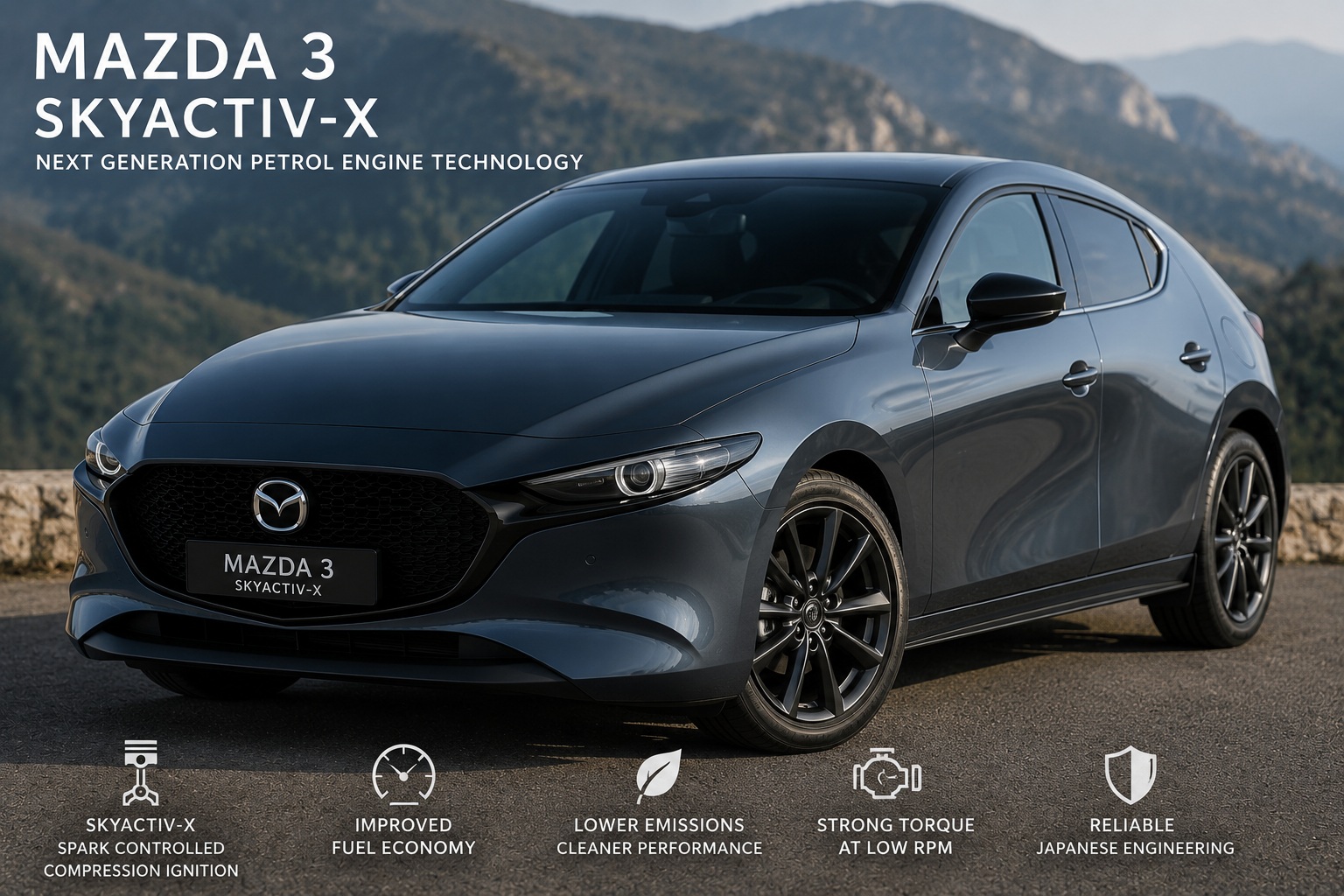
What Makes SKYACTIV-X Different? Mazda offers improved engine technology.
Traditional petrol engines work using spark ignition. Fuel and air are mixed together and ignited by a spark plug.
Diesel engines work differently. They use compression ignition, where the fuel ignites under extremely high pressure without needing a spark.
Mazda’s SKYACTIV-X technology cleverly combines aspects of both systems.
The engine uses what Mazda calls the following:
- Spark Controlled Compression Ignition (SPCCI).
This allows the engine to behave more like a diesel under certain driving conditions whilst still running on petrol fuel.
The result is:
- improved fuel economy,
- lower emissions,
- stronger low-speed torque,
- and smoother overall performance.
When the technology first appeared, many motoring journalists described it as one of the biggest petrol engine breakthroughs seen for years.
Why Mazda Continued Believing in Petrol Engines
Mazda argued that fully electric vehicles were not yet the perfect answer for every driver around the world.
There were still concerns about:
- battery production,
- charging infrastructure,
- electricity generation,
- and vehicle range.
For many motorists, especially those regularly driving long distances through rural areas, petrol engines still offered:
- convenience,
- reliability,
- and easy refuelling.
Mazda therefore believed cleaner, more efficient petrol engines still had an important role to play during the transition towards lower-emission transport.
Looking back now in 2026, that strategy appears to have been quite sensible.
SKYACTIV Technology Continues to Evolve
Since the original launch, Mazda has continued refining its SKYACTIV technology range. Modern Mazda vehicles now feature improvements in the following:
- combustion efficiency,
- hybrid integration,
- lightweight engineering,
- and emissions reduction.
Many newer Mazda models also combine mild hybrid systems with petrol engines to further improve fuel economy without completely changing the driving experience motorists are used to.
This has become particularly popular with drivers who:
- are not yet ready for full electric cars,
- cannot easily install home charging,
- or still prefer traditional driving characteristics.
The rotary engine returns. Mazda offers improved engine technology.
In another interesting twist, Mazda has even brought back a version of its famous rotary engine technology.
The rotary engine became legendary in cars such as the Mazda RX-7 and Mazda RX-8. Although once thought obsolete, Mazda has now adapted rotary technology for use as a compact electricity generator in certain hybrid vehicles.
This shows just how determined Mazda remains to explore alternative engineering ideas instead of simply following the crowd.
Hydrogen Technology Still Moving Forward
Hydrogen technology has also continued developing slowly in the background. Although battery electric vehicles currently dominate the market, hydrogen-powered systems are still seen by many experts as part of the long-term future.
Hydrogen may eventually prove especially useful for:
- heavy goods vehicles,
- buses,
- commercial transport,
- and long-distance haulage.
Mazda itself has previously experimented with hydrogen rotary engines, showing that the company has always been willing to investigate multiple solutions rather than relying on one single technology.
The Future May Be a Mixture of Technologies
One thing becoming clearer every year is that there may never be one perfect solution for every vehicle and every driver.
Instead, the future may involve a combination of:
- electric vehicles,
- hybrids,
- hydrogen systems,
- cleaner petrol engines,
- and alternative fuels.
Here at Pellon Tyres Halifax, we already see this changing mix arriving daily into the garage:
- hybrids,
- mild hybrids,
- electric cars,
- modern diesels,
- and advanced petrol engines.
The motor industry is currently going through one of the biggest technological changes in its history.
Petrol Engines Are Improving, Not Disappearing Overnight
Despite predictions of their rapid demise, petrol engines are still evolving rapidly. Manufacturers continue finding ways to:
- improve combustion,
- reduce emissions,
- increase efficiency,
- and combine engines with electric assistance.
Mazda deserves considerable credit for continuing to invest in engineering innovation rather than simply abandoning combustion technology altogether.
For many motorists, especially in areas such as Yorkshire where long journeys, hills and varied weather conditions remain common, efficient petrol engines still make practical sense.
Final Thoughts: Mazda offers improved engine technology.
The launch of SKYACTIV-X proved that the internal combustion engine still had room for improvement. Rather than accepting the petrol engine’s decline, Mazda showed that clever engineering could deliver the following:
- cleaner emissions,
- excellent fuel economy,
- and enjoyable driving characteristics all at once.
Whether petrol engines survive for another decade or several more decades remains to be seen. However, the technology is certainly far from dead.
In fact, companies like Mazda may have helped give the petrol engine a valuable new lease of life.