About Tyre Compounds
Table of Contents
About Tyre Compounds
About Tyre Compounds
Tyre Compounds – From Formula 1 Technology to the Cars We Drive Every Day
Most motorists rarely think about what their tyres are actually made from.
When customers visit us at Pellon Tyres, Halifax, they usually want to know the following:
- how much the tyres cost,
- how long they will last,
- and whether they are safe.
However, one of the most important parts of any tyre is something that cannot be seen at all.
It is known as the tyre compound.
The compound is essentially the special mixture of rubber, silica, carbon black, oils and other materials that determine how the tyre performs.
Different compounds affect:
- grip,
- braking,
- handling,
- tyre life,
- fuel economy,
- road noise,
- and wet-weather performance.
In fact, tyre compound technology has become so advanced that it now plays a major role in everything from family hatchbacks to Formula 1 racing cars.
What Exactly Is a Tyre Compound? About Tyre Compounds
A tyre compound is not simply rubber.
Modern tyres contain a carefully engineered blend of materials designed to perform under specific conditions.
Tyre manufacturers spend millions of pounds developing compounds that can deliver:
- maximum grip,
- long mileage,
- improved fuel efficiency,
- and better safety.
The challenge is that improving one characteristic often affects another.
For example:
A very soft compound offers:
- excellent grip,
- shorter braking distances,
- and improved handling.
However, it will usually:
- wear out faster.
A harder compound may:
- last longer,
- improve fuel economy,
- and reduce rolling resistance,
but may sacrifice some grip.
This balancing act is one of the biggest challenges facing tyre engineers.
Formula 1 – The Ultimate Tyre Test Laboratory
Nowhere is tyre compound technology more important than in Formula 1.
For many years, Formula 1 has acted as a rolling laboratory for tyre development.
The sole tyre supplier:
continues to develop compounds capable of handling some of the fastest racing cars ever built.
Formula 1 tyres experience incredible forces during racing:
- heavy braking,
- rapid acceleration,
- extreme cornering loads,
- and temperatures exceeding 100°C.
The tyres must perform at the highest level whilst also degrading in a predictable manner.
The Early Pirelli Years: About Tyre Compounds
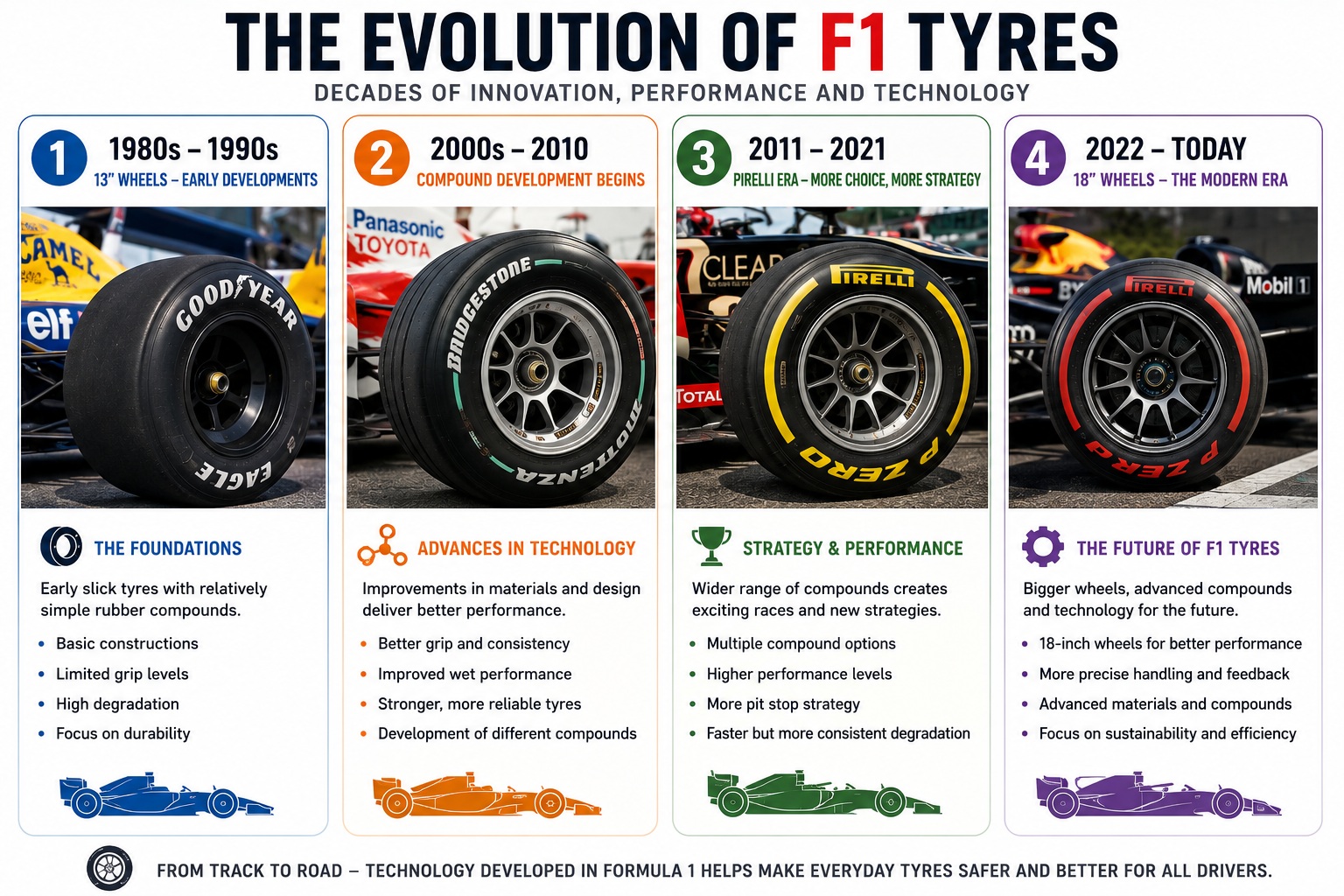
When Pirelli returned to Formula 1 in 2011, they were given a unique challenge.
The sport wanted:
- more overtaking,
- more strategy,
- and less predictable races.
As a result, Pirelli developed tyre compounds designed to wear more quickly than previous generations.
This forced teams to:
- manage tyre life,
- make strategic pit stops,
- and carefully choose race tactics.
It certainly made Formula 1 more interesting for spectators.
Understanding Formula 1 Compounds
Over the years, Formula 1 fans became familiar with names such as the following:
- Super Soft,
- Ultra Soft,
- Hyper Soft,
- Medium,
- Hard,
- and intermediate tyres.
Today, the system is much simpler.
Pirelli now uses a compound range called the following:
- C1,
- C2,
- C3,
- C4,
- and C5.
More recently, even softer compounds such as the following:
- C6
have been introduced for certain circuits.
In simple terms:
- C1 is the hardest tyre.
- C6 is the softest tyre.
The softer the compound:
- the more grip it produces,
- but the faster it wears out.
The harder the compound:
- the longer it lasts,
- But the ultimate grip level is lower.
This creates fascinating race strategy decisions.
The Move to 18-Inch Wheels: About Tyre Compounds
One of the biggest changes in Formula 1 came in 2022.
For decades, Formula 1 cars used the following:
- 13-inch wheels.
Modern road cars had long since moved to much larger wheel sizes, making Formula 1 look increasingly outdated.
As part of the new regulations, Formula 1 switched to:
- 18-inch wheels.
This was a huge change for tyre engineers.
The larger wheels:
- improved relevance to modern road cars,
- reduced sidewall flex,
- and altered the way compounds behaved.
Interestingly, many of the lessons learned from Formula 1 development eventually help improve ordinary road tyres.
How F1 Technology Influences Road Cars
Although Formula 1 tyres are completely different from road tyres, many technologies eventually filter down.
Areas influenced by motorsport include:
- compound development,
- heat management,
- tread design research,
- manufacturing techniques,
- and rolling resistance improvements.
The tyres fitted to modern family cars are vastly more advanced than those fitted twenty years ago.
Modern Road Tyre Compounds
Today, most premium tyre manufacturers offer several different compound technologies.
Manufacturers such as the following:
- Michelin,
- Continental,
- Goodyear,
- Bridgestone,
- and Pirelli
all use highly sophisticated compound designs.
Some compounds focus on:
- wet grip,
- others on mileage,
- and others on fuel economy.
Electric vehicles are changing tyre technology.
One of the biggest influences on tyre compounds today is the rise of electric vehicles.
Electric cars place unique demands on tyres because they:
- weigh more,
- produce instant torque,
- and operate almost silently.
Modern EV tyres require compounds capable of:
- reducing road noise,
- handling increased weight,
- resisting rapid wear,
- and improving efficiency.
This has become one of the fastest-growing areas of tyre research.
Winter Tyres and Compound Technology
Winter tyres provide another excellent example of compound development.
Unlike ordinary summer tyres, winter tyres contain rubber compounds designed to remain flexible below the following:
- 7°C.
This allows them to:
- grip better,
- brake more effectively,
- and perform safely in snow and ice.
Many motorists think winter tyres are all about tread patterns.
In reality, the compound itself is often the biggest difference.
Why Cheap Tyres Often Differ: About Tyre Compounds
One reason premium tyres frequently outperform budget tyres is compound technology.
Premium manufacturers invest enormous sums into research and development.
This often results in:
- better wet braking,
- lower road noise,
- longer tyre life,
- and improved fuel economy.
Whilst budget tyres may appear similar visually, the compound technology underneath can be very different.
The Future of Tyre Compounds
Looking ahead, tyre technology continues advancing rapidly.
Manufacturers are currently developing compounds using:
- sustainable materials,
- recycled content,
- renewable oils,
- and environmentally friendly production methods.
The challenge remains the same as it has always been:
- maximising grip,
- whilst maintaining safety,
- efficiency,
- and durability.
Final Thoughts: About Tyre Compounds
Tyre compounds may not be visible to the average motorist, but they are one of the most important aspects of tyre performance.
From Formula 1 circuits around the world to the roads of Halifax and Calderdale, tyre compounds influence the following:
- safety,
- braking,
- grip,
- and driving confidence.
The next time you fit a new set of tyres, remember that there is far more going on beneath the surface than simply black rubber.
Modern tyre compounds represent decades of engineering, research and innovation, helping keep motorists safer every day.


Leave a Reply
Want to join the discussion?Feel free to contribute!