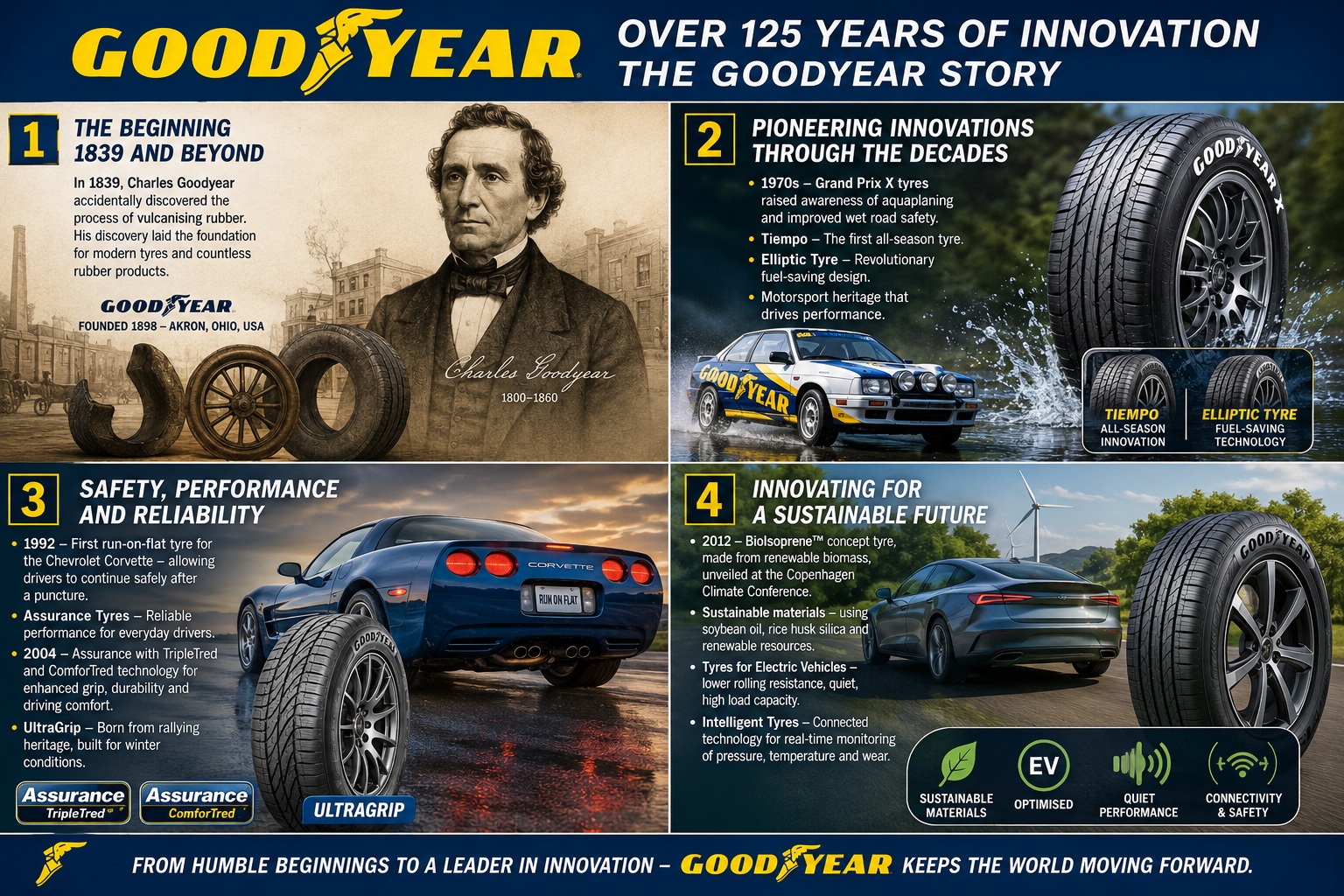
Of course, they kept up the spending on new tyre development. Something that GOODYEAR TYRES were very passionate about. The company started to bring out new products on the back of these new developments. Passionately, new tyres began to emerge. First ones been the The Goodyear Eagle GT and the Eagle GA. I remember these tyre well, they were modeled for the more luxury cars in the early nineties. These new products helped Goodyear tyres to regain the market share that they lost to t
Goodyear Vector 4Seasons Gen 3 — The All-Weather Option for West Yorkshire Roads
If you’re after a tyre that can cope with all the weird weather we get around Halifax and Calderdale — rain, frost, sleet, even occasional snow — the Goodyear Vector 4Seasons Gen 3 is one of the top picks. It’s popular because it balances wet, winter and dry performance more fairly than many earlier all-season tyres. Let’s break down what makes it tick, how it compares, and whether it’s a good match for drivers in Yorkshire.
What Is the Vector 4Seasons Gen 3? Goodyear Vector 4Seasons Calderdale
Goodyear built on its previous Vector 4Seasons versions and launched the Gen 3 (third generation) as a more refined all-season tyre. It’s designed to combine summer and winter capabilities, so you can often run a single set year-round without swapping.
It carries the 3PMSF (Three Peak Mountain Snowflake) mark — meaning it has passed winter testing standards and is legally considered a winter-capable tyre in many markets.
The Gen 3 is used in tests across Europe and has won several accolades. For example, it was named a test winner by Auto Bild for its performance in wet, dry and snowy conditions. Goodyear News Goodyear also highlights three core technologies: Snow Grip Technology, Dry Handling Technology, and Aqua Control for water evacuation. Goodyear News+2
How It Performs — What Tests & Reviews Show
To understand how good it really is, let’s look at how it does in independent tests and what drivers report — especially relevant for roads around Halifax, Brighouse, Hebden Bridge etc.
Test Results & Lab Comparisons
In Auto Express’s all-season tyre group test, the Vector Gen 3 scored well in wet tests, winning the wet handling circuit and doing strongly in snow braking. But it lagged in dry braking, taking about 5 m more to stop from 60 mph than top performers. Auto Express
In Tire Reviews, users comment that Vector Gen 3 is “exceptionally quiet & comfortable”, with superb grip in wet conditions. It’s not always top in dry braking, but overall it’s “well-balanced”. Tire Reviews
Goodyear claims that Gen 3 offers ~5% better dry braking over its predecessor, thanks to reinforced crown and shoulder blocks.
In other tyre tests, it comes close to “perfect all-season”, offering strong performance in bad weather and durable tread life.
So: where it shines is wet grip, snow capability, and comfort. Its weaker spot is dry braking and ultra-high-performance handling in warm weather.
Some BMW and other car owners note the tyre feels a bit firmer, with more road feedback and occasional rumble. But they also say it’s more confident when roads freeze or get icy. Bimmerpost +1
On Reddit, people say the Goodyear’s “do the job” well enough for general road use. One comment: “They definitely do the job, well enough for general road use … Most people wouldn’t even tell the difference.” Reddit
Others point out subtle quirks: uneven tread in the centre groove compared to the edges. Reddit
These kinds of user notes are gold for your blog because local drivers trust anecdotes.
Goodyear Vector 4Seasons Calderdale
.
Pros & Trade-Offs — Especially for Yorkshire Use
Strengths:
Limitations / Things to Watch:
Strong in wet handling and aquaplaning, ideal for West Yorkshire’s heavy rain spells
Good snow/winter capability for an all-season tyre
Quiet, comfortable ride — works well on uneven rural roads and minor lanes
Durable — Goodyear claims improvements in mileage and resistance to wear over earlier versions
Balanced performance: no huge weak spot in most use cases
Limitations / Things to Watch:
Dry braking in warm, dry weather is not top-tier — on hot summer days, it can lag behind pure summer tyres
Steering precision and feedback may feel softer or less sharp in performance cars
As it wears, some tests indicate wet or aquaplaning resistance may drop more than premium summer tyres
For very sporty driving, high loads or powerful cars, there will always be some compromise
Who Should Choose It — And What Version: Goodyear Vector 4Seasons Calderdale
If I were recommending this to a driver around Halifax or Huddersfield, here’s how I’d position it:
Commuters and families who want one set year-round without swapping
Drivers of small to midsize cars (VW, Ford, Hyundai, etc.) who want safety in wet/cold conditions
People doing mixed driving: town, A-roads, occasional motorway — with a few winter trips
Less ideal for those with very powerful or performance-oriented cars where dry handling is a priority
Version-wise: Gen 3 is the go-to now. Earlier versions (Gen 1, Gen 2) exist, but they are older tech. Focus your stock or recommendations on Vector 4Seasons Gen 3.
Local Angle — How It Fits Yorkshire roads: Goodyear Vector 4Seasons Calderdale
Here’s where you sprinkle in the Halifax/Calderdale flavour:
Weather swings: We get frost in the mornings, rain in the afternoons, and unpredictable patches on moorland roads (e.g., over the Pennines). A tyre that can adapt is a huge selling point.
Hilly terrain: Routes like Beacon Hill, Ovenden Moor, or the Calder Valley climbs demand grip under load. The Vector gens’ strong wet and snow grip help here.
Rural lanes & country roads: Many local roads have patches of damp, raised drains, potholes, and uneven surfaces — a tyre that’s comfortable and resilient helps everyday driving.
Commuters & cross-region runs: From Halifax to Leeds, Bradford, and Manchester — drivers cover a mix of motorway, A-road, and rural. The Gen 3’s balance makes it a good match.
Testimonials / local installs: If you’ve already fitted Vector Gen 3 locally (say on a Golf in Brighouse or a Vauxhall in Elland), drop in a short case: “We recently fitted Vector 4Seasons Gen 3 to a customer’s Focus, and they noticed better wet braking over their old tyres, especially on the A58 after rain.”
A Damaged BMW Run-Flat Tyre Reveals an Unexpected MOT Surprise
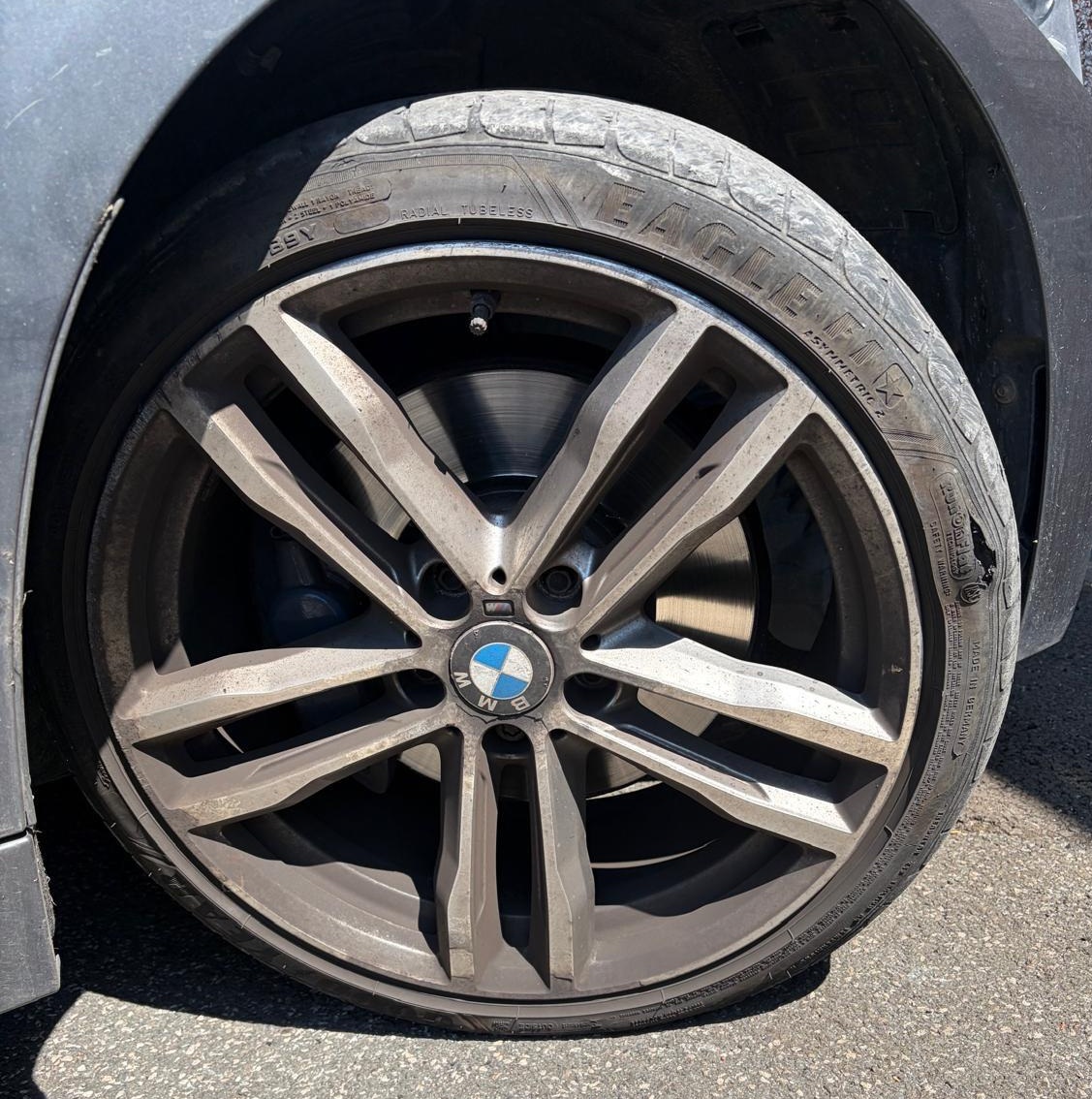
One of the more interesting jobs that came into Pellon Tyres this week involved a rather smart BMW 420i xDrive Gran Coupé belonging to a lady who works for a local timber merchant here in West Yorkshire.
At first glance, it looked like a straightforward tyre replacement.
As it turned out, there was a little more to the story.
A Gaping Hole in the Front Tyre
The customer explained that she had noticed something wasn’t quite right with the car and asked us to inspect the driver’s side front tyre.
Once the vehicle was safely in our workshop, the problem was immediately obvious.
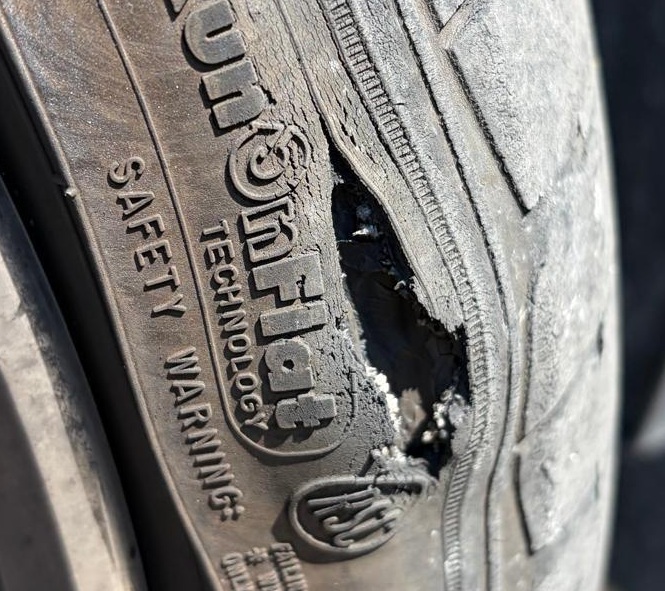
There was a large hole in the side of the tyre.
The BMW was fitted with 225/40 R19 93Y Goodyear Eagle F1 ROF XL run-flat tyres, a premium tyre fitted to many modern BMW models.
To be honest, I was amazed the tyre was still holding air.
The damage was so severe that it appeared to be hanging together only by the tyre’s reinforced internal construction.
It was a good example of just how robust modern run-flat tyres can be.
Unlike conventional tyres, run-flats are built with heavily reinforced sidewalls.
If the tyre loses air pressure after a puncture, those strengthened sidewalls support the weight of the vehicle for a limited distance.
This allows the driver to continue safely to a garage rather than being stranded at the roadside changing a wheel.
It’s a clever piece of engineering.
Many modern BMWs no longer even carry a spare wheel because the run-flat tyre is designed to get you home or to the nearest tyre depot.
Of course, there are limits.
Most manufacturers recommend travelling no more than around 50 miles (80 km) at a reduced speed after a complete loss of pressure.
Once a run-flat has been driven in its deflated condition, it normally has to be replaced.
Why This Tyre Could Not Be Repaired
People often ask whether a puncture can simply be repaired.
Unfortunately, the answer isn’t always yes.
Tyres can only be repaired if the damage falls within very strict British Standard guidelines.
The puncture must normally be within the central tread area and must not be too large.
Damage to the shoulder or sidewall is an entirely different matter.
The sidewall constantly flexes as the tyre rotates, making any repair unsafe.
In the case of this BMW, the hole was simply too large.
There was never any possibility of carrying out a safe repair.
The only sensible option was to replace the damaged tyre.
We fitted a brand-new Goodyear Eagle F1 ROF XL in the correct 225/40 R19 93Y specification, ensuring the vehicle retained the handling characteristics BMW intended.
Modern Workshop Technology Helps Everyone: Driving Without an MOT
After fitting the new tyre, we moved on to the paperwork.
Like many modern garages, Pellon Tyres uses a computerised garage management system that links directly to DVLA vehicle information.
This allows us to confirm details about the vehicle while booking jobs into the workshop.
One particularly useful feature is that it also alerts us if a vehicle’s MOT has expired.
As soon as we entered the BMW’s registration number, the system flagged something unexpected.
She had completely forgotten that her MOT had expired.
Believe me, she isn’t alone.
Over the years, we’ve seen many motorists who have simply lost track of the date.
Life gets busy.
People have work, families, holidays and countless other things to think about.
Sometimes the MOT date simply slips their mind.
Thankfully, our system highlighted the problem before anything more serious happened.
We arranged to book the BMW in for an MOT test as soon as we had an available appointment.
The customer left relieved that the problem had been spotted.
What Does the Law Say About Driving Without an MOT?
In the UK, most vehicles over three years old must have a valid MOT certificate if they are being used on the public highway.
Driving without an MOT can lead to serious consequences.
If your vehicle is stopped by the police and does not have a valid MOT, you could receive a fine of up to £1,000.
However, that’s only part of the story.
If your vehicle is found to have dangerous defects, the penalties can be much more severe.
In those circumstances, drivers can face fines of up to £2,500, receive penalty points and, in some cases, even be disqualified from driving.
Does Your Insurance Still Cover You?
This is another question customers often ask.
Having no MOT does not automatically invalidate your motor insurance.
However, if your vehicle is involved in an accident and investigators find that the lack of an MOT or poor vehicle condition contributed to the collision, your insurer may decide not to cover certain claims or recover costs from you.
It’s not a situation anybody wants to find themselves in.
Keeping your MOT up to date is one of the simplest ways to help ensure your vehicle remains safe and legal.
Can You Drive to an MOT Test Without an MOT?
There is one important exception.
The law allows you to drive a vehicle without an MOT if you are travelling directly to a pre-booked MOT appointment.
You may also drive to a garage for repairs following an MOT failure, provided the journey is directly related to the repair.
Outside these circumstances, driving without a valid MOT is illegal.
Why Regular MOT Testing Matters
Some motorists see the MOT as an inconvenience.
Personally, after spending more than 60 years in the motor trade, I see it rather differently.
The MOT has undoubtedly helped improve road safety across Britain.
Every year, worn tyres, faulty brakes, damaged suspension components, steering defects and dangerous corrosion are identified during MOT inspections.
Many of these faults might otherwise go unnoticed until they cause a breakdown—or worse.
That’s why we always encourage customers not to leave their MOT until the last minute.
Booking a little early can often save unnecessary stress.
Technology Makes It Easier Than Ever: Driving Without an MOT
The interesting thing about this BMW wasn’t just the damaged run-flat tyre.
It was the way modern technology helped protect the customer.
Years ago, we would simply have fitted the tyre and waved her goodbye.
Today, our garage management system automatically checks important vehicle information, helping us spot issues that customers themselves may have forgotten.
In this case, it meant we could remind the customer about her overdue MOT before it became a much bigger problem.
Looking After Our Customers
Here at Pellon Tyres in Halifax, we don’t just fit tyres.
We try to look after our customers as well.
Whether it’s spotting a dangerous tyre, advising against an unsafe repair, or reminding someone that their MOT has expired, it’s all part of providing the sort of service we’ve always believed in.
The BMW left our depot fitted with a brand-new Goodyear Eagle F1 run-flat tyre and with an MOT appointment safely booked.
The customer was naturally relieved.
And although discovering an overdue MOT was a little embarrassing, I’m sure she was much happier finding out in our reception than during a roadside police check.
Sometimes what appears to be an ordinary tyre replacement can turn into something far more interesting.
After more than six decades in the tyre trade, that’s one of the reasons I still enjoy coming to work every morning.
https://www.pellonautocentre.com/wp-content/uploads/2024/07/pellon-tyres-logo-509x321.jpg00Eric Robertshttps://www.pellonautocentre.com/wp-content/uploads/2024/07/pellon-tyres-logo-509x321.jpgEric Roberts2026-07-16 16:31:562026-07-16 16:33:21Driving Without an MOT – A Real Story from Pellon Tyres
My Own Long Association with Goodyear Tyres and Motorsport
When I read that Goodyear is expanding its famous Blue Streak historic racing tyre range, it immediately brought back many memories from my own early days in the tyre trade.
As regular readers of my blog will know, I have been involved with tyres for over 60 years. During that time, I have seen enormous changes in tyre technology, from the old cross-ply tyres of my youth to the sophisticated radial, run-flat, winter and electric vehicle tyres that we fit today at Pellon Tyres here in Halifax.
However, some of my fondest memories go back to the days when I worked for Tyreservices in Huddersfield, which, at that time was owned by Goodyear.
Goodyear wasn’t simply another tyre manufacturer to me. I was actually involved with the company and its products during one of the most exciting periods in motorsport history.
In the 1970s, motorsport felt raw and exciting. Rally cars sounded incredible, drivers were real characters, and spectators could get remarkably close to the action.
I was fortunate enough to be involved in supporting the Goodyear rally scene, including some memorable winter rally events. These experiences helped build my lifelong respect for Goodyear as a tyre manufacturer.
So, when I read about the expansion of the legendary Goodyear Blue Streak racing tyre range, I couldn’t help thinking about how the past and present of the tyre industry have come together.
Goodyear isn’t simply looking back at its history. The company is making sure that some of the world’s greatest historic racing cars can continue competing on tyres appropriate for the eras in which those cars originally raced.
And for somebody like me, who remembers those days first-hand, I think that’s absolutely wonderful.
The Famous Goodyear Blue Streak Racing Tyres Return in a Much Bigger Way
Goodyear has announced a major expansion of its legendary Blue Streak range, strengthening its commitment to the rapidly growing world of historic motorsport.
The company has added 57 additional tyre sizes and specifications, significantly increasing the number of historic racing cars that can use Goodyear tyres.
The expanded range covers an incredible variety of machinery.
We’re talking about everything from pre-war Bentley, ERA and Alfa Romeo racing cars to the great sports cars and Formula cars of the 1950s, 60s and 70s.
Then there are legendary endurance racing machines such as the Porsche 917 and Ferrari 512, cars that fought some of the greatest battles ever seen at Le Mans and in the World Sportscar Championship.
Goodyear is also supporting the smaller, lightweight racing cars that frequently punched above their weight, including famous names such as Matra, Lola and Chevron.
For the more modern classics of the 1980s onwards, Goodyear is also expanding its historic Eagle range to support GT2, LMP2, LMP1 and Super Touring machinery.
To me, this is about far more than nostalgia.
These cars were built to be driven, and there’s something very special about seeing a genuine historic racing car being used as its designers intended rather than simply sitting silently in a museum.
My Days at Goodyear-Owned Tyreservices in Huddersfield: Goodyear Blue Streak Racing Tyres
My own association with Goodyear really developed during my days working at Tyreservices in Huddersfield.
At the time, Tyreservices was owned by Goodyear, and this brought me into much closer contact with the company’s products and motorsport activities.
I was a younger man then, full of enthusiasm for the tyre trade, although I don’t suppose I could possibly have imagined that all these years later I would still be writing about tyres in 2026!
Those days gave me experiences and memories that have stayed with me throughout my life.
Motorsport was an important part of tyre development. Manufacturers such as Goodyear used racing and rallying to push their tyres to the absolute limit.
On a racing circuit, tyres had to cope with extreme cornering forces, high speeds and enormous heat.
Rallying was perhaps even more challenging because conditions could change constantly. A tyre might face dry tarmac, standing water, mud, ice or snow, sometimes all during the same event.
For a young tyre man like myself, it was fascinating.
And I loved every minute of it.
Supporting Goodyear Rallying in the 1970s
Some of my strongest memories involve supporting rallying during the 1970s.
These were the days of proper rally cars and some incredibly talented drivers.
I remember being involved with winter rally events, including the Mintex and HRCR scene. On one memorable occasion, we were out through the night around Scarborough in the middle of winter.
Anybody who has been involved with rallying will know that it isn’t always glamorous!
There can be hours of waiting around in freezing weather, followed by frantic activity as cars arrive and tyres need attention. Then suddenly the cars disappear into the darkness again, leaving behind the smell of hot engines, petrol and tyres.
But there was a wonderful atmosphere.
Everybody was there because they loved motorsport.
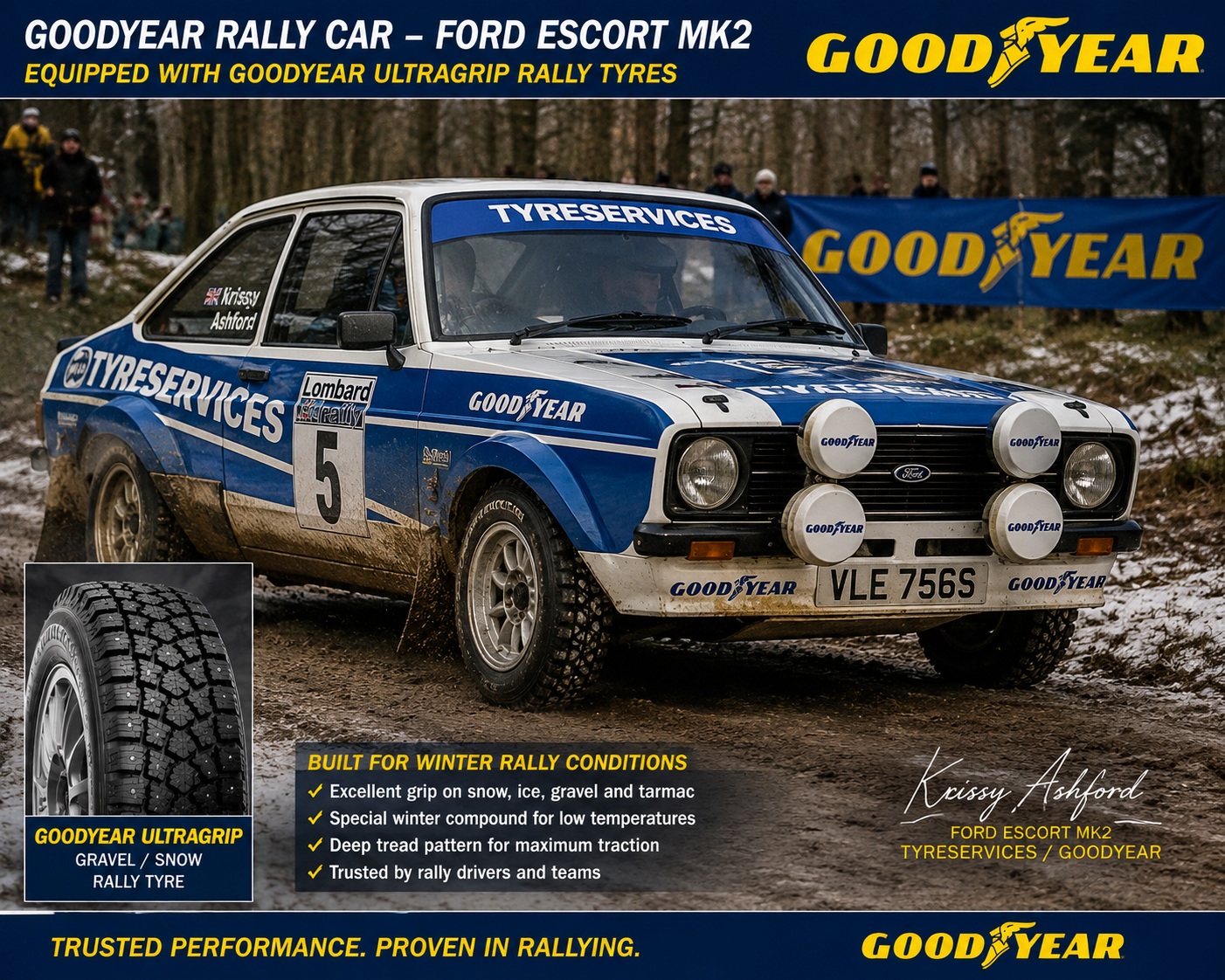
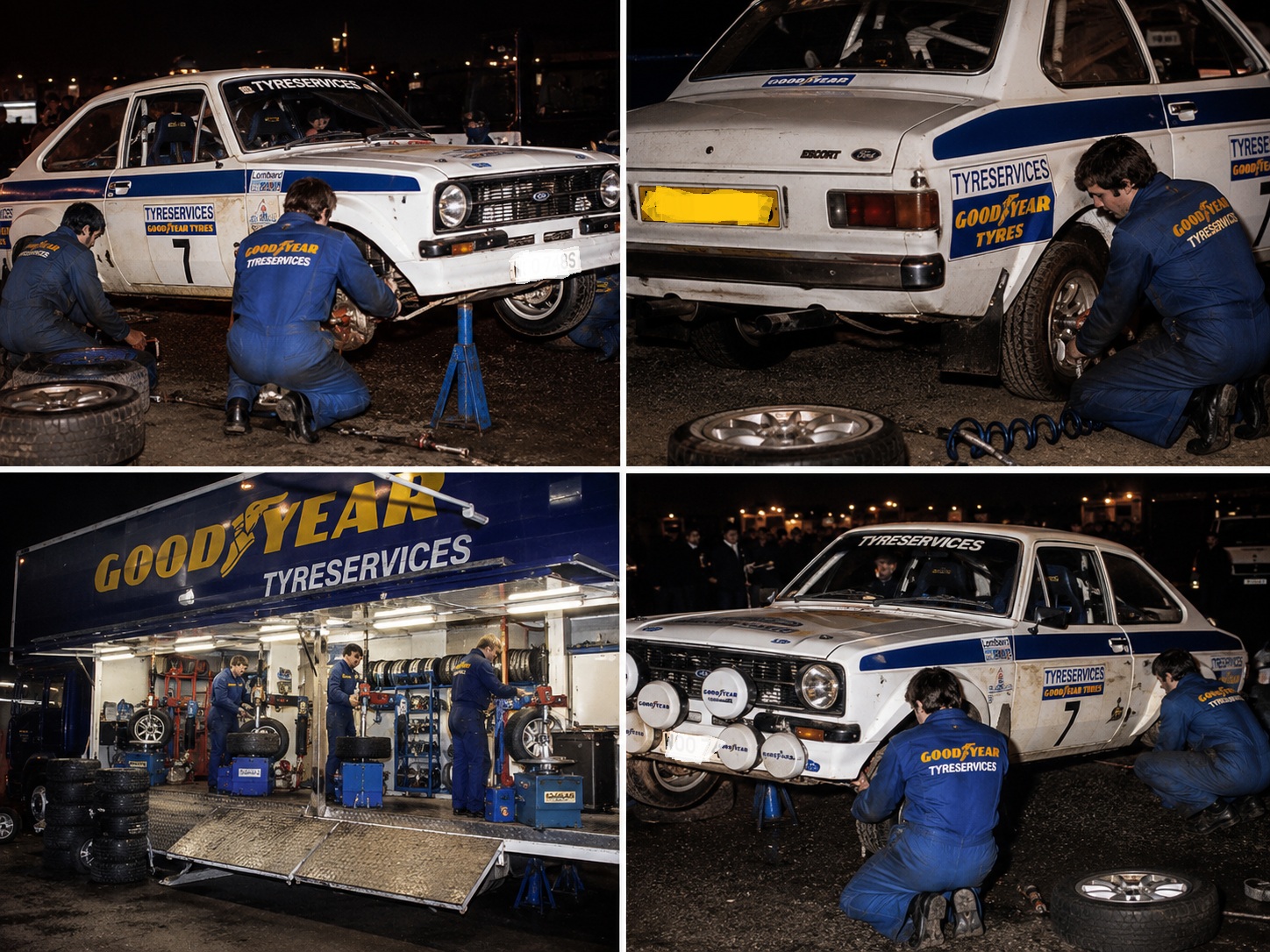
I also remember supporting Krissy Ashford, whose Ford Escort Mk2 carried Tyreservices and Goodyear support. The car was white with a distinctive blue stripe and looked exactly like a proper rally car should.
The Ford Escort Mk2 itself has become one of the great icons of rallying history.
Even today, decades later, these cars remain enormously popular in historic rallying, and good examples can be worth considerable amounts of money.
When I see an Escort Mk2 competing today, it immediately takes me back to those earlier days.
Goodyear’s Incredible Motorsport Record: Goodyear Blue Streak Racing Tyres
Goodyear has one of the greatest motorsport records of any tyre manufacturer in history.
The figures are astonishing.
The company achieved 368 Formula One victories, an extraordinary record from an era when Goodyear tyres were fitted to some of the greatest Formula One cars ever built.
Goodyear has also achieved 14 overall victories at the 24 Hours of Le Mans.
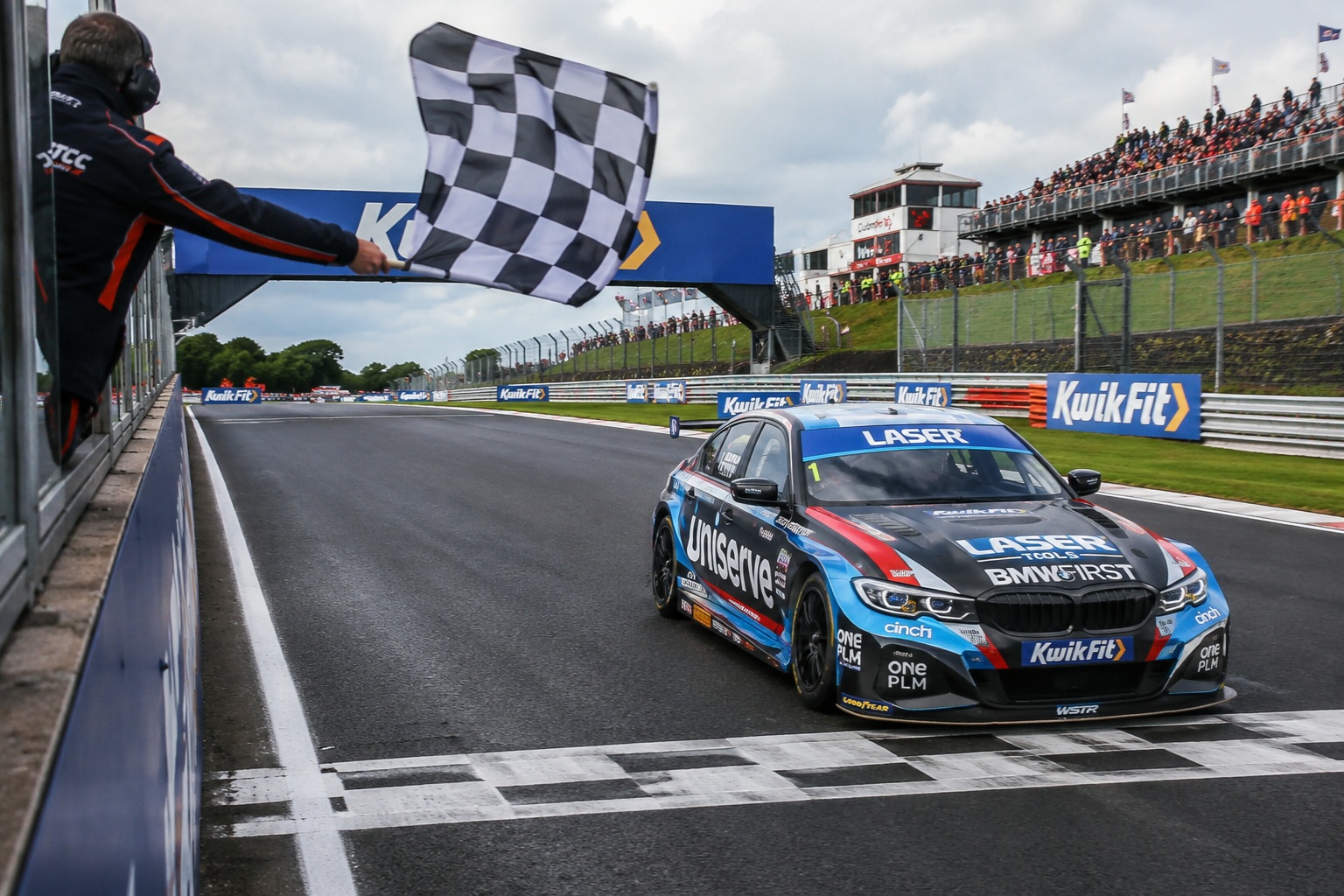
Here in Britain, the company has won more races in the British Touring Car Championship than any other tyre manufacturer since the championship began in 1958.
Then, of course, there is NASCAR.
Goodyear has supplied tyres to NASCAR for more than 70 years and has been the exclusive tyre supplier to NASCAR’s three national series since 1997.
When you look at that history, the expansion of the Blue Streak range makes perfect sense.
Goodyear has played an enormous part in motorsport history, and many legendary racing cars originally competed on its tyres.
Now, those same types of cars can continue racing on Goodyear tyres designed to preserve the authentic performance and appearance of their era.
The Great Porsche 917 and Ferrari 512 Battles
One part of the new Blue Streak expansion that particularly caught my attention is the availability of wider tyre specifications for the great sports racing cars of the 1960s and 1970s.
This was a golden age of endurance racing.
The Porsche 917 and Ferrari 512 became legendary rivals, competing at incredible speeds at circuits around the world.
The Porsche 917, in particular, is remembered as one of the greatest racing cars ever built. It was enormously powerful and frighteningly fast.
These weren’t racing cars filled with computers and electronic driver aids.
The drivers relied on their own skill, courage and feel for the car.
And, of course, everything ultimately depended on those four relatively small contact patches between the tyres and the racing surface.
That’s something I’ve always said throughout my life in the tyre trade.
No matter how powerful, expensive or sophisticated a car might be, the tyres are the only parts actually connecting it to the road.
That was true in the 1970s, and it’s still true today.
Keeping Historic Racing Authentic: Goodyear Blue Streak Racing Tyres
One of the most important aspects of the expanded Goodyear range is authenticity.
Historic racing isn’t simply about putting modern tyres onto old cars and driving them as fast as possible.
The cars should behave and feel in a way that is appropriate for their period.
That’s why the FIA has strict Appendix K homologation requirements governing historic motorsport.
Goodyear says that the approved production methods, moulds, specifications and performance characteristics of its historic tyres will be preserved.
I think that’s extremely important.
If you fitted a historic 1960s racing car with completely modern racing tyres providing vastly more grip than the originals, you would fundamentally change how the car handled.
The suspension, chassis and brakes were all designed around the tyres available at the time.
Historic racing tyres therefore need to provide the right balance between modern manufacturing quality and authentic period performance.
Goodyear Blue Streak for the Earlier Racing Generations
Goodyear has divided its historic racing tyre strategy into two main brands.
The famous Blue Streak name will cover pre-1980s competition cars, while the Goodyear Eagle brand will support historic racing categories from the 1980s through to more recent machinery.
I think this makes good sense because it reflects the different generations of motorsport.
The Blue Streak name itself has a wonderful historic sound to it.
For enthusiasts of classic American racing cars, Formula cars, touring cars and sports racers, it is a name that immediately brings back memories of a different age.
The expanded range now includes tyres suitable for racing machinery going all the way back to the 1920s and 1930s.
That means cars from manufacturers such as Bentley, ERA and Alfa Romeo can continue competing with tyres that provide the appropriate period appearance and performance.
Imagine watching one of those huge old Bentleys thundering around a circuit.
That’s proper motorsport history brought back to life.
The Lightweight Giant Killers: Goodyear Blue Streak Racing Tyres
I was also pleased to see names such as Lola, Chevron and Matra mentioned in connection with the expanded range.
These lightweight sports racing cars were often incredibly successful.
They might not always have had the biggest engines or the most enormous budgets, but their low weight and clever engineering allowed them to compete against much more powerful machinery.
There’s something very British about the idea of a small, lightweight racing car taking on the giants and giving them a good run for their money!
Lola and Chevron, in particular, have a special place in British motorsport history.
Many of these cars still race today at historic events, where spectators can see and hear machinery from motorsport’s golden age being driven hard once again.
My Unforgettable Visit to Goodyear in Luxembourg
One of my greatest personal Goodyear memories was visiting the company’s facilities in Luxembourg.
I was fortunate enough to attend a Goodyear track day where we experienced the company’s Grand Prix X tyres on Vauxhall Cavaliers.
The cars were fitted with 1600cc engines, and we were able to experience the tyres under controlled test conditions.
But the real highlight for me was being driven around the circuit by the legendary Finnish rally driver Timo Mäkinen.
Now, that was an experience!
Timo was one of the famous Flying Finns and a genuine rallying legend. He won the RAC Rally three times and also achieved three victories on the famous 1000 Lakes Rally in Finland.
Sitting alongside a driver of that calibre was something I’ll never forget.
Professional rally drivers operate on another level entirely.
What feels frighteningly fast to an ordinary passenger is completely controlled to them.
Those experiences strengthened my respect for Goodyear and its involvement in motorsport.
They also taught me just how important tyre development is to vehicle performance.
From Goodyear Rally Tyres to Pellon Tyres in Halifax
It’s strange to think about how life develops.
Back then, I was a young tyre man involved with Goodyear, rallying and Tyreservices.
Today, all these decades later, I’m still involved with tyres as the owner of Pellon Tyres here in Halifax.
The industry has changed enormously.
We now fit tyres for electric cars, hybrids, high-performance SUVs and vehicles with wheel sizes that would have seemed enormous when I started out.
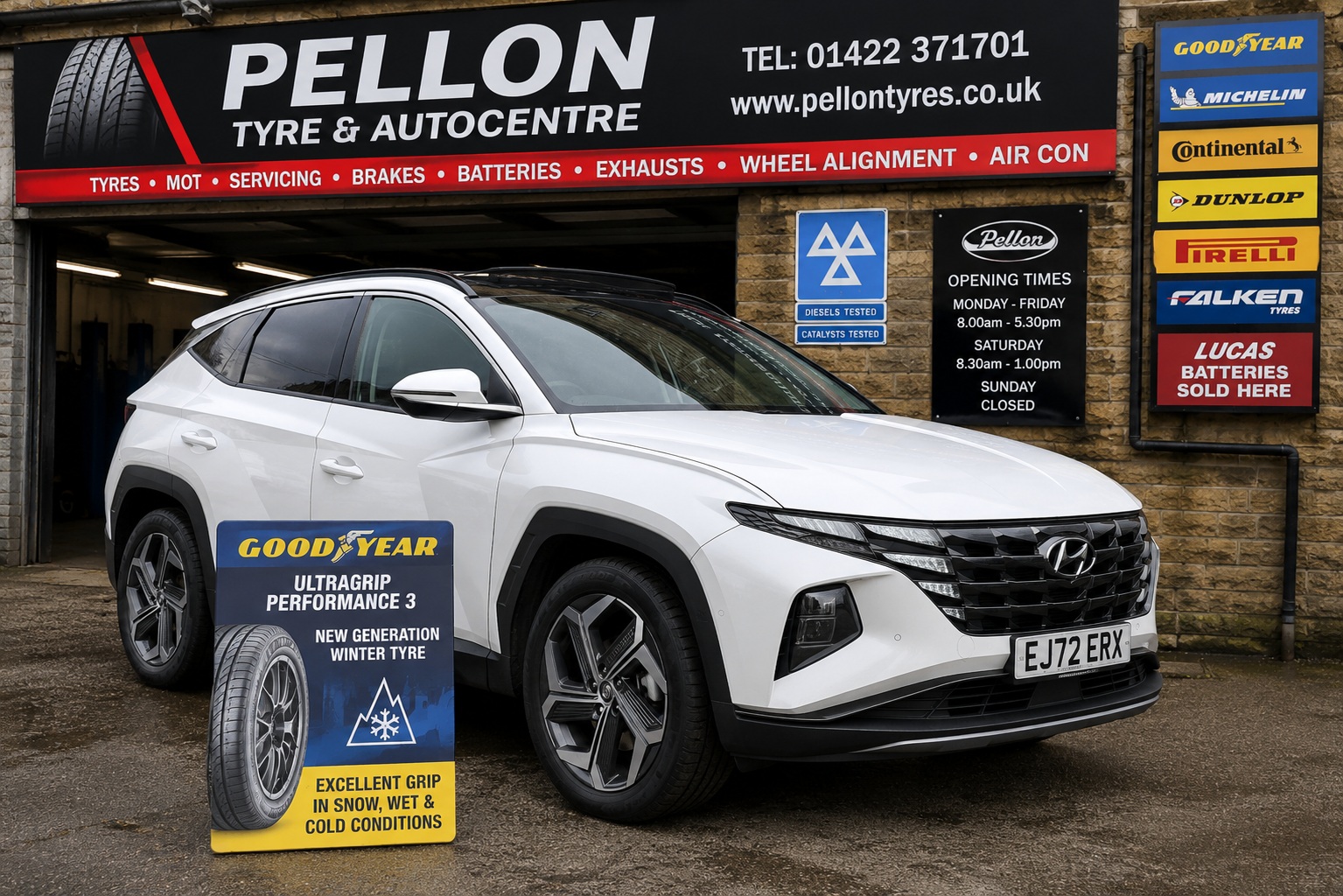
My own white Hyundai Tucson hybrid is a perfect example of how much cars have changed.
Yet my enthusiasm for good tyre brands has remained.
I’ve always had great respect for Goodyear because I have genuine personal experience with the company and its products.
It’s not simply a name I’ve read about in a brochure.
Goodyear forms part of my own journey through the tyre trade.
Modern Historic Racing Is Booming: Goodyear Blue Streak Racing Tyres
Historic motorsport has grown enormously in popularity.
Events such as the Goodwood Revival and Silverstone Festival attract huge crowds who want to see legendary racing cars competing once again.
And I can understand why.
Modern racing cars are incredibly fast and technologically advanced, but historic machinery has something different.
It has character.
You can see the drivers working. You can hear the engines, watch the cars moving around under braking and cornering, and often smell the oil and fuel.
For people of my generation, these cars bring back memories.
For younger enthusiasts, they provide an opportunity to experience machinery they might previously have seen only in old photographs or videos.
The fact that Goodyear is adding 57 more sizes and specifications shows that this isn’t some tiny corner of motorsport.
There is genuine demand for authentic tyres for historic competition cars.
From Blue Streak to Goodyear Eagle
While Blue Streak tyres will concentrate on pre-1980 competition cars, the Goodyear Eagle historic range covers the later generations.
And even cars from the 1990s and 2000s are now becoming historic!
That certainly makes me feel old.
Cars from GT2, LMP2, LMP1 and the Super Touring era are now highly sought-after historic racing machines.
I remember when these cars were the latest technology.
The Super Touring era of the British Touring Car Championship was particularly exciting, with manufacturers spending enormous sums of money developing cars that looked vaguely like the family saloons in the showroom but were, underneath, sophisticated racing machines.
Goodyear’s expanded historic portfolio will help keep these cars racing as well.
Why I Think Goodyear Is Doing the Right Thing
I think Goodyear deserves credit for investing in historic motorsport.
Making specialised tyres in relatively low volumes can’t be as straightforward as mass-producing tyres for everyday road cars.
Different sizes, constructions and specifications are required for cars from very different periods.
Yet preserving these tyres helps preserve the cars themselves.
A racing car was designed to race.
Of course, museums have an important role, but there’s nothing quite like seeing a historic competition car driven at speed.
The noise, movement and atmosphere bring history to life.
Goodyear’s Blue Streak expansion means that more of these legendary cars can continue competing on tyres connected with their original racing eras.
Goodyear Tyres: Part of My Own Tyre Trade Story
Reading about this new expansion brought back many happy memories for me.
From my days at Goodyear-owned Tyreservices in Huddersfield to supporting winter rallies around Yorkshire and Scarborough, helping with Krissy Ashford’s Escort Mk2 and travelling to Luxembourg for that unforgettable track experience with Timo Mäkinen, Goodyear has been part of my own tyre-trade story.
More than 60 years after I first entered the motor trade, I still get excited by developments in the tyre industry.
Perhaps that’s one reason I’ve stayed involved for so long.
I have seen cross-ply tyres give way to radials. I’ve watched wheel sizes grow dramatically. I’ve seen the arrival of run-flat tyres, sophisticated winter tyres, all-season tyres and specialist tyres designed for electric vehicles.
But motorsport heritage reminds us where much of that tyre development began.
Racing pushes tyres to their limits.
And lessons learned on the race circuit and rally stage have helped manufacturers improve tyres for ordinary motorists over many decades.
Keeping the Great Racing Cars Alive
For me, the expansion of the Goodyear Blue Streak historic racing tyre range is about much more than adding another 57 sizes to a product catalogue.
It is about preserving motorsport history.
It’s about allowing Bentleys from the 1920s, Formula cars from the 1950s, Porsche 917s and Ferrari 512s from the great endurance racing era, lightweight Lolas and Chevrons, and later GT and touring cars to continue doing what they were built to do.
Race.
And I think Goodyear’s Xavier Fraipont summed it up perfectly when he explained that historic racers don’t choose tyres through nostalgia alone. They need authentic performance, confidence and consistency.
After my own long career in the tyre trade, I completely understand that.
A great racing car deserves the right tyres.
And after all these years, I am proud to say that Goodyear remains one of the tyre brands I admire most.
From the rally stages of my younger days to the historic racing circuits of today, that famous Goodyear name continues rolling on.
https://www.pellonautocentre.com/wp-content/uploads/2024/07/pellon-tyres-logo-509x321.jpg00Eric Robertshttps://www.pellonautocentre.com/wp-content/uploads/2024/07/pellon-tyres-logo-509x321.jpgEric Roberts2026-07-15 06:43:502026-07-15 07:12:45Goodyear Blue Streak Racing Tyres
Goodyear UltraGrip Performance 3 – A Winter Tyre for Modern British Roads
Here at Pellon Tyres in Halifax, I have been involved with winter tyres for more years than I care to remember. In fact, my association with Goodyear tyres goes right back to my younger days in the tyre trade, when winter tyres were very different from the highly developed products we see today.
So, I am always interested when Goodyear announces something new concerning its famous UltraGrip range.
The latest news is particularly impressive. Goodyear has expanded its UltraGrip Performance 3 winter tyre range to an incredible 344 different sizes and specifications, adding 66 new fitments to cover an even wider selection of modern cars, SUVs and electric vehicles.
According to Goodyear, this gives the UltraGrip Performance 3 the broadest winter tyre coverage available from a single tread pattern.
That’s quite an achievement.
For motorists here in Halifax and across Calderdale, it also means that many more vehicles can now be fitted with the same award-winning winter tyre technology.
One Winter Tyre Pattern Covering 344 Different Fitments: New Goodyear Winter Tyre
The modern car market has become incredibly complicated.
When I first started in the tyre trade, things were much simpler. Wheel sizes were smaller, and there were nowhere near as many tyre sizes as we have today.
Now, we regularly see cars arriving at Pellon Tyres fitted with 18, 19, 20 and even 21-inch wheels. SUVs have become increasingly popular, while electric vehicles often require larger tyres capable of carrying additional weight.
Goodyear has responded by expanding the UltraGrip Performance 3 range to 344 different specifications, covering wheel sizes from 14 inches right up to 23 inches.
Interestingly, more than 90% of the 66 newly added sizes are for wheels of 19 inches or larger.
This tells us a great deal about how the modern car market is changing.
Large wheels were once mainly associated with sports cars and expensive luxury vehicles. Today, they are commonplace on family SUVs, crossovers and electric cars.
Here at Pellon Tyres, we have certainly noticed this change over the years. The days when most family cars arrived on 13, 14 or 15-inch wheels are long gone!
Why Winter Tyres Matter Here in Halifax
Anyone who knows Halifax and the surrounding Calderdale area will understand why I have always been a supporter of winter tyres.
We have hills everywhere!
From Wainstalls and Mount Tabor to Queensbury, Sowerby Bridge and the higher parts of Calderdale, our local roads can become extremely challenging during cold weather.
And it isn’t always deep snow that causes the biggest problems.
Cold rain, slush, frost and icy patches can make winter driving difficult. A good winter tyre is designed to remain flexible at lower temperatures, providing better grip when an ordinary summer tyre can become harder and less effective.
This is particularly important when braking or cornering.
I have seen it many times over the years. A car fitted with proper winter tyres can often climb a snowy Yorkshire hill while another vehicle on summer tyres struggles for grip.
Of course, winter tyres don’t make anyone invincible. Drivers must still adjust their speed and driving style to suit the conditions. However, having the correct tyres underneath you can make an enormous difference.
Goodyear UltraGrip – A Name I Remember Well: New Goodyear Winter Tyre
The UltraGrip name means something special to me personally because of my long history with Goodyear.
Back in the 1970s, I was involved with Goodyear through my work at Tyreservices in Huddersfield, which at the time was owned by Goodyear.
Those were exciting days for me in the tyre trade.
I remember supporting rally cars and attending events where winter tyres were pushed to their limits in some very difficult conditions. Rallying was a fantastic proving ground for tyre manufacturers because it tested tyres on snow, ice, mud, wet roads and loose surfaces.
I was also fortunate enough to visit Goodyear’s facilities in Luxembourg and even experienced being driven around a test track by the great Finnish rally driver Timo Mäkinen.
That’s a memory I’ll never forget!
Tyre technology has changed enormously since those days, but the basic challenge remains the same: keeping a vehicle safely connected to the road in difficult conditions.
The modern UltraGrip Performance 3 is the result of decades of development since those earlier days.
Snow Protect Technology for Winter Conditions
One of the key features of the Goodyear UltraGrip Performance 3 is what the company calls Snow Protect Technology.
In simple terms, the tread pattern is designed to provide strong traction when driving on snow.
The tyre has many grooves and edges that can bite into a snowy surface, helping the car accelerate, brake and maintain control.
This can be especially valuable on the steep roads around Halifax.
Anyone who has tried climbing one of our Pennine hills after a heavy snowfall will understand exactly what I mean!
The trouble with snow is that it can quickly become compacted by traffic. This creates an extremely slippery surface, particularly on hills and at junctions.
Having a tyre specifically designed to work in these conditions can provide valuable extra grip.
Wet Grip+ Technology for British Winters: New Goodyear Winter Tyre
Let’s face it: a British winter usually means more rain than snow!
This is why I think wet-weather performance is every bit as important as snow performance when choosing a winter tyre for UK roads.
The UltraGrip Performance 3 uses Goodyear’s Wet Grip+ Technology, which is designed to improve braking and control on wet roads.
For drivers around Halifax, Brighouse, Elland, Huddersfield and the wider West Yorkshire area, this is particularly relevant.
Our winters can bring weeks of cold rain, standing water and damp roads. Temperatures can hover only a few degrees above freezing, creating conditions where good grip is essential.
A winter tyre that performs well in the wet as well as the snow makes much more sense for the typical British climate.
An Award-Winning Goodyear Winter Tyre
Of course, any tyre manufacturer can tell us how wonderful its own products are.
What interests me more is how a tyre performs in independent testing.
The Goodyear UltraGrip Performance 3 has achieved some impressive results.
According to Goodyear, the tyre secured first place in ADAC winter tyre testing in both 2024 and 2025.
ADAC is one of Europe’s most respected motoring organisations, and its tyre tests are known for examining performance across a wide range of conditions.
The tyre was tested for performance in the wet, dry and snow, as well as for wear and efficiency.
One particularly impressive figure was its predicted mileage of 76,500 kilometres.
That’s approximately 47,500 miles, which is certainly a significant potential lifespan for a winter tyre, although, of course, actual tyre life will always depend on the vehicle, driving style, road conditions, tyre pressures and other factors.
Auto Bild also named Goodyear its Top Manufacturer of the Year 2025 in the winter tyre category, further strengthening the reputation of the UltraGrip Performance 3.
Suitable for Electric Cars and SUVs: New Goodyear Winter Tyre
One of the biggest changes in the motor industry is the rapid growth of electric vehicles and larger SUVs.
These vehicles can place different demands on their tyres.
Electric cars are often heavier because of their large battery packs. They also produce instant torque, which can increase tyre wear if the tyres aren’t suited to the vehicle.
Goodyear says that the UltraGrip Performance 3 has been developed for both electric and traditional petrol or diesel vehicles.
The tyre includes features aimed at reducing rolling resistance and interior noise, both of which can be particularly beneficial for EV drivers.
Because electric vehicles don’t have the noise of a traditional combustion engine, tyre noise can become much more noticeable inside the cabin.
A quieter tyre can therefore make a real difference to comfort.
New Sizes for the Latest Generation of Cars
The expansion of the UltraGrip Performance 3 range includes fitments for some of the newest vehicles on European roads.
These include electric and high-performance vehicles from manufacturers such as BMW, Audi, Volvo, Škoda, Polestar, Porsche and Mercedes-Benz.
The range now covers sizes from 14 inches to 23 inches, meaning the same basic winter tyre design can be fitted to everything from smaller city cars to large SUVs and powerful electric vehicles.
For tyre dealers like ourselves at Pellon Tyres, this wider coverage is useful because the modern tyre market has become so diverse.
We can have a small hatchback in one minute and a large electric SUV the next, both requiring completely different tyre sizes and load capabilities.
The Importance of Choosing the Correct Winter Tyre: New Goodyear Winter Tyre
Although the UltraGrip Performance 3 is available in hundreds of specifications, it’s still important to fit the correct tyre for the individual vehicle.
Tyre size is only part of the story.
The correct load rating and speed rating must also be considered, particularly for heavy SUVs and electric vehicles.
Some cars also use mixed tyre sizes, with different dimensions on the front and rear axles.
This is another reason why it’s worth getting professional advice rather than simply buying a tyre based on size alone.
At Pellon Tyres, we always check the vehicle requirements and make sure that the tyres supplied are suitable for the car.
My Long-Standing Belief in Winter Tyres
I have been writing about winter tyres for many years, long before they became as widely discussed in Britain as they are today.
My interest comes partly from my own experiences in the tyre industry and rallying.
I have seen first-hand the difference that the correct tyres can make in challenging conditions.
Here in Halifax, we don’t need to imagine difficult winter roads. We have them on our doorstep.
The steep hills and high moorland surrounding Calderdale can quickly become challenging when snow, frost or ice arrives.
For people who need to travel regardless of the weather — perhaps for work, healthcare or family commitments — winter tyres can provide extra confidence and grip.
Many of our customers also keep a separate set of winter wheels and tyres, fitting them as temperatures fall and changing back to summer tyres in spring.
Others choose all-season tyres as a compromise for year-round use.
There is no single answer that’s right for everybody. It depends on where you live, where you drive and how essential your car is during bad weather.
A Winter Tyre Range That Keeps Growing: New Goodyear Winter Tyre
For me, the most impressive aspect of the Goodyear UltraGrip Performance 3 is the sheer scale of the range.
One tread pattern. 344 different specifications. Wheel sizes from 14 to 23 inches.
That is an enormous spread of vehicle coverage.
It also shows just how complicated the modern tyre industry has become.
Cars are getting heavier, wheels are getting larger, and electric vehicles are bringing new demands. Yet motorists still expect the same basic things from their tyres: safety, good braking, reliable handling and reasonable mileage.
Goodyear appears to have designed the UltraGrip Performance 3 with all these challenges in mind.
Goodyear Winter Tyres at Pellon Tyres Halifax
After more than 60 years in the tyre trade, I have seen many tyre designs come and go.
I remember the old cross-ply tyres, the early radial tyres and the winter patterns used on rally cars decades ago.
Now we have tyres designed using advanced computer technology, sophisticated rubber compounds and tread patterns capable of working across an enormous range of modern vehicles.
Yet the purpose of a tyre remains exactly the same.
It is still the only part of your vehicle actually touching the road.
For motorists around Halifax, Calderdale and West Yorkshire, the Goodyear UltraGrip Performance 3 looks like a particularly interesting winter tyre option.
Its combination of snow performance, wet grip, independent test results and an enormous choice of sizes makes it one to watch as we head towards the colder months.
And knowing Yorkshire weather, winter can sometimes arrive when we least expect it!
Here at Pellon Tyres in Halifax, we’ll continue helping our customers choose tyres that suit their vehicles, budgets and driving needs.
Because whether you’re driving through Halifax town centre, climbing towards Wainstalls or heading over the Pennine hills on a cold winter morning, having the right tyres fitted can make all the difference.
Goodyear UltraGrip Tyres – Winter Safety You Can Trust in Halifax and Calderdale
When people ask me which winter tyres I would recommend after more than fifty years in the tyre trade, one name always comes to mind – Goodyear UltraGrip.
That probably won’t surprise anyone who knows my background. Before opening Pellon Tyres, I spent several years working for Goodyear, managing some of their retail tyre depots. It gave me a tremendous respect for the company and the amount of research and development that goes into every tyre they produce.
Over the years I have watched tyre technology advance beyond recognition, but one thing has remained constant. Goodyear has always been at the forefront of innovation, particularly when it comes to winter driving.
For motorists travelling around Halifax, Calderdale and the surrounding Pennine roads, the Goodyear UltraGrip range continues to be one of the finest winter tyre choices available.
My Own Goodyear Rally Memories: Goodyear Ultagrip Tyres
One of my fondest memories from my time with Goodyear was becoming involved with rallying. I was manager of the Goodyear Tyre Services depot in Huddersfield before later moving to manage their Halifax branch here in Yorkshire. It was an exciting time to work for the company because Goodyear was heavily involved in British rallying, and I was fortunate enough to play a small part in it.
As I’ve mentioned many times over the years, we sponsored a talented lady rally driver called Krissy Ashford. She competed in a beautifully prepared Ford Escort Mk2, wearing the famous blue and white TyreServices colours. TyreServices was owned by Goodyear, so naturally we looked after the tyres throughout the rallies.
We worked from a huge Goodyear service truck that was fully equipped with tyre-fitting machines, compressors and everything else we needed to support the rally team. Before each event, we built up complete wheel and tyre assemblies at our Huddersfield depot so they were ready to fit at a moment’s notice.
If my memory serves me correctly, the Goodyear UltraGrip rally tyres were available in both slick and gravel tread patterns, allowing us to choose the best tyre depending on the stage conditions. During those years, the original Mini was still proving just how competitive it could be in rallying, and many of them ran on specially developed 13-inch Goodyear Rally Special tyres supplied by Goodyear.
It was always freezing cold because many of the rallies took place during the winter months, but none of us cared.
The atmosphere was fantastic. There was nothing quite like standing in a forest service area surrounded by the sound of high-revving engines, the smell of hot brakes and exhaust fumes, and watching the mechanics work against the clock as rally cars arrived covered in mud and snow.
I always had a soft spot for the Minis. Many competed on 145 x 10 Goodyear UltraGrip tyres, and they performed remarkably well on both forest stages and tarmac. In fact, I remember one driver telling me that he actually preferred the UltraGrip tyres to the wider 165/70 x 10 Goodyear Rally Specials because they gave him greater confidence on slippery stages.
Of course, Goodyear wasn’t the only company involved in rallying during those days. We also saw plenty of Dunlop SP3 tyres, while Avon later introduced its Arctic Steel radial, which also earned an excellent reputation. It was a wonderful period in British motorsport, and I still look back on those days with great affection. Being part of the Goodyear rally support team remains one of the highlights of my career in the tyre industry.
Why Winter Tyres Still Matter: Goodyear Ultagrip Tyres
Every year we hear the same question.
“Do I really need winter tyres in Yorkshire?”
My answer is usually another question.
“Have you ever tried driving up one of Halifax’s steep hills after a heavy snowfall?”
Anyone who has experienced winter around Halifax, Hebden Bridge, Sowerby Bridge or Ripponden knows just how quickly road conditions can change.
One minute the roads are simply wet.
The next they’re covered with slush, snow or black ice.
This is exactly where winter tyres make a huge difference.
Unlike ordinary summer tyres, winter tyres remain flexible in low temperatures. Their specially developed rubber compounds continue gripping the road long after standard tyres begin to harden.
The Story Behind UltraGrip
Goodyear first introduced the UltraGrip name many years ago, and it quickly became one of Europe’s most respected winter tyre ranges.
Much of the technology was developed through extensive winter testing and the company’s long involvement in international motorsport.
The tread design has continually evolved over the years, improving braking, steering precision and traction on snow-covered roads.
Today’s UltraGrip tyres bear little resemblance to the originals.
Every new generation builds upon decades of research and real-world testing.
Designed for Modern British Winters: Goodyear Ultagrip Tyres
Many people imagine winter tyres are only useful in deep snow.
That simply isn’t true.
The biggest advantage often comes on cold, damp mornings when temperatures fall below around 7°C.
This is when ordinary summer tyres begin to lose flexibility.
The UltraGrip compound remains softer, allowing the tyre to maintain better contact with the road surface.
Whether you’re driving to work around Calderdale or setting off early for a trip into the Yorkshire Dales, that extra grip can make all the difference.
Outstanding Wet Weather Performance
Britain receives far more rain than snow.
Fortunately, the UltraGrip range performs exceptionally well in wet conditions too.
Wide circumferential grooves quickly disperse standing water, helping reduce the risk of aquaplaning.
This technology has been one of Goodyear’s greatest strengths for decades.
I still remember when the famous Grand Prix X tyres introduced many motorists to the word “aquaplaning” back in the 1970s.
Since then, Goodyear has continually refined its tread designs to improve wet-weather safety.
Excellent Braking on Snow: Goodyear Ultagrip Tyres
One area where the UltraGrip really excels is braking.
The tread contains thousands of tiny biting edges known as sipes.
These small cuts open as the tyre rotates, allowing it to grip snow and ice far more effectively than a conventional tyre.
The result is shorter stopping distances and improved control when braking on slippery surfaces.
Anyone who has driven across the Pennines during winter will appreciate how valuable that can be.
Comfort and Low Noise
Years ago, many winter tyres produced noticeable road noise.
Modern UltraGrip tyres are very different.
Advanced tread block sequencing helps reduce vibration while maintaining excellent stability at motorway speeds.
Many customers are pleasantly surprised by just how refined they feel during everyday driving.
Ideal for Modern Cars: Goodyear Ultagrip Tyres
The latest UltraGrip range covers a huge variety of vehicles.
Whether you drive:
A small hatchback
A family saloon
A large SUV
A premium executive car
Or even an electric vehicle
There is likely to be an UltraGrip model designed specifically for your vehicle.
Goodyear has also developed winter tyres suitable for the additional weight and instant torque produced by modern electric vehicles.
Built on Over 125 Years of Experience
Goodyear has never stopped investing in tyre technology.
From Charles Goodyear’s discovery of vulcanised rubber through to today’s sustainable materials and intelligent tyre technology, the company has consistently remained amongst the industry’s leading innovators.
Research now includes:
Sustainable raw materials.
Lower rolling resistance.
Reduced road noise.
Improved fuel efficiency.
Tyres developed specifically for electric vehicles.
All of these advances eventually find their way into products like the UltraGrip range.
Why We Recommend UltraGrip at Pellon Tyres
At Pellon Tyres, we have fitted winter tyres for many years.
One thing we’ve learnt is that there is no single tyre suitable for every driver.
However, the Goodyear UltraGrip range has consistently delivered outstanding performance.
Customers frequently return asking for exactly the same tyres because they remember how well they performed during previous winters.
That is perhaps the best recommendation any tyre can receive.
Ready for Whatever a Yorkshire Winter Brings: Goodyear Ultagrip Tyres
Yorkshire weather has always been unpredictable.
Heavy rain.
Frost.
Snow.
Slush.
Ice.
Sometimes all within the same week.
The Goodyear UltraGrip range has been developed specifically to deal with these constantly changing conditions.
If you’re planning winter journeys around Halifax, Calderdale or further afield, fitting the correct tyres before the bad weather arrives could be one of the best investments you make.
At Pellon Tyres, we’ll always be happy to discuss whether winter tyres are the right choice for your vehicle.
After all, keeping our customers safe has always been just as important as fitting the tyres themselves.
Goodyear Tyres – A Lifetime of Innovation and Why They Have Always Been One of My Favourite Brands
If you’ve followed my articles over the years, you’ll know that I rarely recommend a product unless I genuinely believe in it. There are many excellent tyre manufacturers around today, and at Pellon Tyres in Halifax we supply many of the world’s leading brands.
However, one company has always held a special place in my heart – Goodyear.
The reason is simple. I didn’t just sell Goodyear tyres; I actually worked for the company for several years, managing some of their retail tyre depots. Those years gave me a fascinating insight into one of the world’s greatest tyre manufacturers and helped shape the way I have run Pellon Tyres ever since.
Even today, after more than fifty years in the tyre trade, I still have enormous respect for Goodyear and the way they continue to invest in research, safety and innovation.
The Story Begins with Charles Goodyear: Goodyear Tyres Innovations
Ironically, Charles Goodyear never actually founded The Goodyear Tire & Rubber Company.
Instead, he was the man whose remarkable discovery made the tyre industry possible.
In 1839, Charles Goodyear accidentally discovered the process of vulcanising rubber.
Before then, rubber had serious limitations. During hot weather it became soft and sticky, while cold temperatures made it brittle and prone to cracking.
By heating rubber together with sulphur, he created a material that was far stronger, more durable and able to withstand changes in temperature.
This single discovery transformed the rubber industry and eventually paved the way for the development of modern pneumatic tyres.
When The Goodyear Tire & Rubber Company was founded in Akron, Ohio, in 1898, it was named in his honour.
Today it remains one of the world’s largest and most respected tyre manufacturers.
My Own Goodyear Journey
I have many happy memories of my time working for Goodyear.
Managing their retail depots gave me an excellent grounding in tyre technology and customer service.
Goodyear invested heavily in training its staff, ensuring we understood not only the products but also why different tyres suited different vehicles and driving conditions.
Those lessons have stayed with me throughout my career.
Even today, customers visiting Pellon Tyres in Halifax receive honest advice based upon experience rather than simply being sold the most expensive tyre available.
That philosophy is something I learned many years ago.
Motorsport Helped Shape Modern Tyres: Goodyear Tyres Innovations
Throughout its history, Goodyear has been heavily involved in motorsport.
Racing has always been one of the best testing grounds for new tyre technology.
Many features that eventually appear on everyday family cars are first developed under the extreme conditions of motorsport.
I still remember the excitement surrounding the introduction of the famous Goodyear Grand Prix X tyres during the 1970s.
Around that time motorists also became familiar with a new word.
Aquaplaning.
Goodyear invested huge amounts of research into tread designs capable of dispersing standing water more effectively.
This improved wet-weather grip and made drivers far more aware of the importance of tyre condition.
Today, advanced water evacuation remains one of the most important features of every premium tyre.
The Famous UltraGrip Range
One of Goodyear’s greatest successes has undoubtedly been the UltraGrip winter tyre.
Developed using knowledge gained from rallying and winter testing programmes, the UltraGrip quickly established itself as one of Europe’s leading winter tyres.
Here in Yorkshire, we know how quickly winter weather can change.
Anyone travelling across Halifax, Calderdale or the Pennine hills can experience snow, slush and freezing temperatures with very little warning.
The UltraGrip range has helped thousands of motorists travel safely through these challenging conditions for many years.
The Introduction of Run-Flat Tyres: Goodyear Tyres Innovations
Another important milestone came during the early 1990s.
Goodyear introduced one of the first practical run-flat tyre systems for production vehicles, including the Chevrolet Corvette.
Instead of being stranded immediately after a puncture, motorists could continue driving for a limited distance while maintaining control of the vehicle.
Today, run-flat technology has become common on many premium cars, particularly BMW and Mercedes-Benz models.
Many of our customers at Pellon Tyres still choose Goodyear run-flat tyres because of their reliability and performance.
Fuel Efficiency and Driver Comfort
Goodyear has continually looked for ways of making tyres more economical.
Tyres such as the EfficientGrip range were designed to reduce rolling resistance.
Lower rolling resistance means the engine uses less fuel to keep the vehicle moving.
For motorists, this helps reduce fuel costs while also lowering carbon emissions.
Goodyear also introduced technologies such as TripleTred and ComfortTred, improving wet grip, dry handling and overall ride comfort.
Many of these developments have gradually become standard throughout the tyre industry.
One area where Goodyear has invested heavily in recent years is sustainability.
Long before environmental issues became front-page news, the company was already researching renewable materials.
One of its early concepts involved BioIsoprene, using renewable biomass instead of relying solely upon petroleum-based materials.
Research has continued ever since.
Modern Goodyear tyres increasingly make use of renewable soybean oil, rice husk silica and other sustainable raw materials.
The company’s long-term ambition is to manufacture tyres using a much higher proportion of renewable and recycled materials while maintaining the safety standards motorists rightly expect.
Tyres for Electric Vehicles
Electric vehicles have created a completely new challenge for tyre manufacturers.
Battery-powered cars are generally heavier than petrol or diesel models.
They also produce maximum torque almost instantly.
This places much greater demands upon tyres.
Goodyear has responded by developing tyres specifically designed for electric vehicles.
These feature lower rolling resistance to improve battery range while also reducing road noise and maintaining excellent grip.
As more electric vehicles appear around Halifax and Calderdale, these specialist tyres are becoming increasingly important.
Intelligent Tyres and Connected Technology: Goodyear Tyres Innovations
Perhaps the most exciting development is connected tyre technology.
Goodyear is developing intelligent tyres capable of communicating directly with the vehicle.
Built-in sensors monitor tyre pressure, temperature, wear rates and road conditions.
Fleet operators already benefit from this technology, allowing maintenance to be planned before problems occur.
As vehicles become increasingly connected, this technology will almost certainly become more common on everyday family cars.
Why Goodyear Remains One of My Favourite Brands
After more than fifty years in the tyre trade, I have seen tyre technology change beyond recognition.
When I first entered the industry, tyres were relatively simple products.
Today they are highly engineered pieces of technology designed using advanced computer modelling, specialist compounds and extensive testing.
Goodyear has remained at the forefront throughout that journey.
It has never stopped investing in research or looking for ways to make tyres safer, quieter, longer-lasting and more environmentally responsible.
That is one of the reasons I continue to recommend Goodyear products to our customers here at Pellon Tyres.
The company has earned its reputation through decades of innovation.
Looking back, I feel extremely fortunate to have spent part of my own career working for Goodyear.
The experience helped shape my approach to customer service and tyre knowledge, lessons that I still apply every day in our Halifax workshop.
For me, Goodyear is much more than just another tyre manufacturer.
It represents quality, innovation and over a century of engineering excellence, and I believe it will remain one of the world’s leading tyre companies for many years to come.
When Goodyear Flew Me to Luxembourg – And I Met Rally Legend Timo Mäkinen
Over the years I have been fortunate enough to experience many memorable moments in the tyre trade. Looking back now, one of the most exciting things happened during the 1970s when I was invited by Goodyear Tyres to attend a tyre testing event in Luxembourg.
At the time, I had recently started my own business, Kut-Kost Tyres in Batley, Yorkshire. Before that I had worked as depot manager at Tyreservices Huddersfield, a company owned by Goodyear Tyres. I had developed a good relationship with the company and was fortunate enough to receive excellent support from both Goodyear and their subsidiary, Kelly Springfield Tyres.
One day I received an invitation that would become one of the highlights of my career.
Goodyear was launching a new tyre called the Grand Prix X and wanted tyre dealers and managers from around the UK to experience the product firsthand.
There were probably around one hundred of us invited.
The journey itself felt exciting. Goodyear flew us from London Heathrow to Luxembourg, where we would spend time at a famous race circuit watching and participating in tyre demonstrations.
For a young Yorkshire tyre dealer, this was quite an adventure.
Seeing Tyre Development Firsthand: Goodyear Put Fear in my Eyes
When we arrived at the circuit, Goodyear had assembled a fleet of ordinary Vauxhall Cavalier 1600cc saloons.
There was nothing particularly special about the cars.
They were standard family cars, the sort of vehicles you would see on British roads every day.
What was special were the tyres.
Each car was fitted with the new Goodyear Grand Prix X tyres, and the purpose of the day was to demonstrate just how much difference a quality tyre could make.
The plan sounded simple enough.
We would draw lots and then ride around the circuit in the various cars whilst professional drivers demonstrated the tyres’ capabilities.
What could possibly go wrong?
Drawing the Short Straw
As luck would have it, my first driver turned out to be one of the greatest rally drivers of all time.
His name was Timo Mäkinen.
To rally enthusiasts, Timo was already a legend.
The Finnish driver had achieved worldwide fame through his exploits in international rallying, particularly during the 1960s. He became famous for his victories in the Monte Carlo Rally and for his incredible performances driving the Mini Cooper S.
Timo was one of the legendary “Flying Finns”, a group of Finnish drivers who became renowned for their astonishing car control and fearless driving style.
At the time, I knew he was famous.
I just didn’t realise what I was about to experience.
The Ride I Never Forgot: Goodyear Put Fear in my Eyes
The cars lined up and we climbed aboard.
For some reason, whilst most people were happy to sit in the back, I decided to take the front passenger seat.
It seemed like a good idea at the time.
The Vauxhall Cavalier pulled away and quickly gathered speed.
Then it gathered even more speed.
And then even more.
As we approached a chicane and a tight hairpin bend, I became increasingly concerned.
The car wasn’t slowing down.
In fact, it seemed to be going faster.
I remember thinking:
“Surely he must brake soon?”
But Timo had other ideas.
At the very last moment he simply flicked the steering wheel.
The car went sideways at what felt like an impossible speed.
For a few terrifying seconds we appeared to be travelling completely out of control.
Then, as if by magic, the car straightened up and powered away.
I was absolutely terrified.
My eyes shut involuntarily.
I could feel myself trembling.
I genuinely thought I was going to be sick.
How these men drove cars so quickly was beyond my understanding.
The remarkable thing was that these were not racing cars.
They were ordinary Vauxhall Cavaliers fitted with ordinary-looking road tyres.
Yet in the hands of a world-class driver, they seemed capable of impossible things.
By the way, the tyres were changed after each circuit of the track because the drivers had worn them out completely.
A Quick Visit to the Bar
When the session finished, I climbed out of the car feeling rather unsteady.
The other passengers seemed delighted.
I was simply relieved to still be alive!
I headed straight for the bar and treated myself to a quick beer (or three) to steady the nerves.
The organisers offered further opportunities to ride with other drivers throughout the day.
I politely declined.
One ride with Timo Mäkinen had been quite enough excitement for me.
Meeting a True Gentleman: Goodyear Put Fear in my Eyes
The story gets even better.
That evening we all gathered for dinner.
By pure chance, I found myself seated next to Timo Mäkinen.
Despite his fame and achievements, he was friendly, approachable and full of humour.
I eventually confessed just how terrified I had been during our lap of the circuit.
He laughed heartily.
In fact, we spent much of the evening joking about it.
What struck me most was how normal he was.
Here was a world-famous rally driver, yet he treated everyone around him with kindness and respect.
A Reunion Years Later
A few years after the Luxembourg trip, I was fortunate enough to meet Timo again.
What amazed me was that he remembered me.
Not only did he remember me, but he greeted me with a big friendly hug and immediately recalled our conversation about the frightening circuit lap.
That says a great deal about the man.
For someone who had achieved so much in motorsport, he remained down-to-earth and genuinely interested in people.
Lessons That Stayed With Me: Goodyear Put Fear in my Eyes
The whole experience taught me something important.
Tyres are often taken for granted.
Most motorists see them as black rubber rings fitted to a car.
What I learned that day was that tyres are remarkable pieces of engineering.
The difference between an average tyre and a good tyre can be extraordinary.
Combined with a talented driver, they can achieve things that seem impossible.
Nearly fifty years later, I can still picture that Vauxhall Cavalier sliding through the bend.
I can still remember the fear, the excitement and the admiration I felt for Timo Mäkinen’s skill.
It remains one of the highlights of a lifetime spent in the tyre trade.
And every time I hear somebody say that tyres are “just tyres”, I find myself smiling and remembering that unforgettable day in Luxembourg.
https://www.pellonautocentre.com/wp-content/uploads/2024/07/pellon-tyres-logo-509x321.jpg00Eric Robertshttps://www.pellonautocentre.com/wp-content/uploads/2024/07/pellon-tyres-logo-509x321.jpgEric Roberts2026-06-10 04:53:012026-06-10 04:54:12Goodyear Put Fear in my Eyes
Looking back over more than sixty years in the tyre trade, there have been many memorable moments. Some have involved customers, some have involved unusual vehicles, and some have involved opportunities that taught me lessons which I still use today.
One of those opportunities came during the mid-1970s when I was working as a depot manager for Tyreservices in Huddersfield.
At the time, Tyreservices was owned by Goodyear Tyres, one of the biggest names in the tyre industry. I had recently returned to work following my serious fire service accident and was determined to get on with life and build a successful career in the motor trade.
Little did I know that my interest in tyres was about to take me into the exciting world of rallying.
A Chance Introduction to Rallying: Mintex Rally Special Time
My involvement started quite by accident.
One of our customers was involved in local rallying and would regularly call at our depot with rally wheels and tyres. He would ask us to swap tyres around, repair wheels and help with various tyre-related jobs.
In return, he offered to place our company stickers on his rally car.
Many rally drivers in those days were self-funded enthusiasts. They paid for their cars, fuel, repairs and competition entries from their own pockets. There were no huge budgets and very little glamour. Most competitors simply loved the sport.
The rally driver would often leave his wheels and tyres with us, allowing us to work on them when we had spare time.
As a result, I gradually became interested in rallying.
Not so much the driving side of it, but the tyre side.
I found it fascinating how different tyres could completely transform a vehicle’s performance depending on the weather, the road surface and the conditions.
Goodyear Becomes Involved
Word soon got around within the company that I was taking an interest in rally tyres.
One day my area manager told me about a rally team that Goodyear was supporting.
The driver was one of Britain’s leading female rally competitors, Krissy Ashford.
Krissy was competing in a Ford Escort Mk2, one of the most successful rally cars ever built.
Like many people involved in motorsport during that era, she was highly respected throughout the rallying community. Sadly, Krissy passed away a few years ago, which was very sad news. She was not only a talented rally driver but also a genuinely nice person.
When the opportunity arose to help support the team, I immediately volunteered.
The Famous Mintex Rally: Mintex Rally Special Time
The biggest event I became involved with was the famous Mintex Rally.
At the time, it was one of the major events on the British rally calendar.
The rally was held in North Yorkshire, not too far from where I lived, and attracted many of the country’s top competitors.
The conditions were often extremely demanding.
I particularly remember the snow and ice.
Many of the events took place during winter, and the weather could be brutal. Competitors would tackle forest stages, country roads and challenging terrain whilst battling freezing temperatures and slippery conditions.
For tyre engineers and tyre fitters, it was the perfect environment to learn.
The Goodyear Support Truck
One of the most impressive sights was the enormous Goodyear support truck.
This was not a small service van.
It was a huge articulated vehicle loaded with spare tyres and wheels.
The side of the truck folded down to create a working area where several tyre-fitting machines were mounted.
I seem to remember there being around four tyre-fitting machines available for use.
The overnight service stops were often held on Scarborough seafront, where teams would gather after a long day of competition.
Whilst most people were heading off for food and a warm bed, we were preparing tyres.
The atmosphere was incredible.
There would be rally cars arriving covered in mud, snow and grime. Mechanics would be carrying out repairs whilst tyre crews prepared wheels and tyres ready for the next day’s stages.
Learning About Rally Tyres: Mintex Rally Special Time
What amazed me most was the variety of tyres available.
Goodyear produced specialist tyres for different conditions.
There were heavily treaded winter tyres designed to bite into snow and mud.
There were tyres for loose gravel stages.
There were tyres for wet conditions.
There were even tyres that looked almost bald compared to ordinary road tyres, designed for dry tarmac special stages where maximum grip was required.
This was long before the internet and YouTube.
The only way to learn about these products was to see them being used in real-world conditions.
I learned a tremendous amount.
Built Like Nothing Else
One thing that still stands out in my memory is how heavily built the rally tyres were.
Compared with modern tyres, they seemed incredibly heavy.
The sidewalls were exceptionally strong and designed to withstand punishment that would quickly destroy an ordinary road tyre.
Fuel economy was not the priority.
Survival was.
The tyres needed to cope with rocks, potholes, forest tracks, rough ground and freezing conditions.
Many of today’s tyres are far lighter and more efficient, but those old rally tyres were built to take a tremendous amount of punishment.
Lessons That Stayed With Me: Mintex Rally Special Time
The experience taught me lessons that I still use today.
I learned how tyre compounds affect grip.
I learned how tread patterns influence performance.
I learned why selecting the correct tyre for the conditions is so important.
Most importantly, I learned that tyres are far more than simple black rubber circles.
They are highly engineered products designed to perform a specific task.
Whether it is a rally car tackling a snowy forest stage or a family car driving through Halifax on a wet winter morning, tyre choice matters.
A Great Talking Point
When I returned to my depot in Huddersfield, the rally experience became a great talking point with customers.
People were fascinated by the stories.
They wanted to know about the cars, the drivers, the tyres and the conditions.
In many ways, those experiences helped shape my future career in the tyre industry.
Even today, many years later, I still find myself talking about those days.
They were exciting times for a young man working in the tyre trade.
Looking Back: Mintex Rally Special Time
When I look back now, I realise how fortunate I was.
Not many tyre depot managers had the opportunity to work alongside a major manufacturer such as Goodyear at one of Britain’s leading rally events.
The experience gave me knowledge that could never be learned from a textbook.
It also gave me memories that have stayed with me for the rest of my life.
The Mintex Rally may have been many years ago, but whenever I see an old Ford Escort rally car or hear people discussing rally tyres, my mind immediately returns to snowy nights on Scarborough seafront, a giant Goodyear support truck and the excitement of helping keep a rally team on the road.
Those truly were great days in the tyre trade. Also, we became well known at Tyreservices Huddersfield for helping young and amateur rally drivers to fit and repair their rally tyres free of charge.
https://www.pellonautocentre.com/wp-content/uploads/2024/07/pellon-tyres-logo-509x321.jpg00Eric Robertshttps://www.pellonautocentre.com/wp-content/uploads/2024/07/pellon-tyres-logo-509x321.jpgEric Roberts2026-06-10 03:49:112026-06-10 03:51:38Mintex Rally Special Time
Mintex Brakes and Historic Rally Cars – Keeping Motorsport History Alive
When most motorists think about brakes, they probably only think about them when something goes wrong.
However, in the world of motorsport, brakes have always been one of the most important components on any vehicle. Whether it is a modern rally car, a touring car or a historic competition vehicle, the ability to stop quickly and safely can make all the difference.
One company that has played an important role in braking technology over the years is Mintex Brakes.
For generations, Mintex has been associated with high-quality braking products for both road cars and motorsport vehicles. Their products have been fitted to everything from family hatchbacks and commercial vehicles through to some of the most famous rally cars ever built.
Supporting Historic Rally Cars
One area where Mintex has earned considerable respect is through its support of historic rallying.
Historic rallying has become increasingly popular throughout the UK. Enthusiasts invest huge amounts of time, money and effort restoring classic rally cars and keeping them competing in events across the country.
Vehicles such as the Ford Escort Mk2, Mini Cooper, Vauxhall Chevette, Ford Cortina and various historic BMW models continue to attract large crowds at rallies and motorsport events.
Unlike modern vehicles, sourcing quality replacement parts for these classic cars is not always straightforward.
This is where manufacturers such as Mintex have played an important role.
By continuing to supply quality brake components for older vehicles, they help ensure that these wonderful pieces of motoring history remain active and competitive.
Why Brakes Matter in Rallying: Mintex provides stopping power
Tyres often receive much of the attention in rallying, but brakes are equally important.
A rally driver may travel at high speeds on gravel, mud, tarmac, snow or ice, often within the same event.
Braking systems must cope with the following:
High temperatures.
Repeated heavy braking.
Rapid changes in road surface.
Difficult weather conditions.
Reliability is absolutely critical.
A brake problem can end a rally in seconds and, more importantly, create a serious safety issue.
This is why quality brake components remain so important in both motorsport and everyday driving.
How Brake Technology Has Changed
Brake technology has developed dramatically over the years.
Many of the historic rally cars that compete today use braking systems that would appear relatively simple compared with modern vehicles.
Today’s cars are often equipped with:
Anti-lock Braking Systems (ABS)
Electronic Brakeforce Distribution
Emergency Brake Assist
Stability Control Systems
Regenerative Braking Systems on hybrids and EVs
Despite these advances, the basic principles remain unchanged.
Drivers still rely on brake discs, brake pads, callipers and hydraulic systems to safely bring a vehicle to a halt.
Lessons Learned From Motorsport: Mintex provides stopping power
One of the reasons motorsport remains so important is that it often drives innovation.
Many technologies that we now take for granted on ordinary road cars were first developed and tested under competition conditions.
Tyre development, braking materials, suspension systems and vehicle safety technology have all benefited from lessons learned through motorsport.
The demanding conditions found in rallying provide engineers with an ideal testing ground for new ideas and materials.
Looking After Modern Brakes
Whilst most of us are unlikely to compete in a rally, maintaining a healthy braking system remains essential.
At Pellon Tyre and Autocentre, we regularly inspect:
Brake discs
Brake pads
Brake fluid
Brake pipes
Brake callipers
Many modern brake problems are caused not by wear but by corrosion, particularly on vehicles that cover low annual mileages.
We often find that customers notice warning signs such as the following:
Squealing noises
Brake vibration
Reduced braking performance
A spongy brake pedal
Early diagnosis can often prevent more expensive repairs later.
Motorsport Heritage Still Matters: Mintex provides stopping power
Historic rally cars continue to attract enthusiasts because they remind us of a golden age of motorsport.
Events throughout Yorkshire and the UK still feature many of the iconic vehicles that helped shape rallying’s rich history.
Thanks to companies such as Mintex and other specialist suppliers, these vehicles can continue competing and entertaining future generations.
As someone who has spent a lifetime in the tyre and motor trade, I have always appreciated the important relationship between tyres, brakes and vehicle safety.
Whether we are talking about a historic Ford Escort rally car or a modern family hatchback in Halifax, the same principle applies.
The vehicle must be able to stop safely and predictably every time.
That is why quality braking components remain just as important today as they were decades ago.
TMD Friction and its renowned braking brand Mintex provided the stopping power to the latest round of the Historic Rally Car Register (HRCR), the largest historic rally championship in the UK. Formed in 1984, HRCR has
Porsche Taycan 4S Visits Pellon Tyres for Goodyear Eagle F1 Asymmetric Tyres
Another quality vehicle recently arriving at Pellon Tyre and Autocentre was a stunning Porsche Taycan 4S model requiring two new rear tyres.
The Porsche was fitted with huge rear tyres in the following size: 305/30ZR21 104Y
The owner chose two new Goodyear Eagle F1 Asymmetric tyres, which are an excellent choice for high-performance vehicles such as the Taycan.
Modern prestige electric vehicles are becoming increasingly common around Halifax and Calderdale, but the Porsche Taycan still turns heads wherever it goes. Even parked outside the workshop at Pellon Tyres, the car attracted plenty of attention due to its sleek shape and futuristic appearance.
The Porsche Taycan – Porsche Steps Into the Electric Era
When Porsche first announced the Taycan, many motoring enthusiasts wondered whether an electric Porsche could really feel like a proper Porsche.
After all, the company had built its reputation over many decades producing legendary sports cars powered by petrol engines, particularly the famous Porsche 911.
However, once the Taycan arrived, it quickly became clear that Porsche had taken electric performance very seriously indeed.
The Taycan combines:
incredible acceleration
sharp handling
luxury comfort
advanced technology
impressive build quality
while still retaining much of the character Porsche drivers expect.
The Taycan 4S sits nicely within the model range, offering enormous performance while remaining practical enough for everyday use.
Electric Cars Have Changed Dramatically: Porsche Taycan for Goodyear Eagle Tyres
Only a few years ago, many motorists still viewed electric cars as the following:
small
slow
limited in range
slightly unusual
Cars like the Porsche Taycan have completely changed those perceptions.
The Taycan can accelerate with astonishing speed thanks to the instant torque electric motors provide. Unlike traditional petrol engines which build power gradually, electric motors deliver full pulling power almost instantly.
That creates performance levels which would have seemed unbelievable not many years ago.
Even here in Yorkshire, where drivers often deal with steep hills around Halifax and Calderdale, electric vehicles like the Taycan feel incredibly smooth and powerful.
Why Electric Performance Cars Need Special Tyres
One thing many motorists do not realise is just how demanding electric performance cars can be on tyres.
Vehicles like the Porsche Taycan place enormous strain on tyres because of:
instant acceleration
heavy battery weight
high cornering forces
large alloy wheels
powerful braking systems
The rear tyre size fitted to this Taycan — 305/30ZR21 104Y — gives some idea of the enormous grip required.
Wide low-profile tyres like these are essential to help transfer the vehicle’s power safely onto the road.
The History of Goodyear Eagle F1 Tyres: Porsche Taycan for Goodyear Eagle Tyres
Goodyear has a long and fascinating history stretching back to 1898, when the company was founded in Akron, Ohio, USA.
Over the years, Goodyear became one of the largest tyre manufacturers in the world and developed strong links with motorsport and high-performance driving.
The famous Eagle tyre name became closely associated with racing success, particularly through:
Formula One
endurance racing
IndyCar
NASCAR
For many years, Goodyear tyres dominated Formula One racing and became known for producing tyres capable of handling extreme speed and cornering loads.
The Eagle F1 Range Became Legendary
The Goodyear Eagle F1 Asymmetric range gradually became one of Goodyear’s flagship ultra-high-performance tyre products.
Many drivers remember the earlier Eagle F1 tyres becoming extremely popular during the 1990s and early 2000s amongst:
sports car owners
performance saloons
hot hatch drivers
prestige vehicle enthusiasts
The modern Eagle F1 Asymmetric tyre continues that tradition by offering:
excellent wet weather grip
strong steering response
quiet running
good high-speed stability
improved tyre longevity
These qualities make them particularly well suited to powerful modern vehicles such as the Porsche Taycan.
Yorkshire Roads Can Challenge Even Prestige Cars: Porsche Taycan for Goodyear Eagle Tyres
Although the Porsche Taycan is packed with modern technology, roads around Halifax and Calderdale can still present challenges for even the most advanced vehicles.
Large alloy wheels combined with low-profile tyres mean drivers must remain careful around the following:
potholes
rough road surfaces
steep hills
broken tarmac
kerb damage
Unfortunately, modern prestige vehicles with 21-inch alloy wheels have far less cushioning than older cars fitted with smaller wheels and deeper tyre sidewalls.
That is one reason why quality tyre construction matters so much.
Why Premium Tyres Matter on Cars Like the Taycan
A vehicle like the Porsche Taycan deserves premium tyres capable of handling its performance properly.
Cheaper tyres may save money initially, but on high-performance electric vehicles, they often struggle with the following:
grip levels
braking distances
steering precision
durability
road noise
The Goodyear Eagle F1 Asymmetric tyres fitted to this Taycan are specifically designed for powerful performance vehicles and modern driving conditions.
At Pellon Tyres, we regularly see the difference premium tyres make, especially during poor weather conditions on Yorkshire roads.
Modern Electric Cars Are Changing the Tyre Industry: Porsche Taycan for Goodyear Eagle Tyres
Electric vehicles like the Taycan are also changing tyre design itself.
Tyre manufacturers now have to consider the following:
heavier vehicle weights
instant torque delivery
battery efficiency
reduced rolling resistance
quiet operation
As a result, tyre technology is evolving rapidly.
Brands such as Goodyear, Michelin and Continental now produce specialist tyres designed specifically for electric vehicles and high-performance EVs.
Prestige Cars Continue Growing in Popularity Around Halifax
One thing we have certainly noticed at Pellon Tyres over recent years is the increasing number of prestige electric and hybrid vehicles appearing around Halifax and Calderdale.
Cars which once seemed rare or exotic are now becoming regular visitors to local tyre depots and workshops.
The Porsche Taycan is a perfect example of how quickly the motoring world is changing.
Final Thoughts: Porsche Taycan for Goodyear Eagle Tyres
The Porsche Taycan 4S visiting Pellon Tyres for two new Goodyear Eagle F1 Asymmetric tyres was another reminder of just how rapidly modern motoring technology continues evolving.
Electric performance cars may represent the future, but they still rely heavily on high-quality tyres to deliver their performance safely and comfortably.
The Goodyear Eagle F1 range has built its reputation over many years through motorsport success and performance engineering, making it an excellent match for a vehicle as advanced as the Porsche Taycan.
At Pellon Tyre and Autocentre, we continue fitting premium tyres for everything from everyday family cars to some of the latest high-performance electric vehicles now appearing on Yorkshire roads.
We may request cookies to be set on your device. We use cookies to let us know when you visit our websites, how you interact with us, to enrich your user experience, and to customize your relationship with our website.
Click on the different category headings to find out more. You can also change some of your preferences. Note that blocking some types of cookies may impact your experience on our websites and the services we are able to offer.
Essential Website Cookies
These cookies are strictly necessary to provide you with services available through our website and to use some of its features.
Because these cookies are strictly necessary to deliver the website, refusing them will have impact how our site functions. You always can block or delete cookies by changing your browser settings and force blocking all cookies on this website. But this will always prompt you to accept/refuse cookies when revisiting our site.
We fully respect if you want to refuse cookies but to avoid asking you again and again kindly allow us to store a cookie for that. You are free to opt out any time or opt in for other cookies to get a better experience. If you refuse cookies we will remove all set cookies in our domain.
We provide you with a list of stored cookies on your computer in our domain so you can check what we stored. Due to security reasons we are not able to show or modify cookies from other domains. You can check these in your browser security settings.
Other external services
We also use different external services like Google Webfonts, Google Maps, and external Video providers. Since these providers may collect personal data like your IP address we allow you to block them here. Please be aware that this might heavily reduce the functionality and appearance of our site. Changes will take effect once you reload the page.