Warning Lights A Garage Revolution
Warning Lights A Garage Revolution
Table of Contents
Warning Lights A Garage Revolution
Warning Lights: A Garage Revolution
How Modern Vehicle Diagnostics Have Changed the Independent Garage Trade
For those of us who have spent a lifetime in the motor trade, it’s amazing to think just how much our industry has changed.
When I first started working on cars over fifty years ago, there were no dashboard warning lights telling us what was wrong. There were no diagnostic computers, fault codes or software updates. If a customer arrived with a poorly running engine, we relied on experience, instinct and plenty of detective work to find the problem.
Fast forward to 2026, and the picture couldn’t be more different.
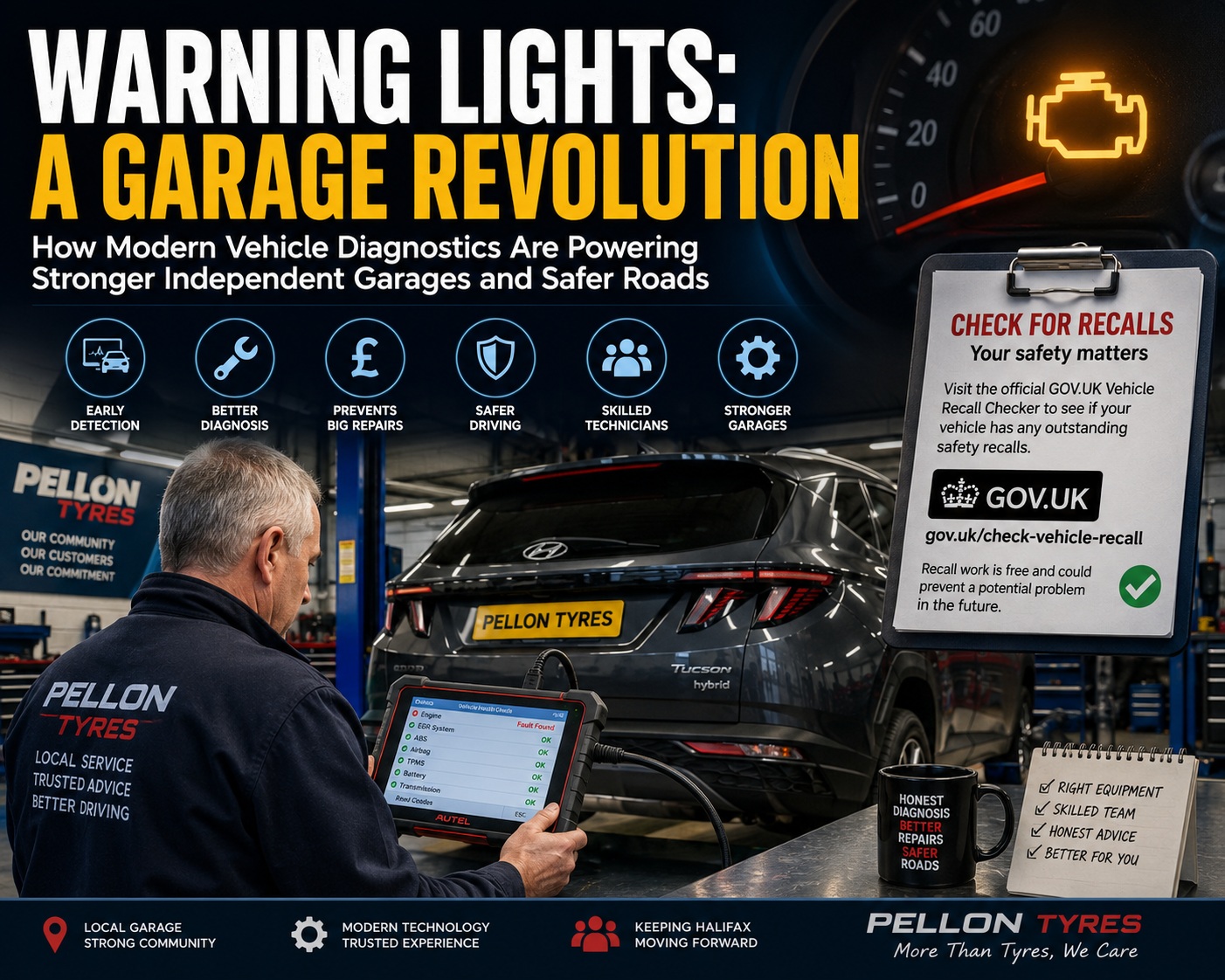
Today’s vehicles are packed with electronic control units, sensors and computers that constantly monitor almost every system on the car. If something isn’t quite right, a warning light appears on the dashboard, prompting the driver to seek professional advice.
As the owner of Pellon Tyres in Halifax, I genuinely believe these warning systems have transformed not only modern motoring but also the future of independent garages like ours.
Cars Have Become Cleverer Than Ever: Warning Lights A Garage Revolution
Modern vehicles monitor hundreds of different components every second.
The engine management system checks fuel delivery, emissions and ignition timing.
The ABS constantly monitors each wheel.
Airbag systems carry out their own safety checks every time you switch on the ignition.
Tyre pressure monitoring systems (TPMS) watch for any drop in pressure.
Hybrid vehicles, like my own recently purchased Hyundai Tucson Hybrid, monitor everything from battery temperatures to electric motors and petrol engine performance.
It’s remarkable technology.
Many motorists worry when they see a warning light appear, but in reality, these systems are there to protect both the driver and the vehicle.
Warning Lights Have Helped Garages
Some people think modern electronics have made life harder for garages.
I actually see it differently.
Over the years, warning lights have encouraged motorists to visit their local garage much sooner than they once did.
Instead of driving for months with an unnoticed fault, customers now come to us while the problem is still relatively small.
That often prevents expensive repairs later.
A failing oxygen sensor.
An EGR valve beginning to stick.
A faulty ignition coil.
A wheel speed sensor affecting the ABS system.
A blocked diesel particulate filter.
All of these can now be detected far earlier than they could twenty or thirty years ago.
Reading Fault Codes Is Only The Beginning: Warning Lights A Garage Revolution
One of the biggest misconceptions is that plugging a diagnostic computer into a vehicle instantly tells the mechanic exactly which part needs replacing.
If only it were that simple!
In reality, the fault code is simply a starting point.
A diagnostic machine may tell us there is a fault within the EGR system.
It doesn’t necessarily mean the EGR valve itself has failed.
It could be:
- Damaged wiring.
- A poor electrical connection.
- A faulty sensor.
- A sticking valve.
- A software issue.
- Carbon build-up.
This is where experience still matters.
A good technician doesn’t simply replace parts until the warning light disappears.
They investigate the fault properly.
That’s exactly the approach we’ve always taken here at Pellon Tyres.
We’ve never believed in replacing parts that don’t need replacing.
Investing In Equipment
Over the years, independent garages have had to invest heavily.
Modern diagnostic equipment doesn’t come cheaply.
Neither does the software required to keep it updated.
Then there’s specialist testing equipment for the following:
- Hybrid vehicles.
- TPMS systems.
- Battery registration.
- ABS diagnosis.
- Electronic parking brakes.
- Air conditioning systems.
- Wheel alignment.
- ADAS safety systems.
These investments are substantial, but they allow independent garages to compete with main dealers while offering the personal service that customers appreciate.
Investing In People: Warning Lights A Garage Revolution
Of course, equipment on its own isn’t enough.
The most important investment any garage can make is in its technicians.
Modern mechanics need a completely different skill set compared with those of my generation.
They still need to understand engines, brakes, suspension and steering.
But they must also understand electronics.
Computer systems.
Communication networks.
Software.
Hybrid technology.
Battery management.
Electrical testing.
Today’s technician is every bit as much an electrical engineer as a traditional mechanic.
That’s why ongoing staff training has become essential.
The independent garages that continue investing in their people are the ones that will thrive over the coming years.
My Own Hyundai Experience
Ironically, I’ve recently experienced this myself.
After purchasing my Hyundai Tucson Hybrid, the engine management light appeared.
Like many motorists, my first thought was,
“I wonder what that’s all about?”
Hyundai’s diagnostic equipment identified an issue with the EGR valve, and it’s now booked in for replacement.
Without modern diagnostics, that fault could have gone unnoticed for many months.
Instead, it was detected early before it had a chance to develop into something much more serious.
That’s exactly what these systems are designed to do.
Vehicle Recalls Are Becoming More Common: Warning Lights A Garage Revolution
Another interesting development is the increasing number of vehicle recalls.
You only have to look online to see headlines talking about manufacturers recalling thousands of vehicles.
At first glance, that sounds worrying.
In reality, I think it’s actually reassuring.
Manufacturers today monitor vehicle performance far more closely than they did years ago.
If they identify a potential safety issue—even if it affects only a small number of vehicles—they are much more likely to issue a recall before problems become widespread.
That demonstrates just how seriously vehicle safety is now taken.
Check Your Own Vehicle
While researching this subject, I decided to check my own Hyundai.
It only took a couple of minutes.
I’d encourage every motorist to do exactly the same.
Visit the official GOV.UK Vehicle Recall Checker and enter your registration number.
If your vehicle has an outstanding safety recall, the manufacturer will normally carry out the work free of charge.
You can also contact your vehicle manufacturer or local main dealer, who can check your vehicle identification number (VIN) for any outstanding recalls.
It’s a simple check that offers valuable peace of mind.
Looking to the Future: Warning Lights A Garage Revolution
As I approach nearly six decades in the tyre and garage industry, I still find modern vehicle technology fascinating.
Cars have changed enormously since I first picked up a spanner.
Yet one thing hasn’t changed.
People still need a garage they can trust.
Technology will continue advancing.
Artificial intelligence will become part of vehicle diagnostics.
Electric vehicles will become increasingly common.
Software updates will become routine.
But there will always be a need for experienced technicians who understand how vehicles actually work.
Our Commitment at Pellon Tyres
Here at Pellon Tyres in Halifax, we’ve always believed in moving with the times.
We’ve invested in modern equipment.
We’ve invested in staff training.
Most importantly, we’ve always believed in honest advice.
If your vehicle displays a warning light, don’t ignore it—but don’t panic either.
Many faults are relatively minor when caught early.
Bring your vehicle to someone who has the right equipment, the right training, and the right experience to diagnose it properly.
After all, warning lights aren’t there to frighten us.
They’re there to help keep our cars safer, more reliable, and on the road for longer.
And that’s good news for every motorist across Halifax, Calderdale, and beyond.

Leave a Reply
Want to join the discussion?Feel free to contribute!